

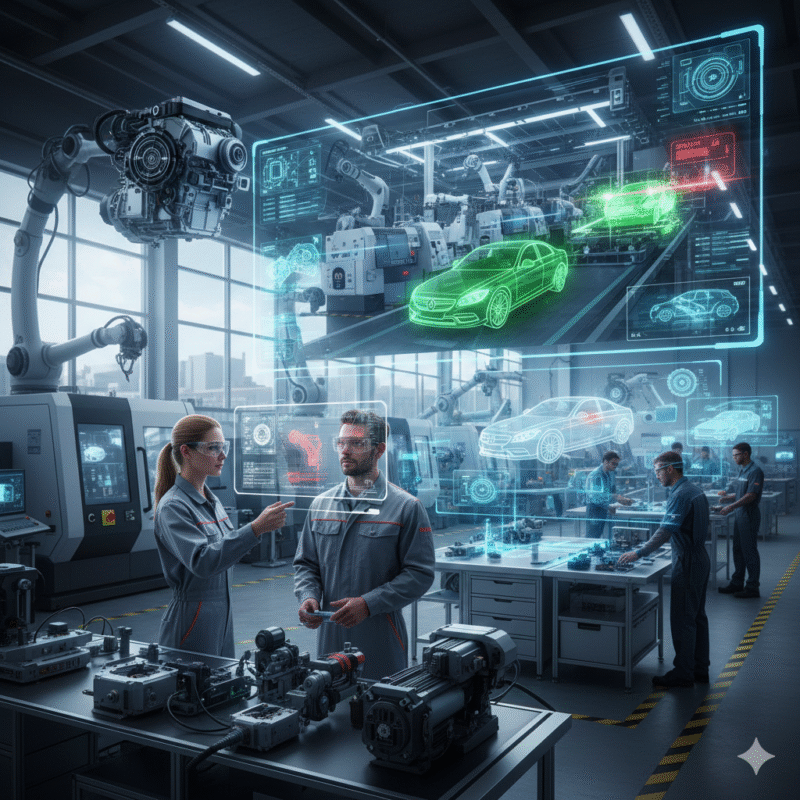
Imagine a metaverse that is a working factory where digital replicas guide real machines, and Augmented Reality (AR) overlays assist technicians in fixing robots. This strategic focusin Germany and across Europe aims to establish a lasting industrial edge through purposeful XR development.
Why Europe Is Designing Its Metaverse Around Manufacturing
When you think of XR or the metaverse, U.S. companies like Meta often come to mind. But Germany didn’t bet on consumers and instead chose to bet on industry. Factories here already possess centuries of expertise, including OEMs, toolmakers, system integrators, and extensive research and development (R&D) networks. These European players aren’t just selling AR headsets; they’re integrating digital twins, simulations, and smart AR workflows to transform the manufacturing industry. Fraunhofer, Germany’s powerhouse research network, has been instrumental in this Effort, turning research into real factory applications rather than academic whiteboards.
Digital Twins- Live Factories in Parallel
Companies like Siemens and Volkswagen are leading the charge. At Siemens’ plant in Erlangen, sensor data is fed into a digital twin that mirrors the physical line in real-time. Engineers run simulations to test changes, catch inefficiencies, and optimise maintenance, showcasing Europe’s advancing industrial XR capabilities.
Volkswagen, meanwhile, uses virtual factories to plan new vehicle models before hardware enters the production line. That means fewer surprises, faster ramp-up, and lower cost from design to deployment.
These twins are engineering platforms, each versions of the physical line that you can tweak, test, and optimise before touching a real machine.
AR for the Real World
In German manufacturing, AR is taking a practical, gritty role. Imagine walking onto a factory floor in a maintenance role, wearing AR glasses that overlay live diagnostic data from a machine’s digital twin. You see failing components, and your glasses highlight what to check, allowing you to walk through repair steps in real-time.
Bosch is already developing this type of tool. It is creating an AR that connects to a twin model, a sensor feed, and a support system, enabling technicians to intervene faster and with greater confidence. The AR becomes a live lens for executing complex operations. It’s decision support and execution support, which is the kind of tool that saves hours, reduces mistakes, and cuts operational risk.
The Technical Architecture Behind It All
Building this industrial metaverse isn’t trivial. It demands:
- Edge computing: The cloud is too slow for some use cases. Real-time simulation and AR need local computing, close to the machines.
- Data standards, including OPC UA, PLM (Product Lifecycle Management), and unified digital-twin formats, become critical so that simulation platforms can communicate with factory software.
- AR tooling + device management: Companies need robust AR devices and management systems to roll out glasses or headsets at scale in factories, including security, updates and version control.
- Platform integration: The metaverse stack must coexist with ERP, MES, and SCADA systems.
European ecosystem players, such as Siemens Xcelerator and Dassault 3DEXPERIENCE, are putting these pieces together. They build unified platforms that connect simulations, digital twins, and AR clients, allowing factories to adopt metaverse workflows without disrupting their existing IT stack.
Where This Actually Moves the Needle?
Companies are already measuring impact, and the results are promising. Digital twin simulations forecast failures and schedule maintenance more intelligently. AR-based training reduces onboarding time because new operators practice within digital twins, not on live machines. These operational gains demonstrate Europe’s tangible progress in industrial metaverse applications, emphasising their significance for manufacturing efficiency.
Technicians guided by AR complete complex maintenance faster and with fewer errors. Other than that, simulating factory modifications virtually reduces the risk of expensive mistakes before pushing changes to the floor.
Because these gains are operational and recurring, industrial buyers are receptive to them. Procurement teams buy platforms that lower cost per unit, improve quality, and reduce risk.
Challenges That Still Need Attention
XR, simulation, and digital-twin-savvy engineers are rare. Many manufacturers don’t yet have large internal teams to own this tech. Additionally, not all digital twins talk the same language. Vendors and factories must align on data models and twin semantics. Many pilots still have fixed-cost implementations. For mainstream adoption, vendors need to transition to outcome-based or subscription pricing models. As more factories digitise, a lack of shared standards could fragment the metaverse. Europe needs cross-industry governance.
Why Europe’s Industrial Metaverse Bet Might Outlast the Consumer One
The U.S. invested heavily in social metaverse platforms, but Europe focused on engineering platforms. This deliberate approach has created a stronger foundation for industrial value, highlighting Europe’s strategic advantage in developing purpose-driven industrial XR solutions.
By embedding XR and twins into real factory workflows, Europe is creating what I call a metaverse of purpose for engineers and business outcomes. That means long-term ROI, genuine scalability, and a competitive advantage.
Conclusion
Europe’s industrial metaverse already exists inside factories, logistics hubs and engineering labs. What German manufacturers are proving is that VR, AR, and digital twins only become powerful when they are integrated into real-world operations, such as predictive maintenance, operator training, production planning, and complex assembly workflows. That’s the layer Europe has quietly perfected while everyone else chased virtual concerts and consumer headsets.
The region’s edge comes from three key factors, a deep industrial base, strong engineering research networks, and vendors like Siemens, Bosch, and Dassault, which build interoperable platforms rather than standalone demonstrations. Although there are gaps, skills shortages, fragmented standards, and uneven adoption, the direction is clear.
If you understand this shift, you know the future of European manufacturing. Factories that are simulated before they’re built, machines that are repaired with AR guidance, and production lines tuned by real-time data flowing into living digital twins. It’s a quieter revolution than Silicon Valley’s, but far more durable.