



The race to bring new medicines from scientific discovery to patients is creating an unexpected challenge: organisations are generating more research and regulatory information than teams can efficiently process manually. Paris based life sciences AI company Biolevate is tackling that bottleneck with an enterprise platform designed to turn scientific knowledge into traceable, automated workflows. The company has raised €30 million in Series A funding to accelerate product development and expand internationally.
Major Series A round
The financing was co led by RAISE France and Orange Ventures, with participation from MSD Global Health Innovation Fund, Station F and existing investor EQT Ventures.
The investment comes as pharmaceutical and life sciences companies increasingly explore AI for research, clinical development, regulatory work and medical operations. Biolevate aims to provide an infrastructure layer that allows these organisations to deploy AI while retaining human oversight and evidence based decision making.
Founded in Paris by former Dataiku engineers and AI researchers, the company has developed an enterprise agentic AI platform designed specifically for the requirements of regulated life sciences environments.
Turning knowledge into workflows
Biolevate’s platform brings together scientific literature, regulatory information and other life sciences documentation so teams can search, analyse and transform complex information into structured outputs.
Its technology is designed around traceability. Rather than producing unsupported answers, the platform links generated results to the underlying evidence, allowing users to review the information used by AI systems. Biolevate’s platform also supports controlled access, collaboration and project based workflows.
The company says this approach is particularly important in life sciences, where scientific and regulatory decisions often need to be documented and reviewed before they can be used in operational processes.
Across the life sciences value chain
Biolevate initially focused on regulatory approval workflows but has expanded its platform to cover a broader range of activities.
Its applications now extend across research, clinical trials, regulatory dossiers, health technology assessments, drug discovery and drug development. The platform is also being applied to medical workflows and manufacturing quality processes.
For example, Biolevate’s clinical protocol co authoring tools can generate initial sections of clinical protocols using information from study documents, previous protocols and regulatory guidance while keeping human reviewers in control. The company says this can reduce first draft effort by up to two times.
Its systematic literature review tools are designed to accelerate evidence screening and extraction while preserving traceability and expert review. Biolevate currently reports a 16 times faster cycle for systematic literature reviews.
AI with human oversight
A major part of Biolevate’s proposition is combining automation with governance. The company is developing AI agents that can execute complex tasks while keeping their outputs connected to source material.
Its medical information tools, for example, can provide answers from controlled evidence collections, with responses linked back to the relevant source passages. Questions that fall outside defined boundaries or require additional expertise can be escalated to human reviewers with an audit trail.
This human in the loop approach is intended to make advanced AI more practical for regulated industries where accuracy, documentation and accountability are essential.
Scaling globally
Since its seed round in 2024, Biolevate says it has expanded its customer and partner base across the life sciences industry. The company now serves more than a dozen enterprise customers and has reported strong growth in annual recurring revenue.
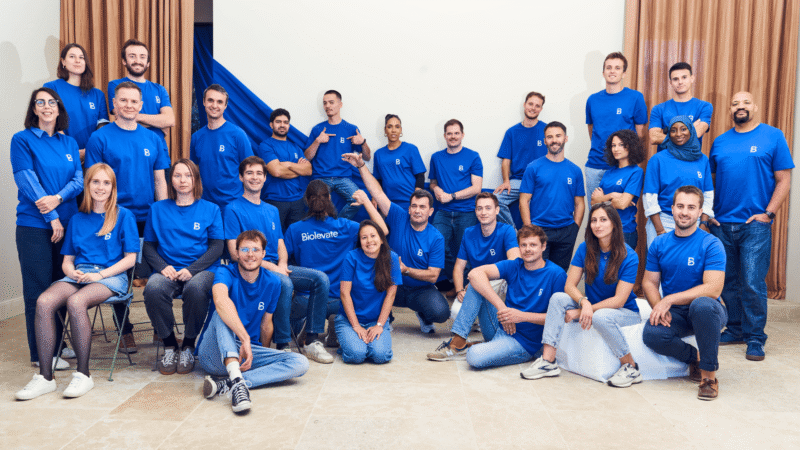
The company has also expanded its workforce and is preparing for further hiring. It has opened an office in Boston as part of its expansion into the United States, adding to its international ambitions.
Building an AI infrastructure for healthcare
Biolevate will use the €30 million investment to accelerate development of its agentic AI platform, expand its international presence and support additional applications across healthcare and life sciences.
The company is also pursuing intellectual property, with seven patent applications drafted across several therapeutic areas and two already filed in Europe.
For Biolevate, the long term opportunity extends beyond automating individual research or regulatory tasks. Its broader ambition is to create an AI layer that allows life sciences organisations to process scientific evidence, execute complex workflows and make better informed decisions while maintaining the human oversight required in a highly regulated industry.