


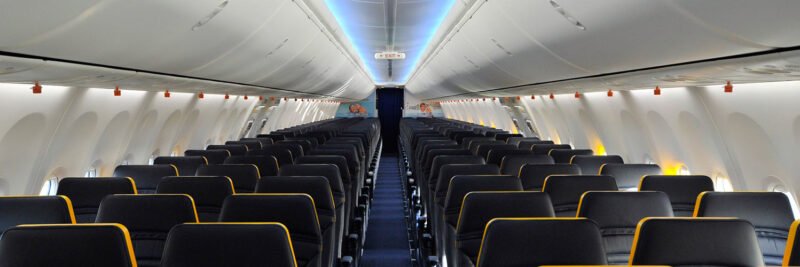
Let’s be honest, flying Ryanair is an exercise in stoicism. You cram yourself into a yellow tube, pray your knees don’t fuse to the seat in front of you, and actively dodge attempts to sell you everything from smokeless cigarettes to scratch cards. However, here is the bold truth that most passengers overlook while busy measuring their carry-on bags with a ruler, Ryanair isn’t just an airline anymore, but a ruthless software house with wings.
In this Ryanair technology case study, we argue that while their customer service reputation might hover somewhere near “hostile,” their backend engineering is arguably some of the most efficient in the aviation industry. To sell seats for €19.99 while maintaining a profit margin that makes legacy carriers weep, you can’t just cut amenities, you have to weaponise technology. Lets dissects the code, the cloud infrastructure, and the controversial UX choices that power Europe’s favourite budget carrier. We aren’t just looking at what they built, but how they scaled it to become the “Amazon of Travel”.
1. Ditching Tape for AWS
For years, the infrastructure highlighted in any Ryanair technology case study prior to 2014 would have looked as vintage as a 1990s Boeing interior. They relied on on-premise data centres and, believe it or not, tape backups. But when you are processing thousands of bookings a minute during a flash sale, “tape” is a four-letter word. The shift began in earnest with Ryanair Labs, their internal digital innovation hub as they went all-in on Amazon Web Services (AWS).
This transformation wasn’t just about storage, it was about the raw compute power needed to calculate dynamic pricing for millions of seat combinations in real-time.
The most distinctive part of this migration was their choice of processors. They heavily adopted AWS Graviton instances (ARM-based processors). Why? Because they offer up to 40% better price-performance than comparable x86-based instances. It is the engineering equivalent of not paying for a checked bag, achieving maximum efficiency at minimum cost.
By moving to a serverless architecture with AWS Lambda and S3 Object Lambda, they reduced their IT costs by nearly 30% while simultaneously lowering latency. This allows their booking engine to modify data on the fly, which is essential when you need to slap a sudden baggage fee onto a ticket purchase in milliseconds. You can read more about their specific AWS implementation on the AWS Innovators page.
2.High-Availability Architecture
If you have ever tried to book a flight during a “Cyber Week” sale, you know the traffic load is insane. A traditional relational database would melt under that pressure. A critical chapter in this Ryanair technology case study is how they handled the “wandering user” problem. Users browse on a phone, switch to a laptop, and jump between data centres in Dublin, Frankfurt, and London. If the session data doesn’t follow them instantly, the booking fails.
To solve this, they implemented NCache, a distributed in-memory cache for .NET. This allows them to handle session locking across multiple sites. If a server in Dublin goes down, NCache automatically moves the session to London without the user losing their selected seat.
This architecture reduces internal bandwidth traffic by nearly 90% because the data doesn’t have to be constantly re-fetched from the main SQL database. This is critical for high-availability systems where “downtime” equals “millions in lost revenue.”
3. Solving the Semi-Static Data Challenge
The Ryanair mobile app is a hit, having been downloaded over 50 million times. However, mobile apps have a specific weakness that every developer is aware of, network latency. An app that needs to fetch the entire route map or seating plan every time it opens is going to feel sluggish, especially on airport Wi-Fi.
In our analysis of the Ryanair technology case study, we found that they classified this data as “semi-static,” referring to things like airport codes, routes, and seating configurations that change often, but not every second.
They tackled this using Couchbase, a NoSQL database that excels at synchronisation. By embedding Couchbase Lite directly into the mobile app, it allows the app to store this semi-static data locally on the device. The app only “phones home” via the Sync Gateway when there is a delta (a change) in the data.
This significantly reduced their network dependency, dropping booking times from 5 minutes to under 2 minutes. It’s a brilliant move as they are using your phone’s storage to save their bandwidth costs. It’s efficient, smart, and classically frugal. Check out the engineering details on the Couchbase blog.
4. Weaponised UX and “Dark Patterns”
Here is where we need to stop applauding the code and start questioning the interface. While the backend discussed in this Ryanair technology case study is a marvel of efficiency, the frontend is often cited by UX designers as a masterclass in “Dark Patterns.”
Most tech blogs will tell you that Ryanair’s UI is “unintuitive.” I disagree. I think it is extremely intuitive if your goal is to trick people into spending money. This isn’t bad design, it’s hostile design.
Consider the booking flow. It utilises what behavioural psychologists call “Privacy Zuckering” and “Roach Motel” patterns. The “No Insurance” option is frequently hidden or placed in counter-intuitive locations (like inside a dropdown menu where it doesn’t belong).
The “Price Anchoring” is aggressive; they show you a “Regular” fare that looks reasonable, making the “Basic” fare look painful (no bag, no seat) and the “Plus” fare look like luxury. As noted in a sharp analysis by ReConvert, this upselling funnel is psychologically calibrated to trigger the phenomenon of “Loss Aversion.” They aren’t just selling a seat but they are engineering anxiety and then selling you the cure (Priority Boarding).
From a developer perspective, this requires complex state management to track exactly which upsells a user has rejected, only to re-offer them later in the flow (“Are you sure you don’t want a bag?”). It is impressive code, but ethically murky.
5. Watching Every Microservice
With a distributed system spanning multiple clouds and microservices (from flight inventory to car rentals), “it works on my machine” is not a valid excuse. If the car rental API hangs, it can block the entire flight booking flow if not handled asynchronously. To manage this, the Ryanair technology case study highlights their adoption of New Relic for full-stack observability.
Instead of waiting for a customer to tweet “FIX YOUR APP,” their Ops team uses real-time dashboards to see exactly which microservice is spiking in latency. This cultural shift is giving developers direct access to production monitoring data allowed them to move from a waterfall deployment model to releasing software updates multiple times a week.
It’s a standard DevOps maturity move, but for an airline, an industry famous for running software from the 1970s, it is revolutionary.
Conclusion
Ryanair is often the punchline of aviation jokes, but its technology stack is serious business. As this Ryanair technology case study has demonstrated, they have successfully decoupled their massive transaction volume from the limitations of legacy infrastructure by leveraging AWS serverless architecture, smart caching with NCache, and edge syncing with Couchbase.
They have proven that you can run an airline like a tech startup, fast, agile, and occasionally breaking things. However, their reliance on “Dark UX” patterns suggests that technical excellence doesn’t always equate to user empathy. They have solved the engineering problems of scaling, but they have introduced new problems of user trust.
So, here is the question for you, as developers and product managers, where do we draw the line between “optimising for conversion” and “manipulating the user”? Does the low price justify the hostile interface, or should we demand better ethical standards even from budget brands?