


Sustainable Tourism Certifications and Tech have become the primary currency of trust in the European travel market. As the European Union tightens its regulatory grip with the Green Deal and the upcoming ban on greenwashing, the era of self-proclaimed eco-friendliness is over. Destinations and hospitality brands must now prove their environmental impact with forensic accuracy. This shift has transformed sustainability from a marketing nice-to-have into a hard operational requirement. This manual provides the definitive roadmap for implementing the rigorous standards and the digital infrastructure required to survive in this new landscape of radical transparency.
Why Certification is the New License to Operate
The primary motivation for adopting Sustainable Tourism Certifications and Tech is to preserve market access. Corporate travel buyers and large tour operators are increasingly refusing to sign contracts with hotels that lack recognised accreditation. They need to report their own Scope 3 emissions, which means they can only work with partners who provide verified carbon data. This chain of accountability forces every player in the ecosystem to upgrade their standards or risk being cut out of the supply chain.
Financial resilience is the second major driver. Governments are prioritising funding for businesses that can demonstrate measurable environmental progress. A certified company is far more likely to secure low-interest loans and non-dilutive grants. Furthermore, the operational efficiency gains from the technology required for certification often lead to significant cost savings. Reducing energy and water consumption is not just good for the planet but essential for protecting margins in an era of volatile utility prices.
The Architecture of the Digital Green Stack
Implementing these standards is impossible without a robust technology layer. You cannot manage what you do not measure, and manual spreadsheets are no longer sufficient for audit purposes. The modern sustainable destination runs on a stack of interconnected SaaS platforms and IoT sensors.
Resource monitoring software serves as the foundation. Platforms like Deepki or Measurabl automate the collection of energy and water data directly from smart meters. This eliminates human error and provides auditors with real-time evidence.
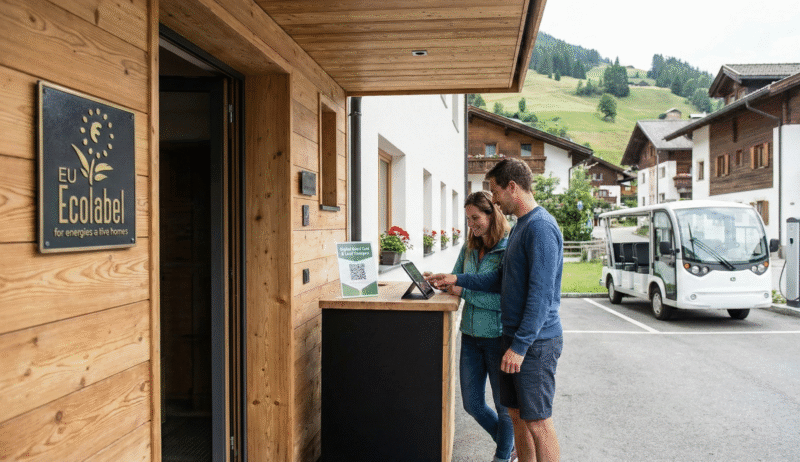
Supply chain transparency tools represent the next layer. Blockchain-based systems allow hotels to trace the origin of their food and linen, ensuring that every product meets ethical standards. This digital provenance is becoming a requirement for certifications like the EU Ecolabel, which demands rigorous proof of sustainable procurement. By integrating these tools, businesses create an immutable audit trail that builds absolute confidence with both regulators and guests.
7 Steps to Implementing Certifications and Tech
Navigating the certification path requires a disciplined and strategic approach. These seven steps provide a clear framework for transforming a legacy operation into a certified green leader.
The first step is the Baseline Digital Audit. Before applying for any label, a business must install the monitoring technology needed to establish its current carbon footprint. Managers must quantify their energy intensity and waste diversion rates to identify the gaps between their current performance and the certification criteria.
The second step is selecting the Right Standard. The European market is crowded with labels, but only a few carry weight. The EU Ecolabel, Green Key and Travelife are the gold standards. Managers must choose the certification that best aligns with their specific asset class, whether it is a campsite, a luxury hotel, or a tour operator.
Step three involves the IoT Retrofit. Once the gaps are identified, the physical infrastructure must be upgraded. This consists of installing smart thermostats, flow restrictors, and waste-monitoring cameras. This hardware provides a continuous stream of data that proves compliance. It turns the building itself into an active participant in the certification process.
The fourth step is Staff Training and Culture Engineering. Technology is useless if the staff ignores it. Training programs must be implemented to ensure that housekeeping and kitchen teams understand how to use the new tools.
Step five is the Digital Documentation Workflow. Certification auditors require mountains of paperwork. Specialised software like Weeva helps teams aggregate policies, invoices and consumption data into a single digital repository. This prepares the business for the audit process and ensures that certification renewal is a simple administrative task rather than a yearly panic.
The sixth step is the External Audit. This is the moment of truth where an independent inspector verifies the data. Because the business has implemented a robust tech stack, the auditor can see real-time proof of compliance rather than relying on estimates. This transparency significantly increases the pass rate and reduces verification time.
The final step is marketing the Badge. Once certified, the business must integrate its status into its digital sales channels. This involves using the certification metadata to trigger green badges on platforms such as Booking.com and Google Travel. This signals to the Future of Direct Booking audience that the property aligns with their values, driving higher conversion rates and premium pricing.
Navigating the European Regulatory Horizon
The urgency of this transition is driven by upcoming legislation. The Corporate Sustainability Reporting Directive, known as CSRD, is forcing large companies to audit their entire supply chain. This means that a small hotel wishing to host corporate guests from companies like Siemens or SAP must be able to provide data that feeds into the corporate ESG report.
Startups that build the API connectors between hospitality property management systems and corporate ESG platforms will thrive in this environment. We are seeing a convergence of travel tech and fintech, with carbon data moving alongside financial data. This integration ensures that sustainability is treated with the same rigour as revenue management.
Conclusion
Sustainable Tourism Certifications and Tech have evolved from a niche interest into the central operating system of the European travel industry, by understanding the how and why behind this shift from the pressure of the Green Deal to the power of IoT monitoring, founders and operators can build future-proof businesses. Implementing standards like Green Key or B Corp certification is not just about saving the planet. It is about creating a defensible commercial moat. As the market becomes increasingly transparent, the destinations that can prove their green credentials with complex data will win the trust and the wallet of the modern traveller. The future of tourism is certified and digital, and it is being built across Europe right now.