


In 2026, remote workers are no longer just looking for a beach with Wi-Fi; they are looking for infrastructure, community, and safety. A true “workation” requires a delicate balance of the cost of living that must grant you a higher quality of life than your home base, the connectivity must be enterprise-grade, and the local transport network must allow you to explore without buying a car.
We have analysed the European landscape to find the cities and towns that offer the best return on investment for your time and money. Here are the 10 best European destinations for a high-performance workation.
Lisbon, Portugal
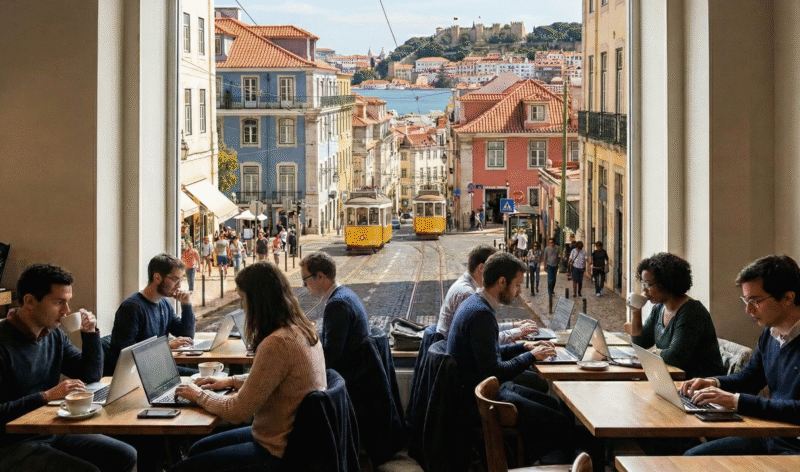
Lisbon remains the gateway to digital nomad life in Europe, despite rising rents. The city offers an unmatched support system, with English widely spoken and a massive density of coworking spaces like Second Home and Croissant. Connectivity is excellent, with fibre-optic speeds averaging 100 Mbps+ in most Airbnbs. Public transport is iconic but quirky; the trams and metro cover the centre well, though the hills make walking a workout. In terms of safety, it remains one of the safest capitals in Europe, though petty crime exists in tourist hotspots. The trade-off here is cost versus community; you pay a premium for instant access to a world-class tech network.
Tallinn, Estonia
If efficiency is your priority, Tallinn is the undisputed champion. As the birthplace of e-Residency, the entire city functions like a well-oiled machine. Connectivity is virtually flawless, with 5G coverage blanketing the city and free Wi-Fi treated as a human right. Public transport is free for residents and exceptionally reliable, connecting the medieval Old Town to the hipster Kalamaja district in minutes. Safety is top-tier; it is one of the few capitals where walking alone at 3 AM feels perfectly secure. The cost is rising, but it still offers significant value compared to London or Paris, specifically for high-quality housing and dining.
Prague, Czech Republic
Prague offers perhaps the best public transport system in the world, given its size. The network of trams, metros, and buses runs 24/7 with metronomic precision, making a car completely unnecessary. The city is incredibly safe, consistently ranking in the top 10 globally for low crime rates. For nomads, the support system is robust, with cafes in districts like Karlín and Vinohrady designed for laptop workers. Connectivity is fast and stable. While costs have normalised with Western Europe, the price-to-quality ratio for beer, food, and entertainment remains unbeatable.
Valencia, Spain
While Barcelona gets the tourists, Valencia gets the smart nomads. The city is flat, sunny, and connected by a massive park (the Turia) that runs through the city centre, making it a cyclist’s paradise. Connectivity is high-speed, and the 5G rollout is comprehensive. The cost of living is significantly lower than in Madrid or Barcelona, allowing for a higher standard of living in apartments and dining. The expat support system is welcoming but less frenetic than Lisbon. Safety is very high, with a relaxed Mediterranean pace that encourages long workations over short trips.
Bansko, Bulgaria
Bansko is a fascinating anomaly. This small ski resort transforms into a nomadic village in the summer, anchored by the legendary Coworking Bansko. The cost of living here is arguably the lowest on this list; you can live like royalty for €1000 a month. Connectivity is surprisingly enterprise-grade because the coworking community demanded it. Public transport is nonexistent because the town is walkable, but you need a car to explore the mountains. Safety is absolute; it is a small town where everyone knows everyone. The support system is intense and tight-knit, perfect for those escaping the isolation of big cities.
Madeira (Ponta do Sol), Portugal
Madeira launched the world’s first “Digital Nomad Village” in Ponta do Sol, creating a government-backed infrastructure for remote work. Connectivity is prioritised, with fast internet piped into a subtropical island environment. The support system is government-curated, with free coworking spaces and community managers organising daily events. Public transport is the weak link; the terrain is steep, and buses are infrequent, so a car is essential for exploring. However, safety is incredibly high, and the cost of living offers a “tropical” lifestyle at European prices.
Budapest, Hungary
Budapest offers the grandeur of Vienna at a fraction of the price. The city is split by the Danube, but connected by an extensive tram and metro system that is cheap and reliable. Connectivity is among the fastest in Eastern Europe. The nomad support system is vast, centred around the ruin bars and cafes of the 7th District. Safety is generally good, though common sense is required in nightlife areas. The real draw is the cost-to-fun ratio; few cities offer this level of architecture, thermal baths, and nightlife on a freelancer’s budget.
Berlin, Germany
Berlin is not cheap, but it offers a specific type of value: access to the cutting edge of art, tech, and culture. The public transport system (U-Bahn/S-Bahn) is sprawling and runs all night on weekends. Connectivity can be hit-or-miss in older buildings (the infamous German internet bureaucracy), so verified speed tests are essential before booking. Safety is moderate; it has the grit of a major metropolis. However, the support system for creatives and tech workers is unparalleled in Europe. If you need to collaborate with avant-garde thinkers, the premium is worth it.
Krakow, Poland
Krakow has quietly become a major tech hub, hosting massive engineering offices for Google and Cisco. This means the connectivity infrastructure is enterprise-level throughout the city. The cost of living is very low compared to the quality of life, with affordable modern apartments and a booming food scene. Public transport relies on a dense tram network that handles the winter weather well. Safety is very high. The city feels compact, historic, and energised by a massive student population, making it an easy place to integrate for younger nomads.
Las Palmas, Gran Canaria
When the rest of Europe freezes, nomads migrate to Las Palmas. The city has a unique infrastructure built for long-term visitors, with a high density of surf hostels and coworking spaces like Talleres Palermo. Connectivity is excellent as Spain has great fibre penetration. The city is walkable and bikeable, with a decent bus network for island exploration. Safety is high, though the island’s relaxed vibe can sometimes lead to slower service. The cost of living allows for a beachfront lifestyle that would be impossible on the mainland, making it the ultimate winter workation base.