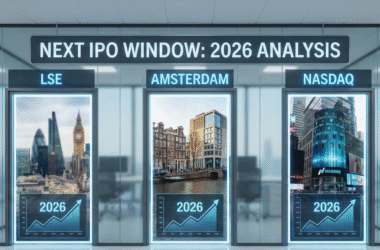




The traditional ten-year private equity cycle is facing a mathematical reckoning. For an investor in London, the 2026 vintage represents a fundamental break from the exit strategies of the past decade. Vintage funds from the 2015 to 2018 era are approaching the end of their terms while holding high-performing assets that are effectively stranded by the moribund IPO market in London and the valuation disconnect in New York. This duration mismatch has catalysed the rapid institutionalisation of GP-led secondaries in Europe. These transactions are no longer viewed as distress signals but as sophisticated portfolio management tools designed to align the duration of capital with the maturity of the underlying asset.
The DPI Crisis and the Liquidity Deadlock
Limited Partners are currently facing a historically low distribution environment. The Distributed to Paid-In Capital (DPI) ratio has slowed significantly as exit channels narrow. European GPs are sitting on billions in unrealised value that is trapped in older fund structures. Selling these “trophy assets” into a depressed M&A market simply to meet a fund deadline destroys value and erodes the Internal Rate of Return.
This friction has created a surge in continuation vehicles (CVs). In these structures, a General Partner transfers one or more assets from an existing fund into a new special-purpose vehicle. This process allows the GP to reset the investment clock while offering existing LPs a binary choice. They can either cash out at the current Net Asset Value or roll their interest into the new vehicle to capture future upside. For the cash-constrained LP, this offers immediate liquidity. For the conviction investor, it provides an opportunity to double down on a proven winner without the blind-pool risk of a new vintage.
The Single-Asset Revolution
The narrative around secondaries has shifted from liquidity for the desperate to liquidity for the strategic. Data from Jefferies Global Secondary Market Review indicates that GP-led transactions now account for a substantial portion of global secondary volume. In Europe, this mechanism is particularly vital given the scarcity of listing venues.
We are seeing a marked bifurcation in the market. Single-Asset Continuation Funds increasingly drive the volume. Investors are increasingly willing to underwrite specific “crown jewel” companies rather than diversified pools.
- Retaining the Alpha
The most compelling use case for a continuation vehicle is retaining a breakout performer. A GP who has nurtured an industrial AI platform for six years often knows the asset better than any new buyer. Selling it to a competitor solely because the fund’s life is ending is a breach of fiduciary optimisation. The continuation vehicle allows the GP to compound value for another 3 to 5 years and crystallise carried interest on the initial gain. - Pricing and Valuation Rigour
These transactions introduce a moment of accurate market pricing to private portfolios. To execute a valid secondary sale, the GP must typically bring in a new lead investor to set the price. This external validation provides LPs with a concrete mark-to-market valuation that is far more reliable than internal quarterly marks.
The UK Regulatory Lens and The Conflict of Interest
For the sophisticated investor, the primary friction point remains the inherent conflict of interest. The GP sits on both sides of the table, acting as both the seller and the buyer’s manager.
This is where the UK market is maturing rapidly. The Financial Conduct Authority (FCA) has flagged valuation rigour and “fairness opinions” as supervisory priorities for 2026. Best-in-class GPs in Mayfair and the City are mitigating this by engaging independent third-party valuation agents and ensuring the “roll” option for LPs is frictionless. The market has effectively self-regulated toward a standard requiring a competitive auction process to validate the entry price of the continuation vehicle.
By The Numbers: The 2026 Shift
The market data for 2026 confirms that the “liquidity crunch” is being solved by structural innovation rather than public listings.
- Volume Explosion
According to DC Advisory’s 2025 Global Report, 90% of GPs now view continuation vehicles as a valuable complement to traditional exits. The volume of GP-led transactions surged 68% year over year in H1 2025, with the broader secondary market poised to approach $200 billion in total volume. - Pricing Recovery
The discount window is closing. Recent data from Macfarlanes highlights that the discount to NAV for high-quality buyout assets has narrowed from 9% to just 6% in 2026. This tightening spread indicates that buyers have grown comfortable with the risk profile of these concentrated bets.
The Liquidity Mosaic
Smart LPs are no longer looking for a “silver bullet” exit. They are building a “Liquidity Mosaic.” This involves layering GP-Led Secondaries alongside NAV Financing and Preferred Equity structures to generate interim distributions without selling the underlying equity.
As noted in the RBS International 2026 Outlook, liquidity is shifting from a tactical consideration to a strategic pillar. The managers who can navigate this mosaic will win the allocation war in 2026.
The Tactical Advantage for 2026
For the European investor, the rise of the GP-led secondary is a positive structural evolution. It transforms illiquidity from a bug into a feature. It allows LPs to manage their own cash flow needs without forcing the GP to liquidate a portfolio at the bottom of a cycle.
Investors evaluating new primary commitments should increasingly assess a manager’s capability to execute these transactions. A GP with a proven track record of using continuation vehicles demonstrates the ability to manage the full lifecycle of an asset, irrespective of arbitrary fund timelines.
For founders exploring non-dilutive options to bridge to these liquidity events, we recommend reviewing the 2026 landscape for venture debt. Additionally, investors analysing these assets must understand how to benchmark European fintech growth vs US competitors to accurately price the liquidity premium. The secondary market is no longer a backwater. It is the new engine room of European private equity liquidity.