



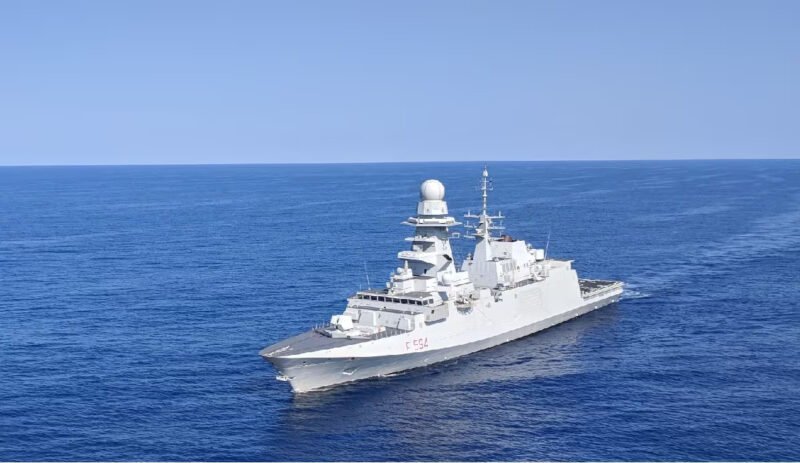
Indra, a Spanish defense technology company, has signed an agreement to design a new radar system for the European Patrol Corvette (EPC) program, which is a major step forward for joint naval European capabilities under the EU’s Permanent Structured Cooperation (PESCO). The deal was done on November 18, which is also the day that the European Council gave its green light to €18 million in funding for building a vessel engineering model and the key subsystems.
The EPC program is intended to create a new generation of modular and multirole patrol corvettes that would be able to perform a wide range of missions, such as maritime security and surveillance as well as high-intensity combat. Indra’s radar will be the core of the system, allowing participating navies to have advanced detection, situational awareness, and coordinated operations.
Advanced radar capabilities
Indra’s innovative concept will involve a turning Active Electronically Scanned Array (AESA) antenna working in the E/F frequency band from 2 to 4 GHz—this is a technology that offers better precision, resistance, and flexibility than typical rotating radars. The company is already producing the Lanza radar series in the D band between 1 and 2 GHz, and it includes the naval versions that have been co-developed with India’s Tata Group. With the EPC radar, Indra is taking a significant step forward in its portfolio by moving into the higher frequency tactical naval systems.
The agreement stipulates a deadline of 30 October 2029 for the completion of all the development work with no provisions for extension. The setting of such a tight deadline is an indication of how strategically crucial the program is in a situation wherein there is an increasing call for enhanced European maritime security and defence autonomy.
A pan-European industrial consortium
The European Patrol Corvette is a product of a multinational industrial team. Spain, France, and Italy are the three countries, which, as a core group, were behind the design that was presented and thus, won the competition in June. Shipbuilder Navantia is the Spanish representative, and it will be playing the leading role in the new radar system integration. Apart from that, the consortium is made up of the French Naval Group and the Italian Fincantieri—all of which are the top naval construction companies in Europe.
Naviris a company collaboratively owned by Naval Group and Fincantieri, along with Greece’s Hydrus, have been awarded the contracts as subcontractors. The political objective of this participation is to promote the defence-industrial cooperation within the EU member states and cut down on the dependence on the suppliers from outside the union.
Moreover, the partners’ goal is to come up with a uniform naval platform that would be flexible enough to meet the specific requirements of a fleet in different nations. Thanks to this modularity the logistics will be less complicated, the operating costs lower, and the interoperability of their cooperation during the joint missions will be more efficient.
Two versions planned to meet national needs
It’s expected that the EPC corvettes will have a displacement of about 3,000 tonnes and be around 110 meters long. They are conceiving just two baseline configurations: one for a patrol-oriented version and the other a more heavily armed combat-oriented model.
Both France and Spain are interested in the lighter patrol version, which would be perfect for maritime security, anti-smuggling missions, and exclusive economic zone surveillance activities. On the contrary, Italy and Greece may want to invest in the combat variant equipped with the capabilities to deal with anti-air, anti-surface, and most probably anti-submarine operations.
It is a Europe-wide plan to replace the fleets that have been around for a long time. Italy could use the EPC as a replacement of its Cassiopea and Sirio patrol ships that were put into service in 1989 and 2002. Spain is planning to phase out the Serviola-class patrol vessels and the last Descubierta-class ship, Infanta Cristina, in service since 1980. France has the intention to retire its six Floréal-class frigates that were introduced in 1992.
Strategic impact
With the EPC programme, Europe will have a naval surface fleet of medium-sized vessels that will form the backbone of its maritime capacity. The EU will be in a better position to secure the sea routes and extend its security influence overseas. Bringing together the resources and sharing the technology development are the two most important features of this initiative that reflect the EU’s commitment to defence integration in the face of changing geopolitical situation.
The combination of cutting-edge radar technology, the modular design of the vessels, and the financing from the different countries shows that European naval autonomy has made a great leap forward, which also means a major step for the continent’s defence industrial base.