



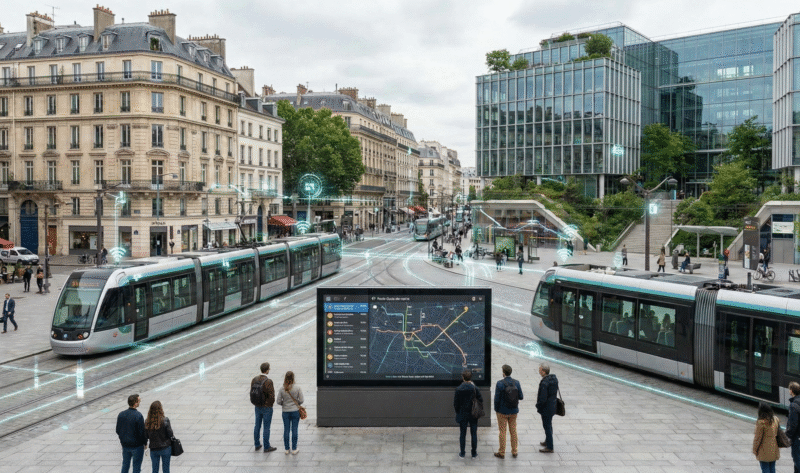
IoT and Smart Cities in Public Transport are fundamentally changing the urban experience for millions of people across Europe. For decades, the public transit systems in major capitals like London, Paris, and Berlin operated on rigid schedules that could not adapt to real-world conditions. Commuters were forced to wait for buses that never arrived and to squeeze onto trains already at capacity. That era of uncertainty is ending as cities transform into intelligent ecosystems where every vehicle and station is connected to a central nervous system. By using sensors to track movement in real time and algorithms to predict demand, urban planners are creating a fluid transport network that responds to the needs of the citizen. This guide explores the strategic implementation of these technologies and the startups that are making the transit experience faster, cleaner, and more reliable.
Why IoT and Smart Cities in Public Transport are Essential for Modern Life
The primary driver for the adoption of IoT and Smart Cities in Public Transport is the massive pressure of urbanisation. European capitals are growing faster than their physical infrastructure, which leads to chronic congestion and air pollution. Expanding a city’s physical footprint by building more roads or tunnels is often impossible due to historic preservation or astronomical costs. This is why cities are turning to a digital expansion instead. By optimising existing assets with intelligence, they can increase network capacity without laying a single new track.
Environmental accountability is another major factor in this transition. Governments are under intense pressure to meet carbon-reduction targets, and improving public transport efficiency is the most effective way to encourage people to leave their cars at home. When a bus system is so reliable that it feels like a personal chauffeur, the incentive to drive disappears. This mirrors the focus on data-driven sustainability we see in other sectors, as discussed in our guide on sustainable tourism metrics. In the urban context, the ability to reduce idling times and optimise routes directly translates to lower emissions and a higher quality of life for every resident.
The third motivation is the economic cost of wasted time. Productivity is lost every time a worker is stuck in a traffic jam or delayed on a platform. Cities that can move their workforce efficiently are more competitive and attract more investment. This creates a cycle in which the smartest cities attract the best talent, which, in turn, drives more innovation in the tech sector. We see a similar trend in the finance world, where firms are reshaping European fintech by automating capital flows. In the world of transport, the goal is to automate the movement of people with the same level of precision and speed.
How IoT and Smart Cities in Public Transport are Being Built
The implementation of IoT and Smart Cities in Public Transport involves a sophisticated layer of hardware and software working in perfect harmony. The foundation of the system is the sensor layer, where millions of data points are collected every second. These sensors are installed on buses, trams, and trains to track their exact location and speed. They are also placed on platforms and at bus stops to monitor the number of people waiting and the local air quality.
Data processing at the edge is a critical component of this architecture. Instead of sending every single data point to a distant cloud server, the information is processed locally on the vehicle or at the station. This allows for near instant response, such as a traffic light turning green to allow a late-running bus to pass through an intersection. This level of responsiveness is vital for maintaining the flow of a dense city centre.
The software layer then processes this data and uses machine learning to build predictive models. These models can forecast where the next crowd will form or when a specific bus engine is likely to fail. By moving from reactive to predictive maintenance, transport operators can keep their fleets on the road longer and reduce service cancellations. This ensures that the promise of a connected city is not just a marketing slogan but a daily operational reality for the commuter.
Vianova and the Micro Mobility Governance
The startup Vianova has become a vital partner for European cities trying to integrate scooters and bikes into the public transport mix. The sudden arrival of thousands of rental vehicles created chaos on the streets of Paris and Brussels. Vianova solved this problem by building a data platform that allows city planners to see where these vehicles are and how they are being used.
Their system uses IoT data to enforce no-parking zones and speed limits in real time. By providing a bridge between the private mobility operators and the public government, they ensure that micro mobility serves as a valid extension of the bus and train network. This prevents scooters from being seen as a nuisance and turns them into a strategic tool for solving the last-mile problem.
Shotl and the On-Demand Shuttle Revolution
Based in Barcelona, the startup Shotl is replacing underutilised bus lines with on-demand shuttles. In many suburban areas, traditional big buses run nearly empty during the day, wasting energy and money. Shotl uses an algorithm to group passengers travelling in the same direction and dispatches a small shuttle to pick them up at a nearby corner.
The system relies on IoT connectivity to enable real-time communication between the passenger app and the driver. By making public transport as convenient as a ride-hailing app, Shotl is bringing high-quality transit to areas that the city centre previously neglected. This approach improves social inclusion and ensures that even those without a car have a reliable way to get to work or the doctor.
Stratio and Predictive Fleet Management
The company Stratio is helping transport operators eliminate the most common cause of delays: mechanical failure. They provide an IoT platform that connects to a bus or truck’s internal computer to monitor its health in real time. Their AI models can detect microscopic signs of wear in an engine or a braking system weeks before a breakdown occurs.
This technology is currently used by some of the largest transport companies in the UK and Europe. By ensuring that every vehicle in the fleet is in peak condition, Stratio allows operators to run more frequent services with fewer backup vehicles. This efficiency gain is essential for cities trying to scale transit capacity on limited budgets.
Citymapper and the Data-Driven Routing
While Citymapper is famous as a consumer app, its most significant contribution is the data it provides back to cities. Their platform aggregates data from hundreds of transit sources and uses it to provide the most efficient routing for users. In London, they have even launched their own bus routes in areas where the data showed a clear gap in the existing network.
Their ability to analyse human movement patterns allows them to suggest new transport hubs and line extensions with incredible accuracy. By acting as the interface between the citizen and the complex machine of the city, they help travellers navigate the gaps in the system. Their predictive logic is the same toolset that travellers use to find cheap flights with AI, ensuring they are always taking the most efficient path.
The Future of Connected Urban Mobility
The long-term goal for IoT and Smart Cities in Public Transport is to create a fully autonomous network. We are already seeing the first pilot programs for self-driving shuttles and trains that operate without a human driver. These systems will be safer and more efficient because they can communicate with each other to maintain perfect spacing and speed.
As 5G networks become the standard, device-to-device latency will disappear entirely. This will enable a level of coordination previously impossible. A train arriving at a station can signal a fleet of electric shuttles to wait for arriving passengers, ensuring a seamless transition. The city will no longer feel like a collection of disconnected parts but like a single living organism that moves its people with effortless grace.
Conclusion
IoT and Smart Cities in Public Transport have transformed the urban landscape from a place of frustration into a place of opportunity. By understanding the how and why behind these changes, such as the need for urbanisation and the implementation of real-time sensors, we can see why startups like Vianova, Shotl, and Stratio are so critical to our future. These companies have proven that if you use data effectively, you can make travel faster, cleaner, and more equitable for everyone. The power of a smart city lies in its ability to listen to its citizens through sensors and respond through software. As these technologies continue to mature, the ability to move through a European capital will become as simple as clicking a button. The future of transport is intelligent, and it is being built right now in the heart of our cities.