


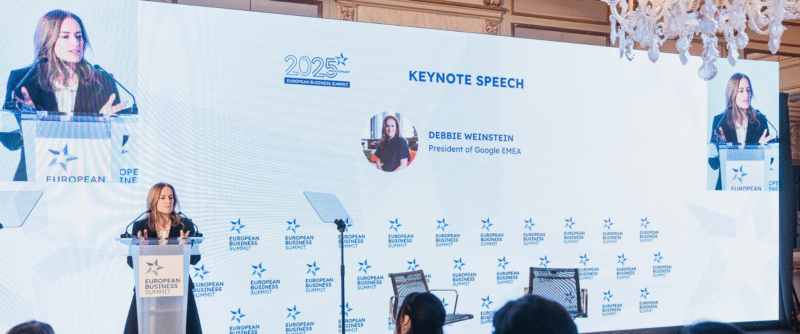
In her first significant public speech following her appointment as President of Google EMEA, Debbie Weinstein made an energizing appeal at the European Business Summit in Brussels for business leaders and local government officials to act fast in making sure that Europe is not losing what she referred to as “a once-in-a-lifetime economic opportunity” of artificial intelligence.
Addressing a full auditorium of entrepreneurs, executives and EU officials, Weinstein combined her own experience with a sharp criticism of the current regulatory environment. Her argument was that Europe has the skill, the drive and the start-up spirit to be a leader in the AI global market — but it would only be possible if it could simplify regulation, facilitate access to advanced technologies and really put the money in the necessary training for its labor force.
Weinstein started by relating everything she says to her own experience. Prior to joining big tech, she started a small children’s food business, a position that she asserts has given her a great understanding of Europe’s small and medium-sized businesses. “I understand what kinds of difficulties small businesses have,” she informed the audience, “and now I can see a lot of potential for the new generation of founders with vision who will create the businesses that will be the engines of our region’s future economy.”
She argued that European innovations like Idoven — a Spanish health-tech company that uses AI to recognize the initial symptoms of heart disease — are proof enough that the European talent pool is at a par with the smartest brains worldwide. She reminded the audience that Google has been on the continent for almost 25 years, building a “deep footprint” with more than 40 offices, 31,000 employees and major infrastructure investments such as the 5.5 billion euro expansion in Germany last week.
Nevertheless, Weinstein cautioned that Europe may fall behind. Although AI could add a total of 1.2 trillion Euros to the EU economy over the next 10 years, only 14% of European companies are currently implementing AI, which is quite a low number compared to AI utilization in China and the US.
“Simply put, European companies should be given the best tools and services for AI,” she stated. “But that is not the case at the moment.”
She argued that a large part of the problem is due to limitations in accessing the most advanced AI models. As she explained, Google’s cutting-edge AI models are 300 times more powerful than the ones that were available just two years ago. Without prompt access to such technology, European businesses are losing the race “while at the same time trying to walk through quicksand,” to use her words.
Weinstein was also concerned about the speed and the intricacy of EU regulation. Since 2019, the EU has passed more than 100 regulations in the field of digital. Most of them, she said, are positively motivated, but the sudden changes and overlapping requirements that they bring have the effects, among others, of slowing down innovation and delaying product launches — including those of Google. By way of illustration, she referred to the delayed release of Google’s AI Overviews and AI Mode in Europe, compared to other parts of the world, as well as the limitations faced by OpenAI and Meta.
“Simpler rules don’t mean weaker rules,” she stressed. “AI needs regulation — but it should be regulated properly.”
Her third major point was the issue of the necessary skills. The European AI triumph to come, she claimed, hinges not only on the presence of engineers and data scientists, but also managers, workers and leaders in all sectors who will have to learn to use AI properly. According to her, Google has already digitally skilled 15 million Europeans, supported over 500 startups, and now through programs such as the AI Opportunity Fund worth €15 million for underprivileged communities, it is deepening its pledge.
Ending on a positive chord, Weinstein expressed her conviction that European inventors are the ones who can “unlock the full AI potential of the region” if there is cooperation between industry and government.
“We must provide them with all necessary resources,” she said. “In exchange, they will enable Europe to grasp the €1.2 trillion AI opportunity – and be the pioneers of the triple world at the same time.”