
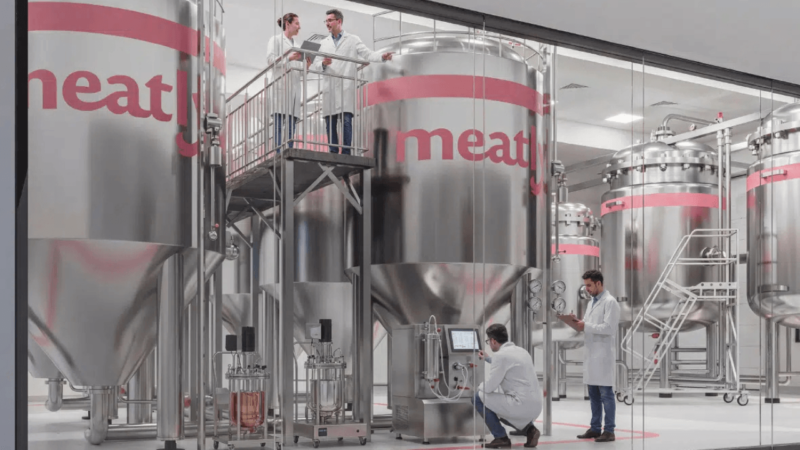
UK foodtech startup Meatly has secured £10.4 million in Series A funding as it accelerates plans to scale cultivated meat production across Europe. The company, which became the first in Europe to commercially sell cultivated meat, is now preparing to build what it describes as the continent’s largest cultivated meat bioreactor facility in London.
Scaling Europe’s Cultivated Meat Industry
Founded in 2022, Meatly has focused on solving some of the biggest technical and economic challenges facing the cultivated meat sector. While many companies in the industry continue to struggle with production costs and scalability, Meatly says it has made significant progress in reducing the expense of core manufacturing processes.
The newly raised funding will support the construction of a 20,000 litre bioreactor facility in London. According to the company, work on fitting out the facility will begin immediately, with commercial product releases expected in 2027.
The site is intended to play a major role in scaling cultivated meat production and moving the industry closer to cost competitive manufacturing.
Investors Back Alternative Protein Expansion
The Series A round attracted support from investors including Oyster Bay Venture Capital, Clean Growth Fund, and JamJar Investments.
The latest financing builds on £7 million in seed funding previously provided by Agronomics and Pets at Home.
With the new investment, Meatly’s total funding now stands at £17.4 million.
Reducing Production Costs
One of the key barriers preventing cultivated meat from reaching mainstream markets has been production cost. Meatly says it has concentrated heavily on reducing these costs over the past four years.
In 2024, the company announced it had lowered the cost of its chemically defined protein free growth medium to £0.22 per litre, which it described as an industry leading figure.
The following year, Meatly also revealed it had reduced bioreactor costs by approximately ten times, another major step toward commercial viability.
These developments are seen as important milestones in making cultivated meat affordable enough for large scale consumer adoption.
First Cultivated Pet Food Launch
Following regulatory approval in 2024, Meatly entered the market in 2025 with what it described as the world’s first cultivated pet food product.
The company initially chose the pet food segment as an entry point because it offers a faster route to market while allowing the company to scale manufacturing capabilities and validate consumer demand.
The move positioned Meatly as one of Europe’s most closely watched cultivated protein startups.
Aiming to Transform Protein Production
According to founder and CEO Owen Ensor, the company’s singular focus has been making commercially viable cultivated meat a reality.
He said Meatly has spent the past several years building a strong technical foundation while systematically reducing key production costs.
The company believes its proprietary technology and scalable manufacturing approach could help establish cultivated meat as a major new category within the global food industry.
Climate and Sustainability Focus
Supporters of cultivated meat argue that it could significantly reduce the environmental impact associated with traditional livestock production, including land use, water consumption, and greenhouse gas emissions.
According to Connor Duffy, rethinking protein production is an important part of addressing the climate crisis, and Meatly has demonstrated that real meat can potentially be produced more sustainably and competitively.
Investors also see the company as part of a broader transformation within food technology and biotechnology.
Preparing for Commercial Expansion
The funding will allow Meatly to scale operations, expand manufacturing capacity, and prepare for wider commercial releases beginning in 2027.
As regulatory frameworks continue evolving and consumer interest in alternative proteins grows, Meatly is positioning itself as one of Europe’s leading cultivated meat companies.
With fresh capital, expanding infrastructure, and major technical progress already achieved, the company is aiming to help shape the future of sustainable protein production.