



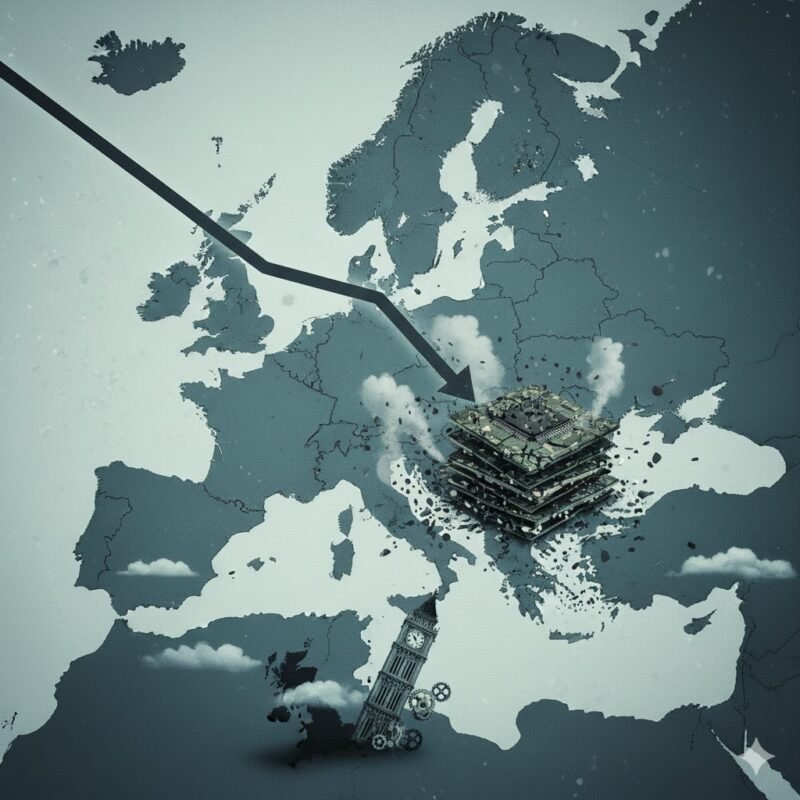
European stocks sharply declined on Friday after a late selloff on Wall Street was also felt in the markets of Asia and Europe. The decline was mainly due to the growing concerns about the overvaluation of technology stocks, which overshadowed even the impressive earnings results of AI leader Nvidia. The retreat reflects the hesitation of investor confidence in the tech sector that has gone up almost without interruption for the last year.
By 3:35 ET (08:35 GMT), the major European stock market indexes were still deep in negative territory. Germany’s DAX went down by 1%, France’s CAC 40 decreased by 0.6%, and the U.K.’s FTSE 100 similarly dropped 0.6%. The trading districts mood was very cautious as the investors were wondering if the extremely strong AI-driven tech stock rally had gone too far, too fast.
Once the announcement of better-than-expected earnings was followed by a precipitous drop, the situation for Nvidia completely reversed on Thursday. In spite of the quarterly report being another excellent one along with a positive outlook for the future, the world’s most valuable company saw its shares drop by 3.2% at the end of the day. The decline removed the intraday rise of more than 5% that was equivalent to a $400 billion change in market value in a single session.
Such an unexpected move stirred a panic wave around the global markets, especially because analysts have been warning that tech valuations may soon become a risky area for a while now.
European chipmakers and semiconductor equipment companies were the ones who had to suffer most from the selling pressure. BE Semiconductor Industries and ASM International fell by 4% to 5% in the first part of the session. Being a vital supplier to the global chip industry, ASML decreased by 4.5% that was indicative of the sector undergoing a broad depressive trend. Investors seemed to be very eager to pocket their profits most of all in those stocks which have been through significant rises due to the AI boom during the year.
Moreover, gloomy sentiment was exacerbated by the UK economic situation, where signs are becoming more apparent of an impending politically sensitive budget for policy-makers next week.
Compared with May, when retail sales rose every month, last October saw a 1.1% decrease which meant the first monthly drop in six months; cash-strapped consumers prioritized spending with wage growth still mediocre and inflation persistently high. The decline signaled that the household budget situation was very fragile which, in turn, caused concern about the way the UK economic recovery would take.
In the meantime, the government’s fiscal position got worse too. The level of public borrowing hit 17.4 billion pounds in October, which was significantly higher than the anticipated 15 billion pounds. That made it one of the months with the highest borrowing figures since records began.
Rachel Reeves, the Chancellor, will deliver her budget speech on Wednesday and Stifel analysts have already sounded a note of warning that it might be one of the most politically difficult budgets in decades. The government has to reconcile its 2024 election promises with the ever-increasing fiscal constraints reality hence Rachel will hardly be able to move around.’
Corporate updates: Ubisoft, Babcock and Veolia in focus
On the corporate side, Europe earnings season is slowly coming to an end, but a couple of noteworthy news have still been able to attract the attention of investors.
In the second quarter, Ubisoft Entertainment showed net bookings that strongly surpassed the forecasted figures. Besides, the company declared that the €1-billion investment made by the Chinese technology giant Tencent would be the factor that led the company to debt reduction. As the game industry is experiencing increasing development costs and a tough competition worldwide, this injection of money is highly welcomed.
With the support of defence spending growth, UK-based engineering services company Babcock International has confidently re-stated its full-year target. Considering geopolitical tensions are still high, the demand for defence and engineering solutions, therefore, is the mainstay of the company’s stable revenue stream.
Moreover, one of the major changes, French utilities group Veolia, to name one, made public, is an agreement to acquire U.S. hazardous waste specialist Clean Earth for $3 billion. The transaction is expected to solidify the waste management market position of Veolia and broaden its North America footprint.
Oil prices went further down on Friday, extending losses this week, as traders were trying to figure out the effects of a potential peace agreement between Russia and Ukraine, which could change global energy markets substantially.
Brent crude went down to $62.55 per barrel or 1.3%., while West Texas Intermediate lowered by 1.5% to $58.11. Both are dropping by more than 3% this week; thus, the gains that were made last week are practically wiped out.
After the information on Washington’s effort to have an agreement that could end the conflict, market sentiment became more cautious. Ukrainian President Volodymyr Zelenskiy said that he had been given a 28-point peace proposal from the US and Russia and that he expected to talk to US President Donald Trump soon.
In case Ukraine agrees to the proposal, analysts think that most of the risk premium related to the war and that is currently supporting oil prices would be gone, which can lead to a rise of the global supply and, thus, lowering the prices even further.