


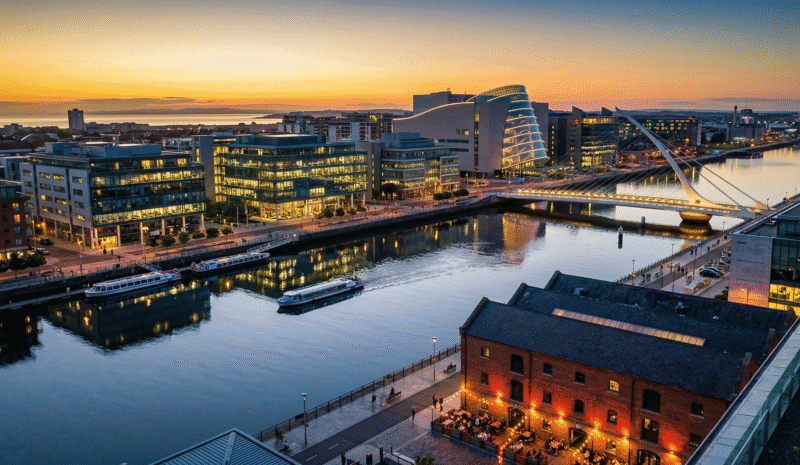
The Silicon Docks area in Dublin stands as a monument to one of the most aggressive and successful economic transformations in European history. By transforming derelict shipyards into a gleaming enterprise zone, the Irish government successfully lured the world’s most powerful technology companies. The underlying policy was based on the concept of colocation. The theory suggested that placing native Irish startups geographically close to global technology giants would generate significant knowledge spillovers and foster an elite innovation ecosystem. Looking ahead to 2026, the data reveals a deeply fractured reality. While the strategy generated immense national wealth, it also created an aggressive real estate environment that actively threatens the survival of early-stage founders.
The Magnetic Pull of Silicon Docks
There is undeniably immense value in geographical proximity. For a native software company operating in the shadow of major search and social media giants brings a distinct level of global prestige. When Irish founders invite international venture capitalists to their Docklands offices, the location itself acts as a silent validator of their ambition. Furthermore, the density of technical talent within a two-mile radius is unprecedented. Engineers, executives, and product managers constantly mingle at local cafes and networking events, creating a highly fluid exchange of ideas. This dense concentration of human capital perfectly mirrors the agglomeration effects that initially built Silicon Valley. The strategy undoubtedly succeeded in putting Dublin on the global technology map and turning it into a mandatory stop for any American venture fund touring the European tech funding landscape.
The Commercial Real Estate Squeeze
However, the financial mechanics of colocation are proving brutal for indigenous startups. When you place heavily funded multinational corporations in a geographically constrained area, commercial real estate prices decouple from standard economic reality. The sheer buying power of American conglomerates heavily distorts the Docklands market. While recent market reports from Murphy Mulhall indicate a global commercial property downturn, with some Dublin North Docks buildings seeing significant valuation drops, the actual cost of prime incubator space remains prohibitively high for a bootstrapped founder. Enterprise spaces and flexible coworking hubs are forced to charge premium rates simply to cover their own underlying leases. Consequently, the very startups the colocation strategy was designed to nurture are being priced out of the cluster. They are entirely unable to justify spending their early-stage seed funding on exorbitant office rents when that capital should be deployed to product development.
The Human Cost and The Housing Crisis
The corporate real estate squeeze is only half the problem. The most devastating failure of the colocation strategy is its direct impact on residential housing. The massive influx of highly paid multinational employees has structurally broken the Dublin rental market. According to recent Daft Ireland market reports, the average monthly rent in Dublin now exceeds 2400 euros. For a native Irish startup attempting to hire junior developers or marketing personnel, this housing reality is an existential threat. When a young engineer is forced to hand over more than half of their monthly salary just to secure a basic apartment near the office, the appeal of working for a high-risk startup evaporates. They are mathematically forced to accept the inflated wages offered by the surrounding multinational corporations simply to survive in the city. This dynamic actively starves local scaleups of the human capital they desperately need.
The Decentralisation Solution
Faced with the hostile economic conditions in the Docklands, native founders are actively rewriting the Irish startup playbook. Rather than fighting a losing battle for premium Dublin real estate, the scaling companies are embracing aggressive decentralisation. Founders are increasingly establishing their primary engineering hubs in Tier 2 cities like Cork and Galway, where lower living costs allow local wages to provide a genuinely high quality of life. Other fast-growing software companies are abandoning physical offices entirely and building fully distributed teams across the European Union. They leverage specialised international talent visas to import senior engineers who can live anywhere in the country, rather than forcing them into the Silicon Docks pressure cooker.
A Victim of Its Own Success
The Dublin colocation strategy is ultimately a victim of its own monumental success. The government successfully built a world-class technology cluster but failed to develop the surrounding residential and commercial infrastructure needed to support a balanced ecosystem. The Docklands will remain the undisputed capital of European foreign direct investment, but it is no longer the definitive home of the native Irish startup. The next generation of indigenous unicorns will undoubtedly utilise the global networks forged in Dublin, but they will build their actual products far beyond the shadows of the Silicon Docks.