



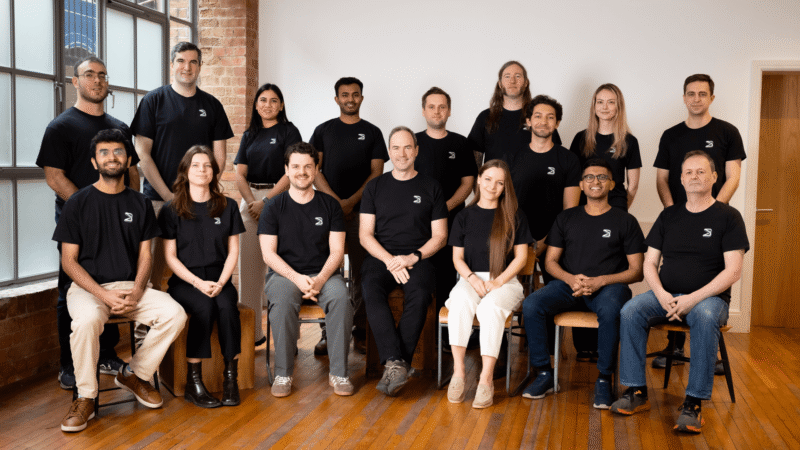
London based BeyondMath, a deeptech startup working at the intersection of artificial intelligence and fundamental physics, has secured a $10 million seed extension to accelerate the commercial rollout of its generative physics technology. The round was led by Cambridge Innovation Capital and included participation from existing backers UP.Partners, Insight Partners, and InMotion Ventures, bringing the company’s total seed funding to $18.5 million. The investment reflects growing demand from industrial players for faster and more flexible simulation tools as engineering complexity continues to rise across sectors.
Rethinking Engineering Simulation
Across industries such as automotive, aerospace, electronics, and energy infrastructure, engineering teams are being asked to design increasingly complex systems under tighter timelines and sustainability constraints. However, many still rely on traditional simulation software built around legacy numerical methods. These tools are often slow, compute intensive, and difficult to integrate with modern AI driven workflows, limiting how quickly engineers can iterate and explore new designs.
BeyondMath was founded to address this bottleneck by reimagining how physical systems are simulated. Instead of relying solely on conventional solvers, the company has developed a foundational AI model trained directly on first principles physics. This approach allows the platform to generate engineering grade simulations in minutes rather than hours or days, while maintaining the accuracy required for industrial use.
A Generative Physics Approach
Founded in 2022 by AI veterans Alan Patterson and Darren Garvey, BeyondMath has built what it describes as the world’s largest foundational physics model. The system is capable of modelling complex phenomena across multiple domains, including aerodynamics, fluid dynamics, heat transfer, and thermal management. By learning the underlying structure of physical laws, the model can generalise across different geometries and conditions, significantly reducing the computational cost of simulation.
According to the company, this generative physics approach can deliver results up to 1,000 times faster than traditional supercomputing based methods. This speed enables engineers to run many more design iterations, explore wider parameter spaces, and make decisions earlier in the development process, all of which can translate into shorter development cycles and improved product performance.
Traction With Industrial Customers
BeyondMath’s technology is already being used by major manufacturers in the automotive, aerospace, and electronics sectors. These customers are applying the platform to challenges such as vehicle aerodynamics, electronic thermal management, and complex system optimisation. The company has also formed strategic partnerships with NVIDIA and AWS, allowing its simulations to run efficiently on modern GPU accelerated and cloud based infrastructure.
Alan Patterson, CEO and co founder of BeyondMath, said engineering teams are increasingly constrained by the limitations of existing tools. He noted that generative physics introduces a fundamentally new way of working, unlocking faster innovation across multiple industries. With the latest funding, the company plans to accelerate its research roadmap and scale adoption, positioning the technology as a potential step change in how physics based engineering is done.
Scaling Research and Commercial Deployment
The new capital will be used to expand BeyondMath’s commercial deployments while continuing to invest heavily in research and development. The company plans to double its headcount over the coming year, adding talent across machine learning, physics, and customer engineering. It also aims to grow its customer base across Europe, the United States, and Japan, markets where advanced manufacturing and engineering simulation play a critical role.
Looking ahead, BeyondMath sees applications for its generative physics platform extending into areas such as data centre design, semiconductor manufacturing, and energy systems. As industries seek to balance performance, cost, and sustainability, faster and more adaptive simulation tools are becoming a strategic advantage. With its latest funding, BeyondMath is positioning itself to play a central role in that transition.