



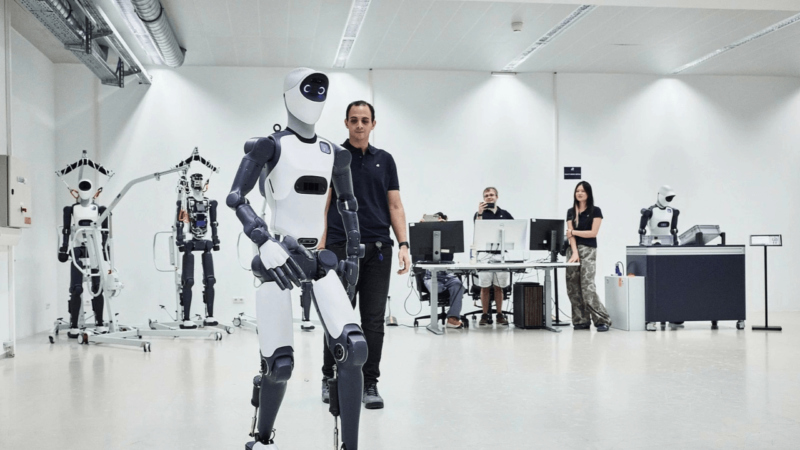
Humanoid robots are moving closer to becoming part of everyday industrial operations, as manufacturers look for ways to automate repetitive tasks, improve productivity and address labour shortages. German robotics company Agile Robots is seeking to accelerate this transition with a major investment led by Japanese technology investor SoftBank. The Munich based company has raised $500 million in a Series F funding round at a valuation of $8.5 billion, strengthening its position in the global race to develop intelligent machines for factories and warehouses.
The funding round also includes participation from Nvidia, Hitachi and T Capital. With the latest investment, Agile Robots has raised approximately $2 billion in total funding. The company plans to use the capital to expand its presence in the United States and increase its manufacturing capacity.
Building Robots for Real Industrial Work
Founded in 2018 as a spin off from the German Aerospace Centre, Agile Robots develops a range of robotic systems designed to perform physical tasks in industrial environments.
Its portfolio includes robotic arms, advanced robotic hands, autonomous mobile robots and humanoid robots. Alongside the hardware, the company develops the software and artificial intelligence models that allow its machines to understand their surroundings, interact with objects and carry out complex operations.
These systems are designed for activities such as assembling products, handling components, inspecting equipment and transporting materials across manufacturing facilities.
Rather than focusing only on robots that perform one repetitive movement, Agile Robots is working towards machines that can adapt to different tasks and operate in changing industrial environments.
The Rise of Physical AI
A central part of Agile Robots’ strategy is Physical AI, a field that combines artificial intelligence with machines capable of interacting with the physical world.
Traditional industrial robots generally operate within carefully programmed environments and follow predefined instructions. Physical AI aims to make robots more adaptable by enabling them to process information from cameras, sensors and other inputs, understand situations and respond accordingly.
This could allow robots to perform tasks that require greater flexibility, including handling different objects, navigating factory floors and working alongside human employees.
Agile Robots is developing the technology needed to connect perception, decision making and physical movement. Its ambition is to move intelligent robotics beyond laboratory demonstrations and into commercial production environments.
Manufacturing Capacity Gets a Major Boost
The company has already taken steps to expand its manufacturing operations. Earlier this year, it opened a factory near Munich with the stated capacity to produce up to 10,000 legged and wheeled humanoid robots annually.
The facility represents an important part of its plans to move from developing robotic technology to manufacturing it at industrial scale.
Agile Robots also has a substantial research and development organisation, employing more than 2,000 specialists. The company says it holds over 650 patents, reflecting its investment in robotics hardware, artificial intelligence and automation technologies.
Its customers operate across several sectors, including automotive manufacturing, consumer electronics, healthcare and services.
SoftBank Backs the Next Phase of Robotics
SoftBank’s investment highlights growing interest in robotics as artificial intelligence expands from digital applications into physical operations.
For industrial companies, intelligent robots could help improve production efficiency, support round the clock operations and reduce the pressure of repetitive manual work. However, widespread adoption will depend on reliability, safety, cost and the ability to integrate robots into existing facilities.
Agile Robots founder and CEO Dr Zhaopeng Chen said the company wants intelligent robots to work alongside people in factories and warehouses around the world.
Expanding Beyond Germany
The latest funding will support Agile Robots’ international expansion, particularly in the United States, while helping it strengthen production capabilities and serve growing customer demand.
With SoftBank, Nvidia and established industrial companies among its investors, Agile Robots is entering its next growth phase with significant financial and technological backing.
Its challenge now is to demonstrate that intelligent robots can perform complex industrial tasks reliably and economically at scale. If successful, the company could become an important player in the transition towards factories where human workers and intelligent machines operate together.