



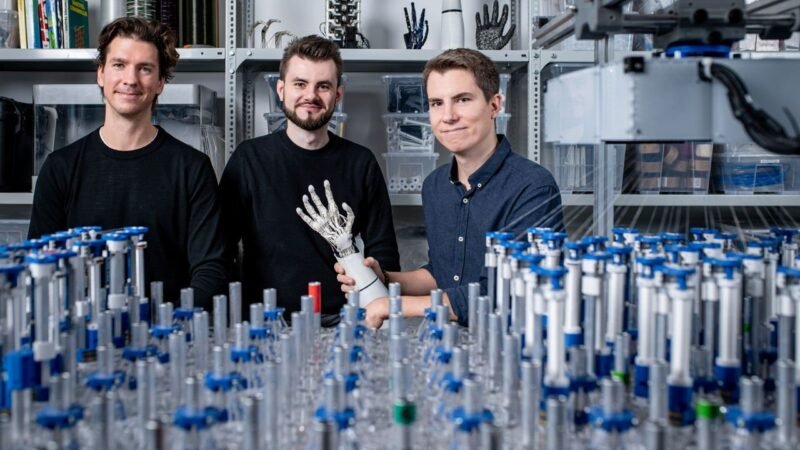
A Budapest based robotics hardware startup is drawing international attention after securing what it describes as the largest pre seed funding round ever raised by a Hungarian company. Allonic has closed a 7.2 million dollar pre seed round as it looks to reinvent how robot bodies are manufactured, tackling one of the most persistent bottlenecks in the robotics industry.
The round was led by Visionaries Club, with participation from Day One Capital and a group of angel investors from leading AI organisations including Hugging Face and OpenAI. The funding marks a significant milestone not only for Allonic but also for Hungary’s emerging deep tech ecosystem.
Rethinking how robots are built
While much of the global robotics conversation focuses on artificial intelligence, perception, and autonomy, Allonic is concentrating on a less visible but equally complex challenge: the physical construction of robot bodies.
Today, robotic hardware is typically assembled from hundreds of individual components. Arms, hands, joints, and manipulators are built piece by piece using screws, bearings, cables, and precision machined parts. This approach is expensive, slow, and difficult to scale, especially as robotics companies race to bring more capable machines to market.
Allonic believes that this manufacturing paradigm has reached its limits. Instead of assembling robots from discrete mechanical parts, the company is developing a new production process that forms entire robotic structures in a single automated workflow.
The idea behind 3D Tissue Braiding
At the heart of Allonic’s approach is a proprietary manufacturing method called 3D Tissue Braiding. Inspired by how ropes achieve strength through structure rather than rigidity, the process weaves robotic tissues directly onto a skeletal core.
Using this method, tendons, joints, and load bearing soft structures are created simultaneously, rather than assembled afterward. This eliminates many of the fragile mechanical interfaces that traditionally limit durability and performance.
According to the company, the result is robotic bodies that combine strength and flexibility while being significantly easier to manufacture. By reducing part count and manual assembly, the process is designed to support faster iteration and lower production costs.
Early validation and industry interest
Allonic revealed its technology publicly in 2025 and has since completed its first pilot project in electronics manufacturing. The pilot validated the ability of the system to produce functional robotic components at industrial standards.
The startup reports growing inbound interest from the humanoid robotics sector, as well as from large consumer technology companies. It says several US based technology firms are exploring how the platform could support faster hardware experimentation and deployment.
With a team of 15 engineers and researchers, Allonic is now focused on refining its manufacturing platform and expanding its pilot deployments across additional industrial use cases.
Removing hardware constraints from robotics design
Benedek Tasi, co founder and CEO of Allonic, says that robotics innovation has long been constrained by manufacturing trade offs.
“A lot of attention is on intelligence and software, but hardware still holds many of the hardest problems,” Tasi said. “The trade offs between durability and softness, dexterity and strength have always been dictated by the limits of manufacturing.”
He added that Allonic’s goal is to remove those constraints entirely.
“We are building a platform that allows robotics teams to design, build and iterate freely, without hardware cost or complexity holding them back. Being able to go from idea to physical robot in minutes instead of weeks fundamentally changes how robotics design works.”
Scaling from Hungary to global markets
With fresh capital in place, Allonic plans to expand its engineering team, scale its manufacturing systems, and deepen collaborations with robotics companies across Europe and the United States.
The company’s ambitions extend beyond any single robot form factor. By positioning its technology as a manufacturing platform rather than a product, Allonic aims to become a foundational layer for next generation robotics, supporting everything from industrial automation to humanoid systems.
As global demand for robotics accelerates, Allonic’s bet is that the future of robotics will be shaped as much by how machines are built as by how they think.