



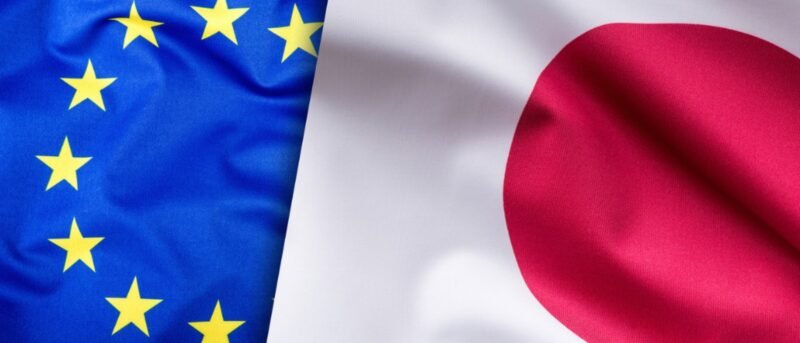
Japan has signed up to participate in Horizon Europe, the €93.5 billion European Union flagship research and innovation programme, in one of the broadest-ever enlargements of EU science collaborations. The agreement makes Japan the biggest non-EU economy to join the programme to date and reinforces the bloc’s position as a focal point for international cooperation in research.
The deal, announced on 22 December, will be fully signed and completed in 2026. But Japanese research institutes, universities and companies won’t have to wait: from January 2025, eligible Japanese organisations can start submitting proposals and become part of collaborative projects under Pillar II of Horizon Europe, which finances large cross-border research efforts between academia and industry. This pillar supports projects related to climate resilience, digital technologies, sustainable industry, and advanced health research.
A transitional agreement allows Japanese participants to take part immediately on an equal footing with EU and associated-country partners. They will be allowed to apply for grants, receive EU funding directly, and even coordinate research consortia. “Japanese participants can receive EU funding as beneficiaries and lead consortia on equal footing as entities from the EU member states,” confirmed Signe Ratso, the European Commission’s chief negotiator.
Japan is now the 23rd non-EU country to join Horizon Europe, adding to an increasingly diverse list of research partners that already includes Canada, South Korea, Switzerland, Egypt, the UK, and New Zealand. Advanced talks are also being held by the EU with Australia. All these do point to a momentum-driven enlargement strategy.
Scientific Powerhouse Partner
Japan brings substantial scientific weight to the table. The nation, according to Organisation for Economic Cooperation and Development statistics from 2023, invests 3.4% of its GDP in research and development, putting it on par with the United States and well ahead of the European Union average. For decades, it has been the source of pioneering research in robotics, materials science, electronics, and biomedical engineering.
This high research capacity should stand to the benefit of Horizon Europe’s collaborative ambitions. Though Japan is a newcomer to the programme, it is no stranger to research in partnership with the EU. Data reviewed by Science|Business shows that, all told, 84 Japanese organisations have already participated in 169 Horizon Europe projects, winning €1.25 million in EU contributions—though most costs were covered domestically due to eligibility restrictions in the past.
Overall participation trends in projects give an indication of Japan’s scientific strengths: approximately a third of past participations have been in the natural sciences, with around a quarter each in the social sciences and engineering/technology. The health sector remains an underdeveloped avenue for collaboration, with just 11 Japanese participations to date in Horizon Europe health-related projects.
A Strategic Move in the Shifting Geopolitical Climate
The deal is seen in Brussels as a strategic milestone in a world where research alliances are increasingly at the intersection of science and geopolitics. “We believe that scientific cooperation can build bridges, even in challenging geopolitical times,” said Ekaterina Zaharieva, EU Commissioner for Start-ups, Research and Innovation.
It may also alter international dynamics. Analysts say that while Europe is broadening its reach in science diplomacy, the United States is being questioned over the continuity of federal research funding and of international partnerships. Policy uncertainty-especially in light of the change in U.S. administration-has caused concerns among those around the world with a stake in global research, even as American institutions remain world leaders in most scientific fields.
Eyes on 2026
Formally, EU-Japan negotiations began only in November 2024 and accelerated through 2025 to the commitment of both sides for completing the draft agreement text. Japan’s Foreign Affairs Ministry says both parties “will continue to work on necessary procedures” ahead of the 2026 signing. For now, Japanese researchers seem ready to hit the ground running. With access to the world’s largest multinational research programme assured, and new channels for innovation opening up, the partnership seems likely to drive advances from green energy to digital transformation – delivering what many in Brussels are hoping will be a model for future science diplomacy.