



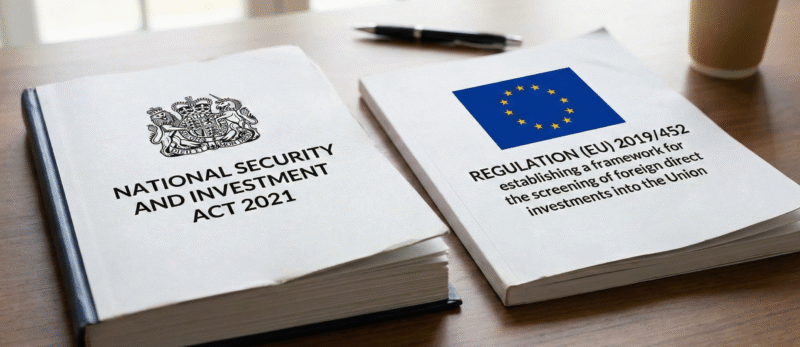
European tech sovereignty has aggressively replaced free trade as the dominant regulatory paradigm. For General Partners managing deep tech portfolios the greatest threat to a successful exit is no longer macroeconomic volatility. The primary threat is the weaponization of national security laws. The United Kingdom National Security and Investment Act and the expanding European Union Foreign Direct Investment screening frameworks are actively blocking cross border acquisitions.
The Brutal Reality of the UK NSI Act
The UK NSI Act introduced a ruthless mandatory notification regime. Any transaction involving seventeen highly sensitive sectors requires explicit government clearance before legal completion. This strict perimeter includes artificial intelligence quantum technologies advanced robotics and cryptographic authentication.
The legislation possesses terrifying retroactive powers allowing the government to forcibly unwind completed deals. Investors can no longer rush a strategic acquisition to satisfy a fund timeline without risking catastrophic legal unravelling. If a buyer acquires twenty five percent or more of a qualifying British entity without submitting the mandatory notification the transaction is legally void. This absolute strict liability has permanently altered the speed and structure of London based tech buyouts.
The Patchwork of European FDI
The European continent presents an even more complex patchwork of regulatory hurdles. The overarching EU FDI screening framework empowers individual member states to block investments that threaten national security or public order.
Germany routinely utilizes its Foreign Trade and Payments Act to veto foreign acquisitions of medical technology and semiconductor assets. France fiercely protects its domestic cloud infrastructure and biotechnology supply chains through the expanding Montebourg decrees. This severe fragmentation means a pan European software rollup faces multiple uncoordinated regulatory audits simultaneously. A buyer might clear the German authorities only to face a total blockade from the French Ministry of Economy.
The Deal Certainty Discount
This immense regulatory friction fundamentally alters transaction economics. Foreign buyers now price a severe deal certainty discount into their term sheets. When an American private equity firm bids on a European quantum computing asset they mathematically factor in the six month regulatory delay and the high probability of a blocked transaction.
Acquirers now demand massive break fees and extended exclusivity periods to compensate for this political risk. This dynamic explicitly favors domestic European buyers who can bypass the FDI friction entirely. Selling to a local industrial incumbent guarantees deal closure while selling to a foreign strategic buyer invites infinite regulatory delays.
Cap Table Contamination
The most devastating impact of these laws actually occurs years before the exit event. Early stage founders who accept capital from restricted foreign geographies permanently contaminate their cap tables.
When a clean American buyer attempts to acquire the company later the historical presence of restricted foreign capital triggers an automatic national security review. General Partners must brutally audit the geopolitical origin of every co investor in the syndicate. You cannot build a sovereign defense asset using hostile capital. Institutional intelligence from the Linklaters Foreign Investment Report confirms that minority investments from sovereign wealth funds often completely poison the eventual exit pathway.
What Should Investors Do?
Board members must proactively manage this regulatory friction from the seed stage onward. Companies operating in sensitive sectors must engage legal counsel to conduct mock FDI audits well before initiating an M&A process.
Founders must also carefully consider the jurisdiction of their corporate holding entity. A poorly timed restructuring can trigger these national security laws entirely by accident as outlined in our recent strategic guide regarding The Delaware Flip Debate.
Geopolitics is now a core component of venture capital underwriting. A breakthrough technology is functionally worthless to an investor if the state legally forbids its sale. General Partners must map the regulatory exit pathways just as rigorously as they project future revenue metrics.