


Every year, the global technology elite descends upon Paris for VivaTech. Under the flashing lights of Europe’s largest startup event, even politicians and venture capitalists celebrate the undisputed resurgence of the French innovation ecosystem. The narrative is heavily polished. The state is pouring billions into artificial intelligence, quantum computing and advanced manufacturing to secure European digital sovereignty.
However, venture capitalists and institutional investors require more than political enthusiasm to deploy capital. They require hard data. When we strip away the conference pageantry and analyse the fundamental metrics of the ambitious France 2030 investment plan, a complex picture emerges. The French state is executing one of the most aggressive public deep-tech funding strategies in the world, but the return on investment is currently bottlenecked by historical academic friction.
The Capital Injection and The 500 Startup Mandate
To understand the French strategy, analysts must look at the sheer scale of public intervention. The government recognised early that private European capital is structurally too risk-averse to fund hardware-intensive, long-horizon, deep-tech projects.
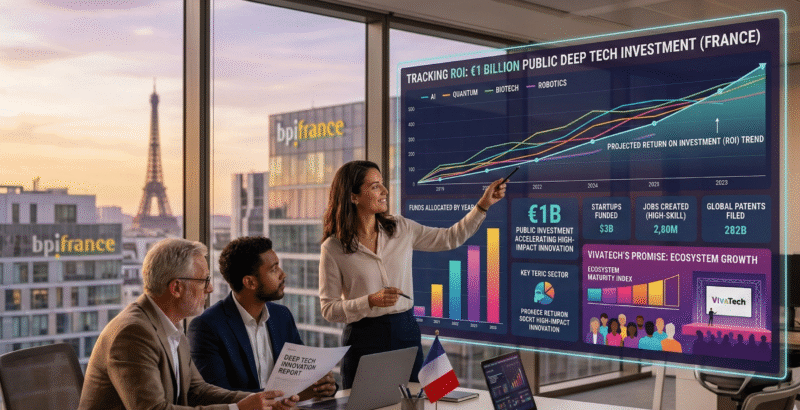
In response, the state launched the massive France 2030 initiative, representing a 54 billion-euro commitment to reindustrialise the nation through technology. Within this umbrella, Bpifrance operates a highly targeted Deeptech Plan. The core metric for this plan’s success is a strict volume mandate. The government aims to generate exactly 500 new deep tech startups annually by the end of the decade.
To achieve this, Bpifrance is deploying hundreds of millions of euros annually through structured competitions such as the i-Lab and i-PhD programs. These state-backed grants provide the critical non-dilutive capital required to move a theoretical quantum algorithm or a novel semiconductor architecture out of a university lab and into a commercially viable corporate structure.
The ROI Metric: The Tech Transfer Bottleneck
While the capital injection is historic, the true measure of state-backed ROI is the efficiency of technology transfer. How much academic research spending does it actually take to produce one commercially viable company? This is where the French ecosystem is currently bleeding efficiency.
Recent government and OECD data highlight a stark global contrast. In the United States, the highly optimised venture ecosystem generates one commercial startup for every 58 million euros of academic research expenditure. The United Kingdom requires roughly 74 million euros. France currently lags significantly behind, requiring an estimated 91 million euros of academic spending to yield a single company.
This friction is the primary bottleneck of the French Tech initiative. For decades, French public research institutions operated in complete isolation from commercial markets. While the government is actively building a 25 dedicated university innovation toolset to systemise the commercialisation of scientific discoveries, rewiring the mindset of legacy academic institutions takes immense time.
Where the Capital is Converting AI and Microelectronics
Despite the academic friction when French deep tech successfully transitions into the private market, the results are globally disruptive. The state heavily prioritised artificial intelligence and semiconductor manufacturing, and those bets are generating massive returns.
The Parisian AI cluster is currently the undisputed crown jewel of the European ecosystem. Propelled by early state support and immense domestic talent, homegrown giants like Mistral AI and Hugging Face have secured multi-billion-dollar valuations. Every year, French universities graduate tens of thousands of highly specialised AI engineers providing the crucial human capital required to sustain this localised boom.
This momentum is bleeding into physical hardware. Deep tech startups addressing critical manufacturing bottlenecks are successfully raising massive late-stage rounds. Companies like Hummink recently secured 15 million euros to bring surgical-level precision to microelectronics manufacturing, tapping into the exact industrial sovereignty themes outlined by the France 2030 mandate.
The Foreign Capital Reality
The ultimate irony of the French push for sovereign technology is how these companies are ultimately funded. Bpifrance serves as the ultimate derisking tool. The state provides the seed capital, allowing founders to build prototypes and secure initial patents. However, when these deep tech companies need 50 million euros to build a commercial fabrication facility, domestic capital often vanishes.
The 2025 and early 2026 funding data reveal that foreign investors increasingly finance French tech. Over 40 per cent of French startups raising capital last year took money from at least one foreign fund. Furthermore, those internationally backed rounds accounted for roughly 5 billion of the 6.7 billion euros raised overall in the final quarters of the year.
Just as in the UK artificial intelligence sector, France acts as an elite incubator. The state absorbs the immense early-stage scientific risk only to watch massive American venture funds and sovereign wealth vehicles capture the late-stage financial upside.
A Necessary Gamble
Evaluating the ROI of a 54 billion euro deep tech initiative halfway through its lifecycle is inherently difficult. If the metric for success is purely sovereign financial control, the initiative is currently falling short as foreign capital dominates the growth rounds.
However, if the goal is to permanently anchor critical technological infrastructure and elite engineering talent within the borders of the European Union, the French Tech initiative is a resounding success. By forcing academic institutions to commercialise their research and heavily subsidising the riskiest phases of hardware development, France has secured its position as a deep-tech superpower for the next decade.