


Dutch clean mobility company Rocsys has introduced a new hands free electric vehicle charging system designed to support the rapid growth of autonomous fleets. Alongside the launch, the company secured a $13 million Series A extension, strengthening its position in the emerging robotaxi infrastructure market and bringing its total funding to $56 million.
Funding to Accelerate Growth
The latest investment round was led by Capricorn Partners, with participation from Scania Invest, Forward.One, SEB Greentech Venture Capital, and Graduate Ventures. The funding will support Rocsys in scaling its technology, expanding deployments, and strengthening its presence across North America and Europe.
The capital will also be used to enhance its AI driven software capabilities and broaden integrations with fleet operators and infrastructure partners.
Addressing a Key Bottleneck in Autonomous Mobility
As the global robotaxi market continues to expand, projected to reach significant scale by the end of the decade, operational efficiency has become a critical challenge. While autonomous driving technology has advanced rapidly, supporting infrastructure has struggled to keep pace.
One of the most persistent issues is vehicle charging. In large fleets, manual charging must be performed repeatedly, creating inefficiencies, increasing operational costs, and introducing safety risks. This limitation can restrict the scalability of autonomous transport systems.
Rocsys aims to solve this problem by fully automating the charging process, enabling fleets to operate continuously without human intervention.
Introducing the Rocsys M1
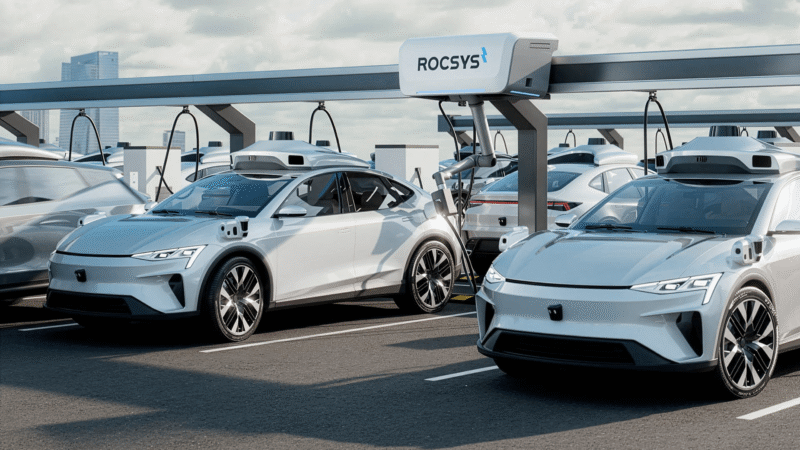
The newly launched Rocsys M1 is designed specifically for robotaxi depot operations. It is capable of serving multiple charging bays simultaneously, making it suitable for large scale fleet environments.
The system features a modular architecture that can support up to ten charging bays from a single unit. Flexible installation options, including overhead, ground, and roof configurations, allow it to integrate into different depot layouts without disrupting existing operations.
In large facilities, such as a 50 bay depot, the company estimates that the system can significantly improve operational efficiency and deliver substantial cost savings annually.
Powered by AI and Real World Data
The Rocsys M1 is built on more than six years of operational data and combines AI driven computer vision with motion intelligence. This enables the system to locate and connect to charging ports automatically, even under varying conditions such as different lighting, weather, or vehicle positioning.
With a plug in success rate exceeding 99.9 percent, the system is designed to deliver consistent and reliable performance. It is also compatible with a wide range of electric vehicles, charging systems, and connector types, allowing deployment without major infrastructure changes.
A Connected Charging Ecosystem
Beyond hardware, the Rocsys platform integrates software and services into a unified ecosystem. Through its digital portal, operators can monitor performance, manage operations, and access real time data.
The platform also supports API integrations with customer systems and provides remote support services, ensuring that fleets remain fully operational with minimal downtime. This connected approach is designed to maximise uptime and streamline fleet management.
Scaling Toward Commercial Deployment
The Rocsys M1 is currently in pilot deployment, with plans for large scale rollout by 2027. The company is working closely with partners to transition from testing environments to full commercial operations.
CEO Crijn Bouman emphasised that hands free infrastructure is essential for the future of autonomous mobility. Without it, the benefits of autonomy cannot be fully realised in real world operations.
Enabling the Future of Autonomous Transport
As autonomous vehicle adoption accelerates, the need for efficient and scalable infrastructure is becoming increasingly urgent. Rocsys is positioning its technology as a critical component of this ecosystem, enabling fleets to operate continuously and reliably.
By automating one of the most repetitive and resource intensive tasks in fleet management, the company is helping to unlock the full potential of robotaxi services and electric mobility.