
The global supply chain is undergoing a massive structural shift. Traditional methods of moving freight are no longer sufficient to meet the extreme demands of modern international trade. At the epicentre of this technological transformation is the Netherlands. Specifically, the Port of Rotterdam is functioning as a massive living laboratory for artificial intelligence, advanced robotics, and interconnected logistics ecosystems. By aggressively integrating deep tech into its maritime and warehouse operations, the Dutch are securing a dominant position in the global logistics hierarchy.
The Maasvlakte 2 Blueprint for Autonomous Shipping
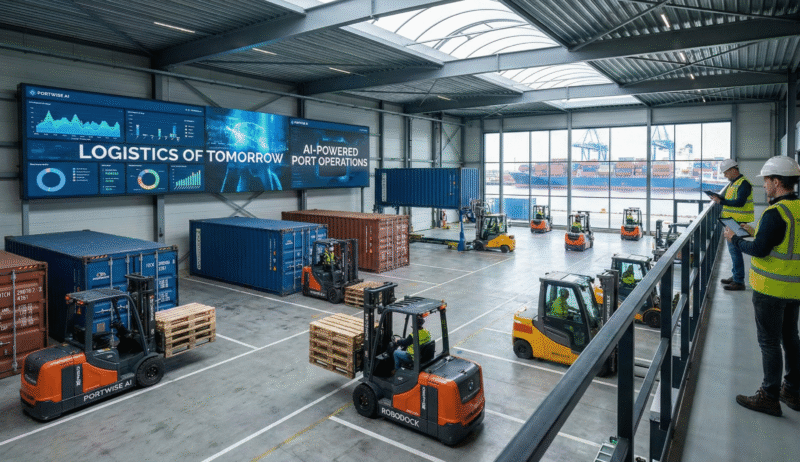
Handling over 470 million tonnes of cargo and moving 14 million containers annually requires unprecedented technological orchestration. The Maasvlakte 2 terminal in Rotterdam stands as one of the most advanced automated facilities in the world. Human drivers are notably absent from the immediate container yards. Instead, self-driving automated guided vehicles navigate the docks alongside fully autonomous cranes that are guided by laser sensors and complex AI control systems.
To enable seamless machine-to-machine communication, Rotterdam has deployed advanced private 5G networks that deliver latency of under 30 milliseconds. This ultra-reliable connectivity allows for the creation of high-fidelity digital twins of the entire port infrastructure. By utilising AI software at the computing edge, port authorities can simulate and predict scheduling bottlenecks before they occur. Recent sector data shows that these AI scheduling optimisations save an average of four hours of berthing time per ship while simultaneously cutting carbon emissions by 28 tonnes per vessel. This strategy aligns perfectly with the broader regional trend of leveraging IoT and smart cities to improve public transport in European capitals, while applying similar data-driven principles to heavy-industrial maritime traffic.
The Startups Powering the Automation Engine
The operational success of Rotterdam is not solely built on government infrastructure. It relies heavily on a vibrant ecosystem of Dutch deep-tech startups and scaleups. These localised companies provide the critical software and hardware layers that make autonomous logistics a commercial reality.
Fizyr: Based in nearby Delft, this fast-growing scaleup specialises in advanced computer vision software for robotic picking and placing. Their proprietary algorithms enable robotic arms in warehouses and sorting facilities to identify, grasp, and move irregularly shaped parcels with near-perfect accuracy, which is a critical capability for unpredictable e-commerce fulfilment operations.
Blockbax: This Rotterdam-based startup provides an intuitive platform for automating complex business processes using raw sensor and machine data. In a port environment heavily reliant on connected devices, Blockbax allows logistics providers to monitor asset health and track cargo in real time without requiring extensive coding expertise or massive IT overhead.
Shypple: Acting as a digital freight forwarder, Shypple brings much-needed transparency to global supply chains. By analyzing shipping data in real time, they allow companies to manage their freight with the same ease as booking a passenger flight, significantly reducing the administrative friction associated with international customs and terminal coordination.
Warehouse Robotics and the Hinterland Connection
The absolute efficiency of an autonomous port is severely diminished if the cargo hits a bottleneck the moment it leaves the dock. To solve this structural issue, Dutch logistics technology extends deep into the warehousing sector. Companies are heavily deploying Autonomous Mobile Robots to handle picking, sorting, and inventory management. Systems from providers like Vanderlande, a Dutch powerhouse in logistic process automation, ensure that goods flowing from the port are immediately processed through highly automated fulfilment centres.
These advanced robotic systems can often cover up to 90% of standard warehouse automation needs and have been shown to boost operational efficiency by up to 300% in modernised logistics centres. When seamlessly integrated with European mobility and RailTech solutions, the automated warehouses create a frictionless transport corridor from the ocean vessel directly to the final European distribution hub.
The Path to Global Dominance
While Asian mega-ports are also heavily investing in automation, the Dutch strategy focuses entirely on open collaboration and on integrating specialised tech ecosystems. Rather than relying on closed or proprietary legacy systems, the Netherlands encourages the use of standardised application programming interfaces and shared digital platforms. This interconnected approach allows third-party software vendors, AI developers, and independent freight forwarders to plug directly into the Rotterdam digital infrastructure.
By leading the charge in open-architecture port automation and fostering a dense network of AI and robotics startups, the Netherlands is doing much more than just moving boxes efficiently. The region is actively writing the foundational software code and hardware blueprints for the future of global trade..