


This week, the Consumer Electronics Show (CES) kicks off in Las Vegas, once again transforming the city into the world’s largest showcase for consumer and industrial technology. Spanning multiple venues and hundreds of side events, CES remains known for flashy gadgets and experimental wearables, many of which never make it beyond novelty status.
Yet beneath the surface spectacle, CES 2026 highlights a more pragmatic shift. Advances in AI, edge computing, sensors, and hardware efficiency are pushing connected devices out of the “nice-to-have” category and into real-world infrastructure. European startups, in particular, are arriving with mature, deployable technologies focused on health, accessibility, energy, cities, and industry.
France Tackles Food Safety With a Pocket Lab
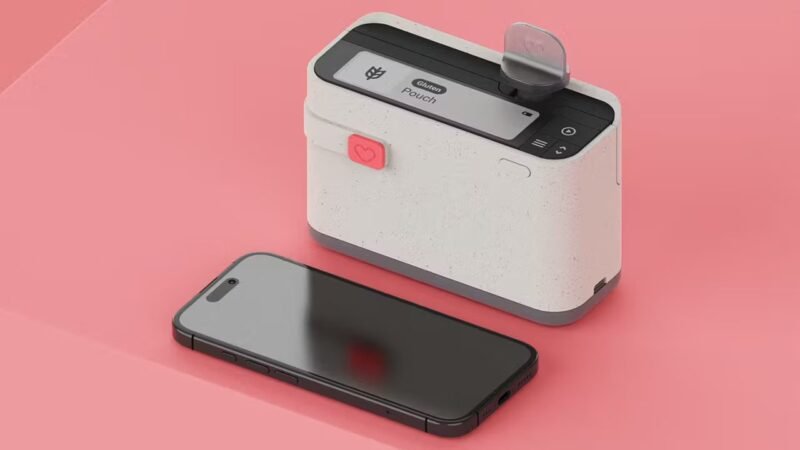
Allergen Alert is presenting a portable device that enables people with food allergies or coeliac disease to directly test meals for allergens or gluten with laboratory-level precision.
Unlike barcode scanners or photo-based apps, the device functions as a pocket-sized mini-lab. It uses a patented single-use pouch derived from laboratory technologies developed by bioMérieux, miniaturising and automating a professional analytical test. Users collect a food sample, insert the pouch, press a button, and receive a clear result within minutes.
Developed in collaboration with allergists, patients, and food safety experts, the technology could later expand into broader food analysis, water testing, and environmental monitoring.
Romania’s AI Guide Dog in Glasses Form
Romanian deeptech startup .lumen is showcasing smart glasses designed to provide independent navigation for people who are blind or severely visually impaired.
.lumen Glasses for the Blind combine cameras, inertial sensors, GNSS localisation, and onboard AI processing inspired by autonomous driving systems. The glasses interpret the environment in real time and guide users via a patented haptic interface on the forehead, supported by audio prompts. The system identifies safe paths, detects obstacles at ground and head level, and steers users toward destinations.
Tested by hundreds of users in more than 40 countries, the product was named a CES 2026 Innovation Awards Honouree in the Accessibility and Longevity category.
Hungary Builds Smart, Solar Public Spaces
Budapest-based Kuube is demonstrating how connected hardware can become part of everyday urban infrastructure. The company designs solar-powered smart street furniture that integrates renewable energy with digital services.
Products range from Kuube PLUS, an eight-seat bench with Wi-Fi, USB and wireless charging, environmental sensors, and digital displays, to Kuube BOOK, a solar-powered public book exchange aimed at community engagement. The goal is to merge sustainability, connectivity, and social value into public spaces without relying on grid power.
Switzerland Reinvents Energy Storage
Swistor, an EPFL spin-off, is bringing high-performance supercapacitors to CES. Using nanostructured carbon-based electrodes and advanced materials, Swistor’s devices offer rapid charging, high power density, and long lifetimes with slow degradation.
Designed to complement or potentially replace lithium-ion batteries, the technology avoids reliance on scarce materials like lithium and cobalt. Swistor targets B2B applications, from IoT sensors and portable electronics to renewable energy systems and grid support.
Italy Targets Industrial Energy Waste
Italian startup Tinental is focused on energy optimisation and predictive maintenance for industrial operators. Its Caleno Energy device integrates directly with existing motor-driven machinery through variable-frequency drives, dynamically matching output to real demand.
The plug-and-play system installs with zero downtime and no additional sensors, delivering energy savings of up to 60 percent. Tinental also offers Caleno Predict, an AI-powered predictive maintenance solution that identifies anomalies and reduces unplanned downtime.
Ukraine Prints Buildings on Site
Kyiv-based UTU is presenting industrial-scale 3D printing technology for construction. The company designs large concrete 3D printers capable of printing structural walls directly on-site, reducing labour, construction time, and material waste.
UTU became the first Ukrainian company to 3D print a residential house using its own technology, completing the structure in roughly 58 hours. The approach highlights how robotics and automation can reshape construction under real-world conditions.
Europe’s Practical Turn at CES
At CES 2026, Europe’s presence reflects a broader shift in connected hardware. These are not speculative concepts, but systems already designed for deployment. As IoT, AI, and energy technologies mature, the focus is increasingly on infrastructure that solves concrete problems rather than gadgets destined for drawers.