


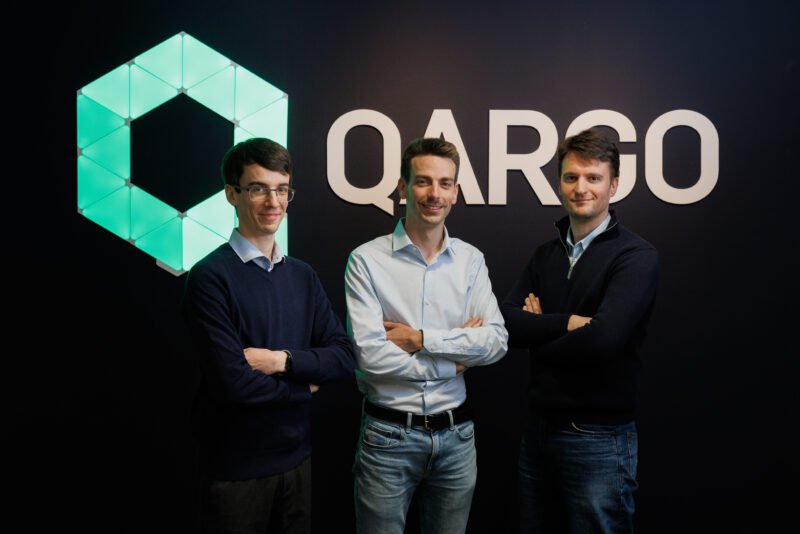
Qargo, a transport-technology company based in Belgium–UK and specialising in intelligent Transport Management Systems (TMS), has been able to raise $33 million in Series B funding after a period of fast expansion across Europe. The main investor in this financing round was Sofina, the Brussels-listed investment group known for its long-term support of industrial innovators. The new investor included also existing investor Balderton Capital. With this funding round, Qargo’s total funding amount is $54 million, which it has raised since 2020.
The investment is a clear signal of the growing impact of AI on road transport, which has been the most analog sector in Europe for a long time. The continued regulatory pressure, the shortage of drivers, and the volatile operating costs have made the carriers turn to automation and digital optimisation on a large scale.
Growth spurt across Europe
During the 18 months following its Series A round in May 2024, Qargo experienced what it calls “exponential” growth. The company managed to expand the number of its customers by four times-from about 100 to more than 400 transport operators-and at the same time, it spread its wings from two to six European logistics markets, i.e., Belgium, the Netherlands, the UK, France, Germany, and Spain.
At the same time, the volume of money invoiced yearly through Qargo’s platform increased from £420 million to more than £1.9 billion, which is a very strong indication that TMS has become a vital tool for the companies that carry out their operations via the platform. Total revenue gained five times as much as before, which was due to not only the increase of new customers but also the deepening of the current accounts.
This significant amount of growth occurred while European logistical operators were experiencing some of the most severe margin problems of the last several years, which were brought about by unstable fuel prices, tough decarbonization requirements, and the ever-present threat of cyber attacks. In such a scenario, operators are becoming more willing to switch to cloud-native, AI-powered platforms as they weigh up the cost and disadvantages of their existing on-premise TMS systems.
AI engine reshaping transport operations
One of the biggest innovations to Qargo’s platform is the AI unit Qargo Intelligence, which is capable of figuring out the entire transport chain in an automated manner from order creation and route planning to load building, invoicing, and warehouse time-slot allocation. More specifically, the organization reports that its clients have the possibility to achieve a 75% reduction in the time they allocate to performing administrative duties, thus resulting in the liberation of desk-planners as well as customer-service personnel and their redirecting to valuable activities.
One major improvement to the company’s agentic AI is the ability it confers the latter to mutually communicate with external systems. As a result, it would be possible for the activities, e.g., booking ferry slots, customer portals updating, or documentation synchronising, which are usually done manually, to be done automatically, thus saving on overheads and preventing human error.
Moreover, Qargo’s optimisation features have been instrumental that the company has been able to achieve certain environmental goals while at the same time reducing costs. Operators, in particular, have seen the elimination of up to 30% of empty runs, which is the fundamental objective for such operators who are gaining an increasing volume of pressure to lower CO₂ emissions and enhance the level of utilisation.
Security as a differentiator
Recognizing the rapid and substantial rise of cyberattacks on the logistics networks, Qargo concentrated on security as the most important aspect of its platform. To begin with, the company achieved ISO 27001 certification in the early stage of its lifecycle, and it solely operates on Google Cloud. Besides that, it uses the likes of Aikido for the real-time code scanning. Qargo follows an approach that is based on the cloud and thus usually lessening the security burden to the transport companies that are historically maintained on vulnerable and even old infrastructures by means of the regular penetration testing and dedicated in-house security specialists.
Qargo’s growing work-sharing network, Qargo Network, has also become a valuable feature for carriers navigating a subcontractor-heavy market. It allows the transportation of ways in which the fleets can exchange certain jobs with third parties and, at the same time, receive the same overview and command as internal assignments. So, the manual calling, spreadsheet usage, and e-mailing operations that default subcontracting workflows slow down are eliminated.
Investors and customers signal strong confidence
Adriaan Coppens, CEO and co-founder of Qargo, commented that the financing marks a transitional point: “This round is a loud affirmation of our achievements and our mission to revolutionise transport management. While being highly capital-efficient, we have made exceptional progress in terms of revenue, customer base, and the team.”
Anthony Keusters, Principal at Sofina, was impressed by Qargo’s momentum: “Road transport is the core of Europe’s economy, and Qargo is the one that gives the most significant, measurable, and cost-effective’ emissions’-saving potential to fleets of all sizes. “
Customers saying the same thing as well. Stijn Gheyle, COO of CLdN Cargo, pointed out that Qargo furnishes “the scalability and automation we require to further enhance our multimodal services.”
Looking forward
With the additional fund, Qargo intends to extend its business further deep into Europe, increase the headcount of its engineering and go-to-market teams, and speed up the development of its AI features. As the digitisation process changes the face of logistics on the continent, the firm is eager to be the default intelligent TMS solution provider for fleets seeking efficiency, resilience, and sustainability.