




As early-stage fundraising in the United Kingdom becomes increasingly sophisticated, convertible loan notes (CLNs) have evolved into one of the most strategic financing instruments for founders navigating the pre-seed and seed landscape. Their hybrid nature bridging debt and equity offers a flexible mechanism that aligns the interests of founders, investors, and future institutional backers. For the UK’s rapidly expanding tech ecosystem, understanding how CLNs work is no longer optional; it is a structural advantage in securing capital while preserving long-term ownership and negotiating power.
At their core, convertible loan notes allow startups to raise capital quickly without the immediate burden of assigning a valuation, an especially useful feature for companies still validating product-market fit or operating in markets where comparable benchmarks are unclear. Instead of forcing a premature valuation discussion, CLNs postpone the equity pricing to a later funding round, typically the next qualified equity investment. This feature has made them particularly popular among UK deep-tech, SaaS, and fintech founders, who often require early funding to build or test technology before formal valuation can be justified.
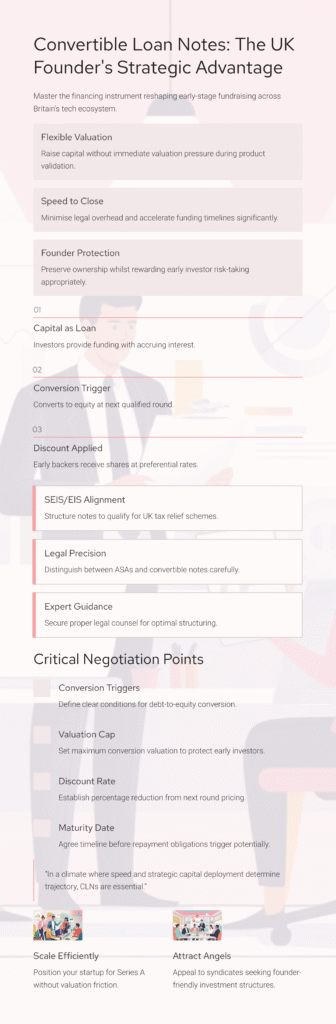
The operational mechanics of CLNs are deceptively simple yet strategically nuanced. Investors provide capital as a loan, accruing interest over time, with the understanding that both principal and interest will convert into shares at a later date usually at a discount to the next round’s valuation or at a pre-agreed valuation cap. These mechanisms reward early risk-taking while ensuring founders are not subjected to excessive dilution. In contrast to priced equity rounds, CLNs minimise legal overhead, accelerate closing timelines, and offer a level of structural clarity preferred by angel syndicates and early-stage VC firms.In the UK, the regulatory and tax landscape further strengthens the appeal of convertible instruments. Many CLNs are structured to align with the expectations of SEIS and EIS investors, though not all variations qualify, making legal guidance essential in the drafting process. The difference between advanced subscription agreements (ASAs) and convertible notes is also significant, particularly when tax relief eligibility, interest accrual, or repayment rights are involved. For founders seeking UK angel investment, understanding these nuances can dramatically alter the success of a funding round.
Despite their advantages, CLNs carry inherent considerations that both founders and investors must navigate. The conversion triggers, maturity date, valuation cap, discount rate, and interest structure form the backbone of the negotiation. Any misalignment in these terms can create downstream disputes during future investment rounds, especially if the company’s valuation trajectory diverges from early expectations. Furthermore, CLNs that include repayment rights in the event of non-conversion may introduce financial liabilities that early-stage companies cannot realistically bear, underscoring the need for careful legal and financial structuring.
For the broader UK tech ecosystem, the rise of convertible loan notes reflects a shift towards more agile and founder-friendly fundraising models. As venture capital becomes increasingly competitive, CLNs offer a mechanism that balances investor protection with entrepreneurial flexibility. They not only simplify early-stage deal making but also position UK startups to scale efficiently into Series A and beyond without the friction of premature valuation constraints.
In a climate where speed, clarity, and strategic capital deployment can determine a startup’s trajectory, convertible loan notes stand out as an essential tool. For founders navigating the complexities of the UK funding environment, mastering their structure and implications is key to raising intelligently, negotiating confidently, and building sustainably in one of Europe’s most dynamic innovation hubs.