


The centre of gravity in European technology is shifting, and the nature of the capital is fundamentally changing. The era of the traditional general partner chasing a 10x return in 7 years is ending. In its place,e the era of the industrial family fighting for its survival over the next 50 years has begun.
Germany’s economic backbone rests on the Mittelstand, which consists of thousands of highly specialised, privately owned manufacturing firms known globally as hidden champions. For decades, these companies perfected physical hardware. Moving into 202,6 they face an existential mandate to digitise. Instead of passively waiting for Silicon Valley to build the enterprise software they need, these hidden champions are aggressively launching Corporate Venture Capital arms.
The Mittelstand Liquidity Event and 2026 Funding Data
To understand the sheer scale of this transition, institutional investors must look at the macro data from the DACH region. Market data from late 2025 and early 2026 reveals a massive structural shift termed the Mittelstand Liquidity Event.
According to the official Germany Trade and Invest reports, German startups secured €8.4B in venture capital in 2025, representing a 19 per cent year-over-year increase. A massive 3568 new startups were established, breaking the record set back in 2021. This capital injection is completely bypassing consumer applications. Over 25 per cent of these new ventures use artificial intelligence as a core business model, and the software sector recorded the largest absolute increase, with 853 new startups.
This boom is directly fueled by family wealth. An estimated €1T to €2T in private industrial capital is currently moving from passive preservation into active venture defence. The German Growth Booster Act accelerates this by increasing the R&D tax allowance cap to €12M annually, providing founders with a 20 per cent flat-rate cash refund on innovation expenses.
TRUMPF Venture and The Optical AI Stack
TRUMPF, headquartered in Ditzingen, is a dominant global player in machine tools and laser technology,y generating billions in annual revenue. Rather than keeping all R&D siloed internally, ly the company aggressively deploys capital through its corporate venture arm, TRUMPF Venture.
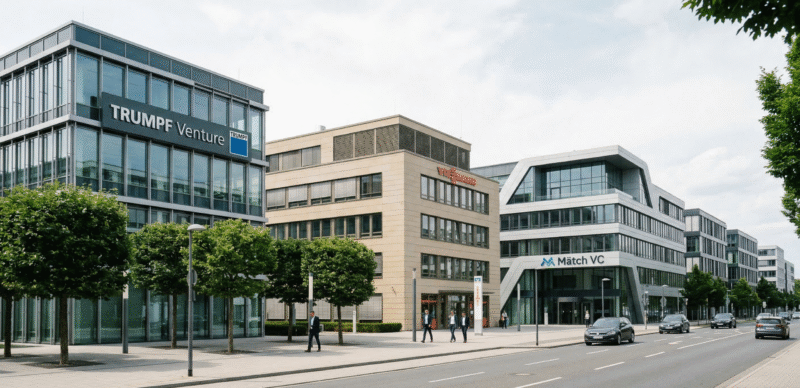
TRUMPF Venture operates as the archetypal strategic corporate investor. They typically deploy initial tickets between € 500,000 and €4M, targeting minority equity stakes of 5 to 25 per cent. Their 2026 investment thesis is hyper-focused on optical computation, AI factory assistance and quantum technologies.
A prime example of this industrial software synergy is their aggressive backing of deep physics software that simulates complex processes in semiconductor lasers. TRUMPF actively funds B2B startups that help make their physical hardware exponentially more efficient. When a founder secures a term sheet from TRUMPF, they gain immediate access to a massive global supply chain and a board member who measures success in decades rather than financial quarters.
Viessmann and The Climate SaaS Pivot
The most aggressive example of a hidden champion leveraging its balance sheet for deep tech venture capital is the Viessmann Generations Group. After selling its core climate solutions business to Carrier Global for roughly €12B, the family-owned titan did not retreat into passive wealth management. Instead, they weaponised that liquidity to build a massive investment empire.
Viessmann is heavily deploying capital into European climate tech software, focusing strictly on early- and growth-stage startups that decarbonise the built environment. They act as a massive super angel and limited partner across the ecosystem.
Their strategy highlights the ultimate venture clienting model. Viessmann possesses the historical manufacturing data, regulatory knowledge, and massive distribution channels required to turn a seed-stage climate SaaS prototype into a pan-European standard within 24 months. For foreign institutional investors partnering with a vehicle like Viessmann, the brutal hardware and regulatory phases of climate tech investment are entirely derisked.
Mätch VC and The Black Forest Automation Engine
This corporate venture activity is not limited to massive €10B conglomerates. It extends deep into the regional Mittelstand. Mätch, VC-backed by VEGA Grieshaber KG, a classic hidden champion in measurement technology based in the Black Forest, proves that regional industrial leaders are directly funding the next wave of factory SaaS.
Mätch VC specifically targets pre-seed and seed stage startups solving highly technical B2B challenges. Their portfolio perfectly illustrates the convergence of software and factory operations.
Assemblio is an AI-driven SaaS platform that revolutionises assembly planning, drastically reducing the time and cost required to engineer manual manufacturing workflows. Alloqis is a Stuttgart-based startup that provides algorithmic intelligence for internal resource allocation, enabling legacy manufacturers to balance competing business targets dynamically.
By funding agile software companies, regional hardware manufacturers ensure that the B2B software governing their factory floors is built locally, maintaining strict European data sovereignty and operational control.
A 2 Stage Relay Race
The traditional 10-year venture capital fund model is fundamentally broken for deep industrial innovation. You cannot build a sovereign optical semiconductor network or a deeply integrated supply chain AI on a timeline dictated by a general partners need to fundraise for their next vehicle.
The German hidden champions understand this mathematical reality. They engineered a highly effective 2-stage relay race. Early-stage funds handle the high-risk blueprint phase. Once the technology is proven and requires €50M to commercialise, the venture arms step in. They understand capital expenditures, they understand physical assets,s and they possess the massive balance sheets required to scale them. For global, for-profit investors looking to capture the next wave of B2B unicorns, partnering with the German industrial family is the only viable strategy.