


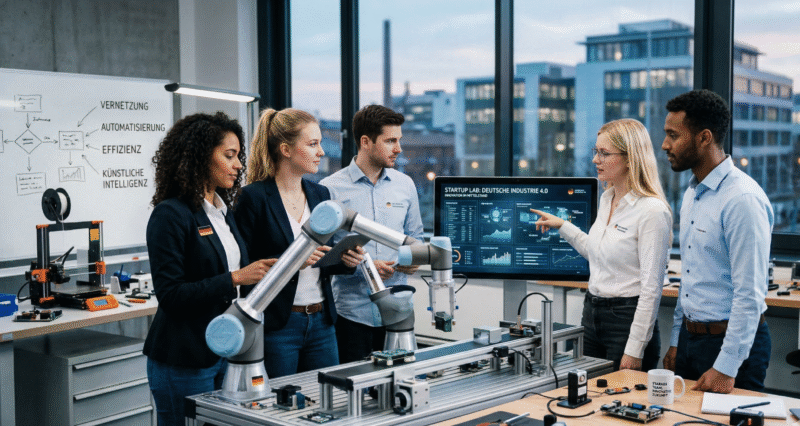
While Berlin aggressively codes and Munich engineers sovereign aerospace hardware, the actual physical economy of Germany operates deep in the provincial heartlands. The next phase of Industry 4.0 is not happening in a trendy coworking space in a capital city. It is gestating in the industrial belts of Baden-Württemberg and North Rhine-Westphalia.
The German Mittelstand is undergoing a brutal, mandatory digitisation. Legacy factory floors require advanced cognitive robotics, zero-latency Industrial Internet of Things (IIoT) sensors, and hyper-transparent supply chain software to survive the current macroeconomic volatility. For institutional investors hunting for the next deep tech unicorn, the most lucrative B2B hardware and software plays of 2026 are found heavily outside the major technology hubs.
The Swabian Robotics Belt
Stuttgart and its surrounding municipalities have historically served as the undisputed engine room of the global automotive industry. Today, that legacy engineering talent is aggressively pivoting into cognitive robotics and artificial intelligence.
Unlike traditional industrial robots that are bolted to the floor and highly dangerous to humans, the startups in this region are building collaborative, AI-powered machines with advanced perception capabilities.
- Sereact: Based in Stuttgart, this startup completely bypasses rigid programming by equipping warehouse robots with LLM-level perception. They recently secured a $31M Series A round led by Creandum. Their software allows robotic arms to dynamically adapt to highly complex pick-and-pack scenarios, drastically reducing fulfilment bottlenecks.
- Fruitcore Robotics: Based in Konstanz, they secured a $44.2M Series B to scale their “digital robot” platforms. They are aggressively dropping the barrier to entry for smaller manufacturers to automate their assembly lines without requiring a team of highly specialised, expensive software engineers.
- Neura Robotics: Located in Metzingen, Neura is rapidly scaling cognitive robots capable of working directly alongside human operators, learning through demonstration rather than complex code.
When venture funds deploy capital in the Swabian belt, they are tapping into a regional DNA that inherently understands factory-floor physics.
Aachen and the IIoT Hardware Layer
For a smart factory to operate efficiently, thousands of IIoT sensors must transmit large data payloads in real time. Traditional copper wiring and legacy electrical chips simply cannot handle the latency requirements of modern AI-driven manufacturing.
The solution to this hardware bottleneck is emerging from Aachen. Black Semiconductor is fundamentally pioneering the future of chip connectivity using graphene. By utilising light rather than electrical signals for optical communication between chips, they promise to radically accelerate data transmission speeds across data centres and industrial IoT networks.
The financial markets have strongly validated this deep-tech approach. Black Semiconductor recently secured a staggering €254.4M in funding, backed heavily by the German government and the state of North Rhine-Westphalia. They are actively utilising this capital to build a pilot manufacturing facility in Aachen by 2026. This is the exact type of physical infrastructure required to ensure European digital sovereignty at the most foundational level of hardware.
Supply Chain AI and The Digital Twin
The physical movement of robotic arms and optical data is useless if a manufacturer does not know where their raw materials are sourced. Severe geopolitical friction has forced German manufacturers to abandon “just-in-time” supply chains in favour of hyper-resilient, AI-mapped logistics networks.
Stuttgart-based Makersite operates directly at this critical intersection. The company provides a cloud-based digital twin platform that utilises artificial intelligence to map highly complex manufacturing supply chains. Instead of simply tracking shipping containers, Makersite allows engineers to analyse product sustainability, compliance risk, and raw material costs simultaneously across millions of data points.
They successfully raised $78.3M in a Series B to scale this enterprise software globally. By providing deep data visibility, Makersite acts as the digital nervous system for the modern German factory, allowing legacy manufacturers to adapt to global supply chain shocks instantly.
The Sovereign Subsidy Kicker
Building optical chips and cognitive robotics requires substantial upfront CapEx, which traditionally terrifies early-stage venture capitalists. However, the German state is aggressively intervening to derisk these deep tech investments.
The recent German Growth Booster Act successfully increased the national R&D tax allowance cap to €12M annually. For a startup burning heavy cash on hardware prototyping, this translates to a 20% flat-rate cash refund on innovation expenses.
When you combine this sovereign financial backing with the massive influx of patient capital, the financial runway for these provincial startups extends drastically.
Engineering the Factory Floor
The Industry 4.0 revolution is a brutal, capital-intensive marathon. Startups operating in Stuttgart, Aachen, and beyond are successfully proving that the true value of artificial intelligence lies not in generating text but in orchestrating the physical world. By marrying elite software engineering with generational manufacturing expertise, these regional hidden champions are building the undeniable future of global factory automation.