



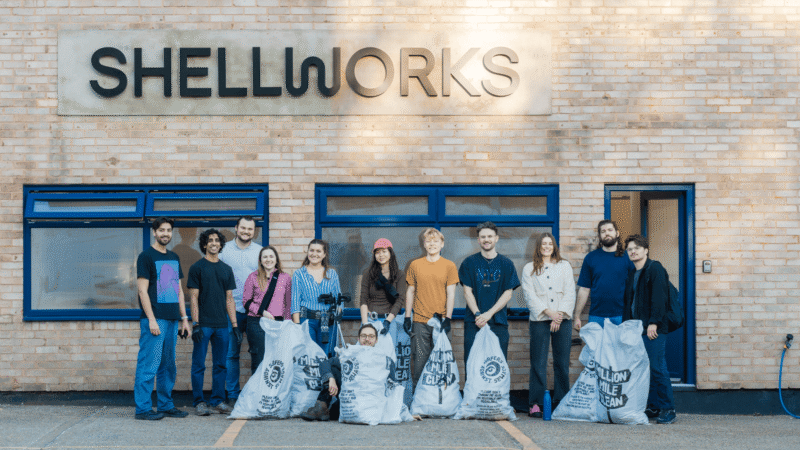
As governments, brands and consumers push for alternatives to conventional plastics, the search for scalable and affordable sustainable materials has intensified. Packaging remains one of the largest contributors to global plastic waste, and many companies are looking for materials that can perform like traditional plastics while reducing environmental impact. London based biomaterials company Shellworks is aiming to address this challenge through a new generation of bio based materials designed to replace petroleum derived plastics. The company has now secured $15 million in Series A funding to expand production and bring its material technology to new markets.
New funding to accelerate sustainable material adoption
The Series A round was led by Paris based impact investment fund alter equity. Additional investment came from Nat Friedman through NFDG and JamJar, the venture firm created by the founders of Innocent Drinks. Existing investors including Founder Collective, LocalGlobe and Third Sphere also participated in the round.
The funding will support Shellworks as it continues scaling production of its biomaterial technology and expanding its commercial presence internationally. The company plans to accelerate adoption among consumer brands seeking packaging alternatives that combine sustainability with practical functionality.
Developing an alternative to conventional plastics
Founded in 2019, Shellworks focuses on developing biomaterials that can serve as direct replacements for traditional plastics in packaging applications. Its flagship material, Vivomer, is designed to deliver similar performance characteristics to conventional plastics during use while offering a more environmentally responsible end of life profile.
Vivomer is created using a fermentation process in which microbes convert second generation feedstocks such as used cooking oil into a polymer material. The resulting material can be processed and shaped using techniques commonly applied to plastics, enabling manufacturers to integrate it into existing packaging workflows.
Unlike many traditional plastics derived from fossil fuels, the material is designed to biodegrade naturally after disposal, helping to reduce the long term environmental impact of packaging waste.
Reaching cost competitiveness at an early scale
One of the most significant challenges for sustainable materials has historically been cost. Alternatives to plastic often struggle to compete economically with large scale petrochemical production, which can limit adoption by brands operating in price sensitive markets.
Shellworks reports that it has now reached an important milestone by demonstrating that Vivomer can match the cost of conventional packaging materials such as glass and aluminium even while operating at a relatively modest production scale of around five million units.
Achieving this level of cost competitiveness at an early stage could help remove one of the main barriers that has slowed the adoption of sustainable materials in the past. As production volumes increase, the company expects further improvements in cost efficiency.
Expanding production and global reach
With the new funding secured, Shellworks plans to expand its operations across both the United States and the European Union. The company intends to focus initially on the rapidly growing wellness and consumer health sectors, where brands are increasingly prioritising sustainable packaging solutions.
As part of its expansion strategy, Shellworks aims to establish regional production capabilities that can reduce transportation related emissions and strengthen supply chain resilience. The company is also planning to build a broader global production network that supports scalable manufacturing technologies such as blow moulding.
Future facilities are expected to be developed across the United Kingdom, Europe and the United States as demand for sustainable packaging continues to grow.
Supporting the transition to sustainable packaging
Shellworks’ technology is designed to help companies transition away from petroleum based packaging without sacrificing product performance or economic viability. By combining bio based feedstocks, microbial fermentation and scalable manufacturing methods, the company aims to deliver materials that meet the practical needs of large consumer brands.
As regulatory pressure and consumer expectations around sustainability continue to rise, materials capable of replacing traditional plastics while maintaining cost competitiveness may become increasingly important for packaging innovation. With its latest funding round, Shellworks is positioning itself to play a role in that shift by expanding production and bringing its biomaterials technology to global markets.