

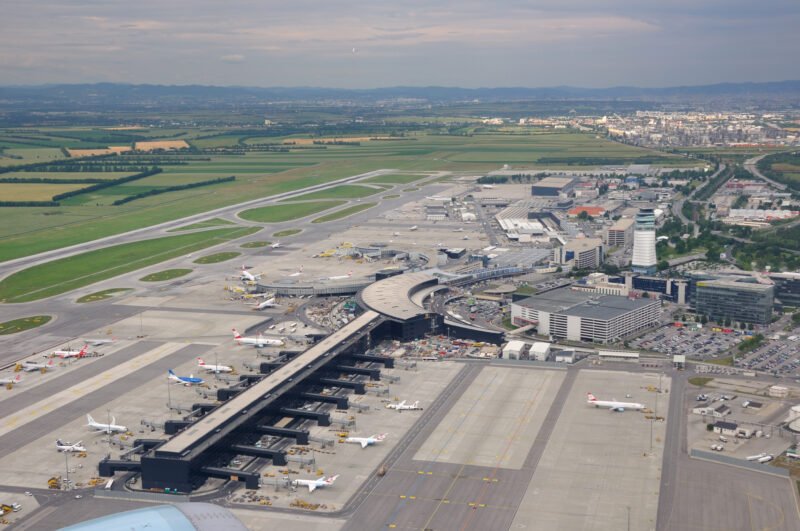
Vienna International Airport is set to speed up its digital transformation significantly with the deployment of an extensive digital twin platform aimed at maximizing operational efficiency, facilitating long-term infrastructure planning, and enhancing creative collaboration across the entire airport ecosystem. The airport, the initiative places, is one of the most technologically advanced aviation hubs in Europe, which comprises the adoption of technologies that are generally considered as the core of the future of big transport facilities.
By introducing dTwin, a digital-twin product of the Nemetschek technology group and its software division dRofus, the airport intends to build comprehensive virtual models of facilities, equipment, networks, and also the airport’s operational procedures. Since it relies on openBIM standards, the platform will combine data derived from different sources in such a way that airport teams, engineers, contractors, tenants, and service providers will all be able to get the up-to-the-minute, joint data during any stage of the infrastructure development process – the initial planning, construction, and further facility management.
Digital twins give users the opportunity to anticipate how assets operate, find that faults will happen before the time, analyze the maintenance needs, and, at the same time, create models for future expansion or a change in the operation. An airport, being one, for example, that can have interlinked systems like terminals and utilities, security technology, and passenger flows, can benefit hugely from these cost-saving and efficiency-enhancement measures that the approach is designed to bring.
“Digitisation Is Unavoidable”
One time the CEO of Vienna Airport AG, Dr. Günther Ofner, outlined that the use of digital-twin technology by the airport confirmed its strategic determination of modernising infrastructure management and at the same time, making the growth trend more eco-friendly.
“Digitization is absolutely necessary for any large construction project nowadays,” Ofner remarked. “Vienna Airport is very active in digitally mapping its infrastructure. In the future, all airport buildings and open areas will be digitally documented. Therefore, Vienna Airport will be the proud owner of a digital twin, which will allow us to not only handle construction and operations more efficiently but also more environmentally friendly,”
Besides, the airport system will act as a principal coordination instrument across the various departments, thus, the practice of the double works and existence of data silos will be substantially curtailed. By way of network linking the data on assets, space use, life-cycle costs, technical data and 3D models into one digital setting, managers will have the ability to forecast the influence of their activities on the operation before they physically undertake the changes at the site.
The Declaration goes parallel with Vienna Airport’s preparations of the next major
Projects Programms
Programms As Vienna Airport is getting ready to undertake a substantial revamp program, the declaration came. Large-scale expansion of Terminal 3 is planned to be finished in 2027, thereby the three floors will be extended by about 70,000 square meters. New areas such as a central security screening zone redesigned, boarding gates along with lounges upgraded, and retail and hospitality zone extended will make the expansion more attractive.
By using the digital twin model, the airport will be able to keep track of the building’s progress, of compliance with regulations and of what the maintenance strategy will be for the future through the different phases of the expansion project in the most efficient way. It will also allow the stakeholders to get a better understanding of the project and predict how it might affect passenger flow before the actual work starts.
Experts from the industry say that the ability to digitally simulate the consequences of infrastructure choices on things like queue management, energy efficiency upgrades, or commercial space layouts could result in the improvement of customer experience and operational resilience at a time when factors such as inflation, workforce shortages, and increasing travel demand are putting the airports under global pressure.
Increase Austria’s Competitiveness in Aviation
Vienna Airport, the largest air-travel hub in Austria and a vital link in Central and Eastern Europe, handles more than 31 million passengers per year. The airport is bouncing back from the pandemic situation and is progressively spending on capacity and sustainability initiatives such as better energy systems and mobility infrastructure.
It is anticipated that digital-twin technology will be at the core of these initiatives by providing the means for improved environmental performance through predictive maintenance, energy consumption modelling, and long-term asset planning. The project, in addition, aligns with the global aviation trends as major hubs, like Singapore Changi, Heathrow, and Amsterdam Schiphol, are also on the same track of virtual-infrastructure strategies.
For Vienna, it is the project that signifies the investment in the foundation before the rapid modernization of terminals, logistics operations, and customer-experience systems.
“As airports transform into complete digital ecosystems,” the airport’s statement went on, “smart infrastructure and the availability of real-time data are the main factors that help maintain the competitive edge.”
The initial stage of the digital-twin project will probably take place during the upcoming several months, and the full implementation will be in line with the ongoing construction and the future master-planning.