




In a global tech ecosystem defined by aggressive innovation, heightened competition, and increasingly cautious capital deployment, the due diligence process has become the ultimate determinant of investment success. What once functioned merely as a procedural safeguard has now matured into a deeply analytical and strategically layered exercise one that allows investors to separate sustainable, high-quality ventures from those driven by momentum alone. As venture capital firms, angel networks, and corporate innovation arms refine their investment philosophies, due diligence has shifted from a passive review into a rigorous, investigative discipline that shapes the future of technology portfolios.
The beginning of this process is almost always anchored in establishing alignment between the startup’s vision and the investor’s broader mandate. Investors first seek to understand whether the opportunity fits within their sector focus, risk appetite, and long-term strategic themes. For a tech investor, this means evaluating the relevance of the underlying technology, the clarity of the product-market fit, and the credibility of early traction. If the startup’s narrative resonates with the investor’s thesis—both in ambition and execution deeper analysis becomes not only justified but necessary.
Market analysis follows naturally as investors assess the environment in which the startup operates. This involves a broad yet detailed exploration of industry trends, market size, competitive intensity, regulatory conditions, and future growth prospects. For tech companies, markets can shift rapidly; therefore, investors seek clear evidence that the startup is positioned within a scalable, sustainable, and strategically advantageous segment. They pay close attention to the durability of demand, the potential for international expansion, and the presence of external forces such as emerging technologies or policy developments that could influence future growth trajectories.
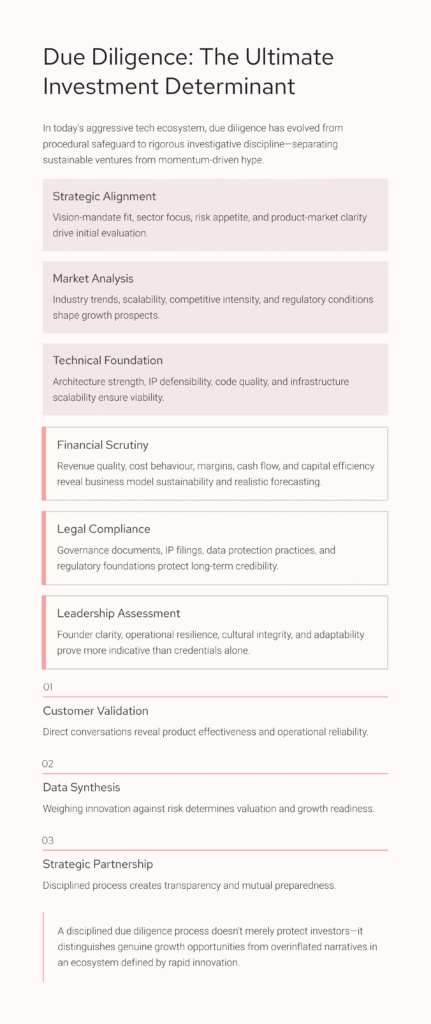
A central component of the entire process lies in assessing the product and underlying technology. Investors examine the technical foundation of the company’s offering, evaluating the strength and uniqueness of its architecture, the robustness of its engineering standards, and the defensibility of any intellectual property. This scrutiny ensures that the product is not only functional but capable of evolving under competitive pressure. Technology due diligence frequently involves discussions with product leads and engineering teams, as well as an examination of documentation, code quality, infrastructure scalability, security practices, and long-term technical viability.
Financial analysis then provides a critical reality check. As startups often operate within an environment of uncertainty and rapid experimentation, their financial statements must be carefully examined to determine whether the underlying business model is viable and scalable. Investors study revenue quality, cost behaviour, margins, cash flow patterns, and capital efficiency. They evaluate whether customer growth is organic or artificially inflated, and whether the company’s cost structure can withstand the pressures of scale. Startups that demonstrate disciplined financial management, realistic forecasting, and transparent reporting tend to inspire greater confidence particularly in an era where investors increasingly prioritise sustainability over speculative expansion.
Legal and compliance reviews serve as a protective measure, ensuring that the company operates on solid regulatory and contractual foundations. During this phase, investors assess corporate governance documents, ownership structures, intellectual property filings, employment agreements, data protection practices, and any existing or potential legal liabilities. For tech startups, especially those handling customer data or operating in regulated sectors compliance is not merely a formal requirement but a determinant of long-term credibility.
At the heart of every startup lies its leadership, and investors devote considerable effort to evaluating the founders and senior team. Beyond technical expertise or impressive credentials, investors look for clarity of thinking, operational resilience, and the capacity to attract and retain talent. Leadership cohesion, cultural integrity, and adaptability are often more indicative of future performance than any product roadmap. Investors observe how founders communicate, how they rationalise decisions, and how they respond to difficult questions recognising that leadership under pressure reveals more than leadership on a pitch deck.
Direct conversations with customers, partners, and industry stakeholders provide a final layer of real-world insight. These interactions reveal the true effectiveness of the product, the sentiment within the user community, and the reliability of the company’s operational commitments. Customer feedback often sheds light on issues that internal data may overlook, such as onboarding challenges, support quality, or comparative satisfaction relative to competitors.
When each layer of information has been gathered, analysed, and synthesised, investors reach a crucial moment of judgement. They weigh the promise of innovation against potential risks, evaluate valuation against long-term returns, and determine whether the startup is truly equipped for the next stage of growth. The outcome of this synthesis shapes the structure of the deal, the nature of strategic involvement, and the quality of the partnership that follows. A disciplined due diligence process does not merely protect the investor it creates transparency, alignment, and mutual preparedness between both parties.
In a tech ecosystem defined by rapid innovation and intense competition, due diligence stands as the decisive tool that distinguishes genuine growth opportunities from overinflated narratives. For investors seeking to build resilient portfolios, a disciplined and holistic approach to evaluating startups is no longer optional, it is essential.