


The Exploration Company, a European space company building reusable vehicles for orbital transportation, has raised $450 million in Series C funding to accelerate spacecraft development, expand manufacturing and strengthen its international operations. The round is the largest Series C announced by a European space company and brings the company’s total funding secured to approximately $680 million.
Major Backing
The financing was co led by Bessemer Venture Partners, Atomico and the Scaleup Europe Fund, managed by EQT. Existing investors including Balderton, Plural, Cherry and Red River West also participated.
As part of the investment, Bessemer partner Alex Ferrara will join The Exploration Company’s board of directors. The funding also expands the company’s investor base across Europe and the United States as it moves toward larger scale spacecraft production and operations.
Founded in 2021 by Hélène Huby and a team of aerospace veterans, The Exploration Company is developing a full stack space transportation platform designed to make access to orbit more reusable, affordable and accessible. The company operates across several European countries, with additional operations in the United States and the United Arab Emirates.
Nyx Takes Centre Stage
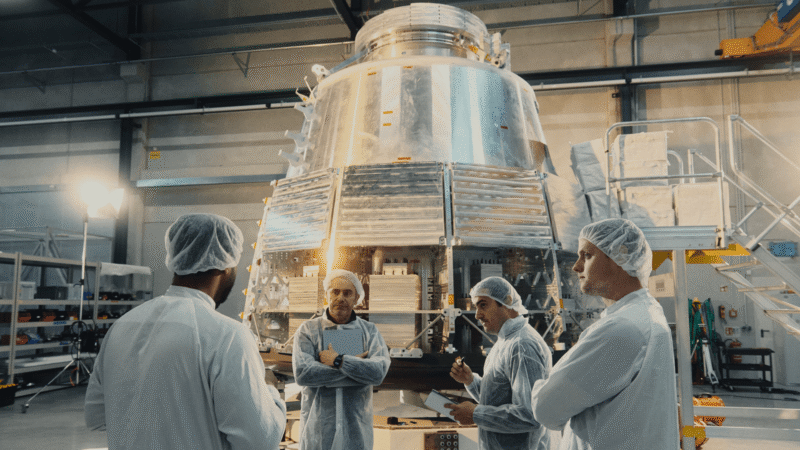
The immediate priority for the company is Nyx, its reusable orbital capsule designed to transport cargo to space stations and safely return it to Earth.
Nyx is designed to be compatible with heavy launchers from around the world and can dock with space stations before bringing cargo back. The company says the spacecraft is designed for reuse across as many as 10 missions and can return up to 3,000 kilograms of cargo to Earth.
The Series C funding will help move Nyx toward its first full scale orbital demonstration, which is planned to include docking with the International Space Station before returning safely to Earth. Recent development has included recovery system testing and splashdown validation as the company works toward its first demonstration flight.
Building Storm
Alongside Nyx, a major portion of the funding will support Storm, The Exploration Company’s high thrust reusable rocket engine programme.
Storm uses a full flow staged combustion architecture and liquid oxygen with biomethane as propellants. The company says the engine is designed to deliver up to 180 tonnes of sea level thrust and eventually provide the propulsion foundation for a reusable European heavy lift launcher.
Development is following a hardware driven approach, with testing covering components such as turbomachinery, combustion chambers and preburners before progressing toward integrated engine testing. The programme is also intended to strengthen European capabilities in advanced manufacturing and reusable propulsion.
Growing Commercial Pipeline
The company says it has secured more than $2 billion in contracts and commitments from public and private customers globally. Its relationships include the European Space Agency and commercial space station operators, while it has also established a Space Act Agreement with NASA for work connected to future missions.
The new funding comes as demand grows for transportation services supporting space stations, scientific missions, communications infrastructure and other activities in low Earth orbit.
Scaling Across Europe
The capital will also support hiring and industrial expansion across engineering, manufacturing, mission operations, propulsion and programme delivery. The company currently employs more than 550 people across Europe, the United States and the United Arab Emirates.
With Nyx focused on reusable orbital logistics and Storm targeting future heavy launch systems, The Exploration Company is positioning itself to build a broader European space transportation infrastructure. Its strategy is centred on developing reusable systems that can repeatedly move cargo, and eventually people, between Earth and orbit.
The latest funding gives the company the resources to move that vision from development and testing toward operational space transportation, while strengthening Europe’s ambitions to build independent and reusable access to orbit.