


Japan’s manufacturing sector has spent decades perfecting industrial robotics, but the next generation of machines may need to be far more flexible than traditional factory automation. Tokyo based robotics startup O-ID is building humanoid robots around that idea, with a focus on machines that can be repaired, upgraded and customised module by module instead of requiring an entire robot to be replaced when one component fails.
Fresh Funding
O-ID has raised $1.2 million in pre seed funding in a round led by Chicago based TAWANI Ventures, with participation from Hustle Fund, Techstars and angel investors, including the founders of Humanoid Guide.
Founded in Tokyo in 2025 by Norwegian CEO Stian Jakobsen and Dutch CTO Simon Gormuzov, O-ID is developing modular humanoid robots for manufacturing and logistics. The company’s founders met at Waseda University and combined backgrounds in cyber defence, mechanical engineering and industrial robotics.
The company says its robots are designed and built in Japan, taking advantage of the country’s deep manufacturing ecosystem and long history of robotics engineering. Its official platform describes the machines as swappable, serviceable and customisable, with a modular architecture designed for deployment in real industrial environments.
Designed for Existing Factories
O-ID’s approach is based on a simple industrial challenge. Many factories are already designed around human workers, with workstations, tools and equipment positioned for human reach and movement.
Traditional industrial robots can automate specific processes extremely well, but introducing them can require factories to redesign production lines or modify equipment. O-ID believes humanoid machines can offer another option by operating in environments that already exist.
The company is initially targeting repetitive and precision sensitive manufacturing tasks, including assembly and movement of components between stages of production. Its platform also identifies logistics applications such as warehouse picking, sorting and packing, alongside industrial inspection in hazardous or confined environments.
Modularity at the Core
The central feature of O-ID’s design is modularity. Its official specifications currently describe a 172 centimetre robot weighing about 70 kilograms, with a payload of up to 16 kilograms, 30 degrees of freedom and more than nine replaceable modules.
The architecture covers major components including the head, torso, shoulders, elbows, forearms, hands and base.
Instead of sending an entire machine back to a specialist facility when a component wears out, O-ID wants factory teams to replace individual modules on site. The same principle could allow customers to upgrade a hand, computing unit or other component without purchasing an entirely new robot.
Predictive Maintenance
O-ID is also designing its robots around long term serviceability. Sensors and software can monitor how components behave during operation, helping identify signs of wear before they result in unexpected downtime.
This approach is particularly important for industrial customers, where equipment failure can interrupt production and create significant costs.
By combining modular hardware with monitoring and predictive maintenance, O-ID aims to make humanoid robots easier to operate across large deployments.
Building in Japan
The company’s decision to build in Japan is closely connected to its industrial strategy. O-ID says Japan has a dense industrial supply chain and decades of robotics engineering expertise, creating an ecosystem capable of producing the precision components required for humanoid machines.
The company is working toward a predominantly Japanese supply chain while also collaborating with international technology developers. It has signed a letter of intent with Sumitomo Electric Industries to explore the application of its technologies to humanoid robot wire harnesses.
From Prototype to Factory
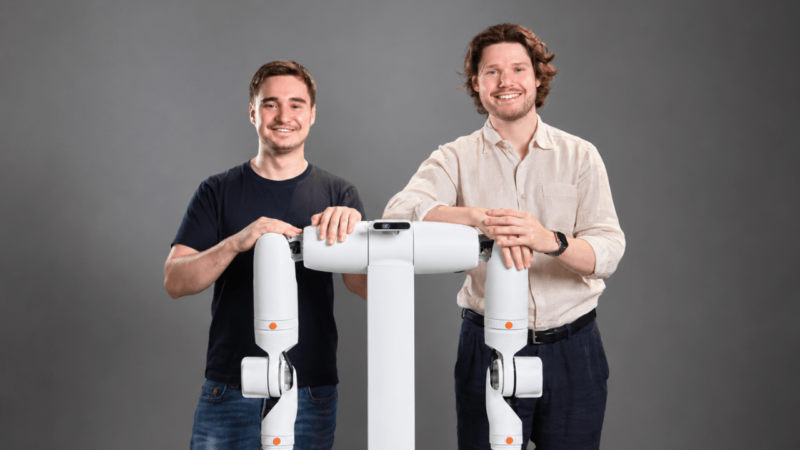
O-ID is moving from prototype development toward industrial deployment. Its first prototype is a stationary dual arm system being used to test integration and manipulation capabilities, while the next generation is expected to add mobility and greater strength.
The company is targeting its first factory pilots for early 2027 and plans to unveil its next version at CES 2027.
With the new funding, O-ID plans to move closer to production and begin placing its robots into Japanese industrial environments.
Its broader ambition is to build humanoids that can work alongside people without forcing factories to rebuild themselves around automation, while making the machines easier to repair, upgrade and deploy at scale.