



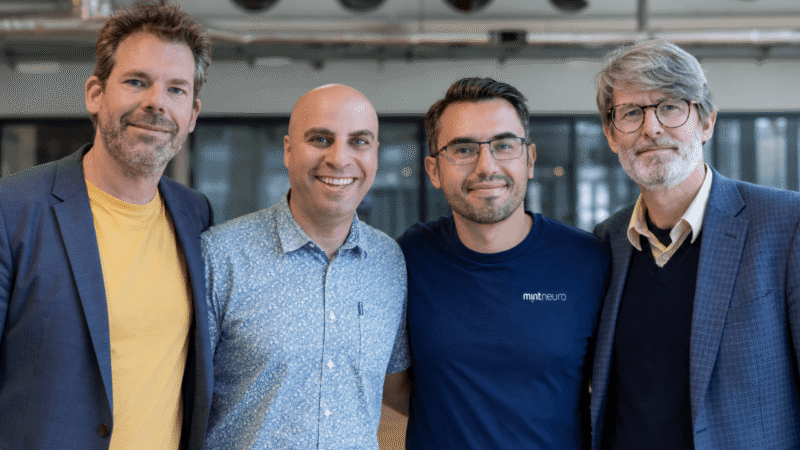
The next generation of brain and nerve devices may depend as much on semiconductor innovation as on breakthroughs in neuroscience. UK startup MintNeuro is building specialised chips designed specifically for devices that interact with the nervous system, from brain computer interfaces to implantable therapies. The Imperial College London spinout has now raised $5 million to move its technology from validation into broader commercial deployment.
The funding round was led by Odyssey Ventures, with participation from 33East, JSK Investments and Alumni Ventures. Existing investors including Empirical Ventures and Jumpspace Ventures also returned to support the company. MintNeuro says the investment will help expand its engineering and commercial teams, accelerate product launches and support customers adopting its semiconductor technology.
Building Chips for Neural Devices
Neurotechnology companies have traditionally faced a difficult hardware choice. They can adapt general purpose semiconductor components that were not designed for neural applications, or invest significant time and money developing custom chips.
MintNeuro is attempting to create a middle ground with a modular semiconductor platform built specifically for neural interfaces.
The company develops chips capable of sensing electrical activity from the nervous system, processing those signals and delivering electrical stimulation. These functions are central to technologies including brain computer interfaces, neuromodulation systems, sensory prostheses and bioelectronic medicines.
By combining sensing, processing and stimulation at the chip level, MintNeuro aims to help developers create devices that are smaller, consume less power and can support more sophisticated interactions with the nervous system.
Enabling Closed Loop Neurotechnology
One of the most important opportunities for specialised neural chips is the development of closed loop devices.
Rather than simply delivering a predetermined electrical signal, a closed loop system can detect activity from the nervous system, process that information and respond with targeted stimulation.
This could allow future devices to continuously adapt their operation according to signals coming from a patient’s brain or nerves.
The potential applications extend across several areas of medicine. Neural technologies are being explored for conditions including Parkinson’s disease, epilepsy and depression, while related bioelectronic systems could have applications in hearing restoration and inflammatory diseases.
MintNeuro’s technology is designed to provide the underlying electronics required for these systems without forcing every neurotechnology company to develop its own semiconductor architecture from scratch.
From Silicon to Commercial Partnerships
MintNeuro has already moved beyond early research and development, delivering working silicon and reaching integration milestones with technology partners.
One of its most significant commercial relationships is with Motif Neurotech, which is developing minimally invasive neurostimulation technology. MintNeuro announced a multi year commercial chip supply agreement with Motif to support development of its neurostimulator, initially targeting treatment resistant depression.
The partnership gives MintNeuro an opportunity to demonstrate how its semiconductor platform can operate inside real world neural devices, while giving neurotechnology developers access to specialised chip capabilities.
Other neural device companies are also evaluating or integrating MintNeuro’s technology, alongside academic and research groups developing implantable systems.
Backed for Global Expansion
The new funding marks a shift in MintNeuro’s development from technology validation toward commercial scale up.
The company plans to increase the size of its engineering and commercial teams, support customer programmes and bring additional products to market. It also intends to strengthen its presence in the United States, while continuing to operate from its UK and European base.
For MintNeuro, the broader opportunity is to become an infrastructure provider for a rapidly developing neurotechnology industry.
As more companies move brain computer interfaces, neuromodulation and bioelectronic medicine from laboratories toward clinical and commercial applications, the underlying hardware will need to become smaller, more power efficient and easier to integrate.
MintNeuro is betting that specialised semiconductor technology can become a critical layer in that transition, providing the electronic foundation that allows developers to build the next generation of devices connecting humans and machines.