


Swedish energy technology company Rebaba has raised $4.6 million in an oversubscribed seed funding round to expand its battery energy storage business built around repurposed electric vehicle batteries.
The round was led by Sistafund alongside EIT Urban Mobility, with participation from existing shareholders and new European investors. The investment will support production expansion, hiring and international growth as Rebaba seeks to establish a larger European network for second life battery storage.
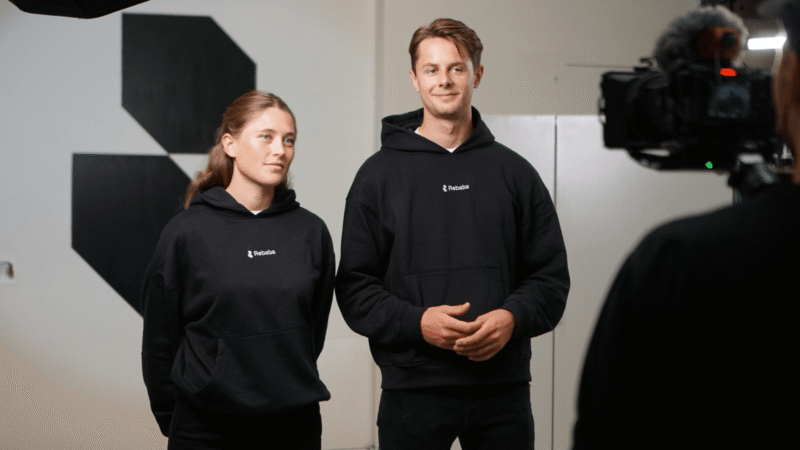
Founded by Paula Runsten and Felix Kruse, Rebaba is developing energy storage systems that give used EV batteries a second useful life after they are no longer suitable for demanding automotive applications.
Giving EV Batteries a Second Life
Electric vehicle batteries are commonly retired from vehicles before their electrochemical capabilities are completely exhausted. While a battery may no longer provide the performance, range or power characteristics required by an electric car, it can still have significant capacity for stationary applications where weight, size and rapid acceleration are far less important.
Rebaba says EV batteries can retain approximately 70 to 80 percent of their useful life when they are removed from vehicles. Instead of sending these batteries directly toward recycling, the company integrates them into stationary energy storage systems.
The approach creates a circular model in which batteries can continue providing value after their first life in transportation.
Supporting the Energy Transition
The need for energy storage is increasing as electricity consumption grows, transportation and industry become more electrified and renewable energy accounts for a larger share of power generation.
Rebaba’s systems are designed to help customers make better use of electricity generated locally, particularly from renewable sources. Energy can be stored when electricity is available and used later when demand or prices are higher.
The systems can also help businesses reduce peak electricity demand and provide services that support grid balancing.
By combining existing EV batteries with its own energy storage technology, Rebaba aims to offer customers a way to access these capabilities while reducing the need for batteries manufactured specifically for stationary storage.
Two Storage Solutions
Rebaba currently offers two main energy storage products.
Companion is a compact cabinet based system with 40 kWh of storage capacity, designed primarily for residential customers and smaller commercial applications. It provides a relatively compact solution for customers looking to store locally generated energy or manage electricity consumption.
The company’s Containerised system is aimed at larger commercial and industrial installations, where substantially greater storage capacity is required.
Both products are built around Rebaba’s ability to integrate different types of used EV batteries into stationary systems.
Simplifying Production
A central part of Rebaba’s strategy is keeping its technology flexible enough to work with batteries from different electric vehicles and manufacturers.
The company combines its own battery management and system technology with standard components for other parts of the storage infrastructure. This approach is intended to make production easier to replicate while reducing dependence on specialised components.
Rebaba believes this model could eventually allow technicians in different markets to assemble its systems using locally available equipment.
Expanding CircularHub
The new funding will be used to expand Rebaba’s CircularHub production facility in Stockholm. The company plans to increase annual production capacity to 40 MWh while adding employees across several areas of the business.
Rebaba also plans to establish additional CircularHubs outside Sweden as it expands into European markets. These facilities are expected to support a more distributed production model, allowing the company to process batteries and build storage systems closer to customers.
The expansion reflects Rebaba’s broader ambition to develop a scalable circular energy infrastructure rather than simply sell individual battery systems.
Scaling Second Life Energy Storage
With the latest investment, Rebaba is positioning repurposed EV batteries as an important resource for Europe’s growing energy storage market. Its strategy connects two major transitions, the electrification of transportation and the expansion of renewable power.
As millions of electric vehicles enter the global fleet, the number of batteries reaching the end of their automotive lives is expected to increase. Rebaba is betting that many of those batteries can continue contributing to the energy system for years before eventually reaching the recycling stage.