


What if the next generation of construction materials did not need to be invented from scratch, but could instead be engineered from one of the oldest materials used by humans? Strong by Form is pursuing that idea by turning wood into lightweight structural components designed to compete with concrete and other carbon intensive materials. The Madrid headquartered deeptech company has raised €5.8 million in Series A funding to move its technology toward industrial scale and expand its presence in the construction market.
Engineering Wood Differently
Founded in Chile in 2018, Strong by Form develops Woodflow, a biomimetic technology inspired by the way trees distribute material and orient fibres according to structural loads. The company combines computational design, digital fabrication and proprietary manufacturing processes to create timber components with optimised fibre architecture.
The company is headquartered in Madrid and also operates from Santiago and Stuttgart. Its approach is aimed at making wood suitable for applications where conventional timber has struggled to compete with concrete, steel and aluminium on strength, weight, cost and design flexibility.
Woodflow Core Targets Construction
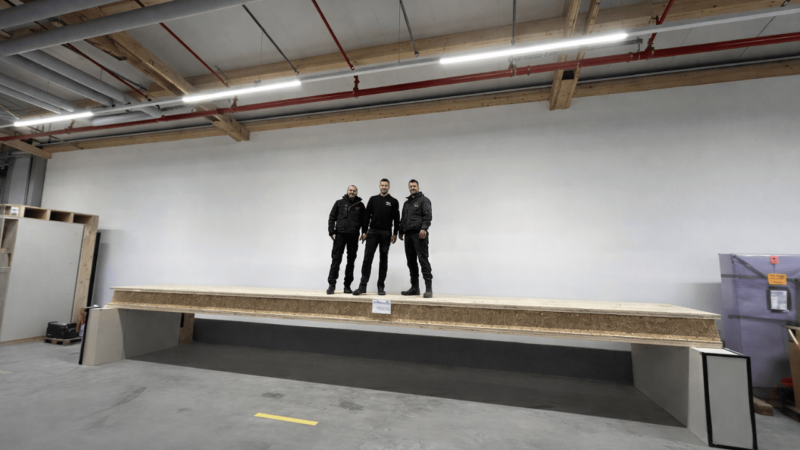
The company’s flagship construction product, Woodflow core, is a prefabricated structural slab designed for long spans and high rise buildings. Strong by Form says the system can deliver load bearing capacity comparable to reinforced concrete while being significantly lighter. Its current specifications indicate structural spans of more than 10 metres and substantial reductions in installation time and material use.
The technology works by transforming wood into engineered strands and arranging the fibres according to the forces expected within a structure. This allows the company to use lower grade wood and reduce the amount of material needed compared with conventional mass timber.
Strong by Form says Woodflow core can use more than 85% of a log, compared with around 30% to 40% for conventional cross laminated timber. It also aims to compete with reinforced concrete on cost at scale, rather than relying on customers paying a premium for sustainable construction.
Inspired by Trees
The technology is based on biomimicry, with the company looking to nature for clues about how to build strong structures efficiently. Trees concentrate material where loads are higher and orient their fibres according to mechanical stresses.
Strong by Form applies a similar principle through software and manufacturing technology, creating structures where material is placed according to performance requirements rather than using uniform blocks of timber.
The company believes this approach can also broaden the types of wood that can be used for structural products. Because Woodflow is designed to work with different species and lower grade material, it could help reduce dependence on a narrow range of commercially valuable timber species and make greater use of underutilised forest resources.
Beyond Construction
Strong by Form is developing several applications under the Woodflow platform. Woodflow skin is an architectural cladding product that uses digitally designed shapes and engineered fibre structures to create lightweight interior surfaces. The company says the panels contain 88% natural wood and can be removed and reused through a mechanical fastening system.
The technology is also being explored for mobility applications. Strong by Form says its work with companies including BMW, Talgo and Nederlandse Spoorwegen demonstrates how engineered wood can be used in vehicle components and mass transit applications.
Funding Industrial Expansion
The €5.8 million Series A round is led by boisei investments, the investment arm of US based boisei labs, with participation from existing investor CMPC Ventures, alongside VX Ventures, Ternel, Savia Ventures, Teampact Ventures, Axel Carbon, FINSA and family offices. Boisei describes Strong by Form as a deeptech company combining advanced engineering with opportunities to reduce carbon emissions and improve material efficiency.
The new capital will support manufacturing capacity in Europe and help take Woodflow core through certification and market entry. The company plans to work with construction partners in Spain, France, Germany and Switzerland as it moves toward wider commercial deployment.
Scaling Through Partners
Rather than becoming a large scale manufacturer itself, Strong by Form plans to license its technology and work with established manufacturers. Its model is designed to integrate Woodflow into existing industrial and construction supply chains.
The company believes this partnership driven approach can accelerate adoption by allowing established timber manufacturers to produce the components while Strong by Form focuses on technology, design and new applications.
With its latest funding, Strong by Form is now moving from technology development toward industrialisation, aiming to demonstrate that engineered wood can compete with conventional construction materials not only on sustainability, but also on performance, efficiency and economics.