

London based deeptech startup Anemo Labs has secured £700,000 in pre seed funding to advance its technology for detecting disease related compounds through smell. The round was led by Zinc and SFC Capital, with additional support from Innovate UK.
Founded in 2025 by Koye Sodipo, Anemo Labs is developing an electronic nose, known as an e nose, that combines specialised sensors, electronics and artificial intelligence to identify volatile organic compounds, or VOCs. These molecules are responsible for the smells produced by substances and biological systems.
The company believes analysing these chemical signatures could create a new route to non invasive disease screening.
Turning Smell Into Data
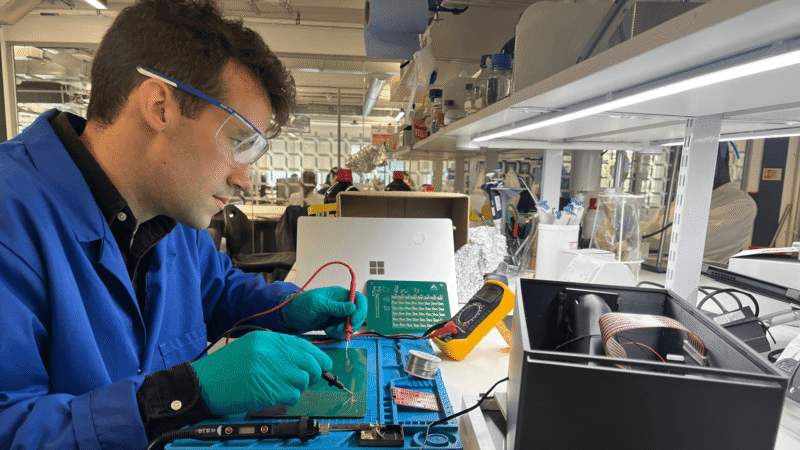
Anemo’s technology is designed to replicate some of the functions of the human sense of smell while adding the ability to process and classify chemical patterns using machine learning.
Its sensors detect VOCs and convert their chemical characteristics into data that can be analysed by AI models. Rather than simply identifying whether something has a particular smell, the system is being developed to recognise complex patterns that may be associated with different health conditions.
The company is initially focusing on healthcare, where changes in the compounds released by the human body can potentially provide biological signals linked to disease.
Starting With Urine
Anemo is currently developing its platform to analyse VOCs found in urine. The goal is to create a non invasive screening approach that could eventually help identify signs of disease without requiring conventional invasive procedures.
The company is exploring applications in conditions including urinary tract infections and certain cancers, where changes in the body’s chemical emissions may provide useful diagnostic information.
Anemo’s longer term vision is to develop olfactory diagnostic technologies that can support earlier detection and monitoring of disease. The company believes smell could offer a passive and potentially repeatable way of gathering biological information.
Building a Large Smell Dataset
One of the most important components of Anemo’s technology is the data required to train its AI models.
The startup has developed an in house sampling platform capable of collecting and labelling up to 5,000 smells a day. This infrastructure is designed to generate large datasets that can be used to train machine learning models to distinguish between different chemical patterns.
In early testing using the Sniffin’ Sticks olfactory testing protocol, Anemo says its models achieved an 84.15 percent classification accuracy across 12 scent categories.
The company is now working to expand its data collection capabilities while improving the underlying sensor chemistry and machine learning systems.
Combining Sensors and AI
Anemo’s technology brings together sensor chemistry, electronics and machine learning. Its scientific team includes researchers with PhDs in sensor chemistry and electronics, while clinical advisers are helping guide the company’s early diagnostic validation programme.
This combination is important because biological smells can contain complex mixtures of VOCs. The company is therefore developing both the physical sensing technology and the software needed to interpret the resulting chemical signals.
Rather than relying on a single marker, its approach is focused on identifying patterns across multiple compounds.
Funding the Next Stage
The £700,000 investment will allow Anemo Labs to continue developing its sensor chemistry, expand its smell collection and labelling infrastructure and advance validation work with clinical partners.
The company is also seeking to build the evidence required to establish whether its technology can reliably identify disease related chemical signatures in real world healthcare settings.
If successful, the approach could open the door to new forms of screening that are less invasive and potentially easier to repeat than traditional diagnostic methods.
For Anemo Labs, the immediate challenge is moving from promising technology and early model results to clinically validated applications. With fresh funding and a growing dataset, the startup is now working toward demonstrating whether artificial intelligence and advanced sensing can turn smell into a practical new source of medical information.