


Europe’s race to turn microgravity into a commercial resource is gaining momentum as Space Cargo Unlimited moves to connect early stage research with future manufacturing in orbit. The company has announced a strategic investment in Novespace, a leading European provider of parabolic flight services and a subsidiary of France’s national space agency CNES. The investment makes Space Cargo a shareholder alongside CNES and adds another important microgravity access point to its growing space manufacturing ecosystem.
Building a Microgravity Ecosystem
Space Cargo Unlimited is developing autonomous platforms and mission services designed to help companies use microgravity for research, product development and manufacturing. Its strategy is built around creating a flexible infrastructure that can support customers across different stages of development, from experiments and technology validation to production and the return of materials to Earth.
The company’s flagship BentoBox platform sits at the centre of this approach. BentoBox is a modular and autonomous space factory designed to provide customers with a standardized environment for in space experimentation and manufacturing. It can operate across multiple vehicles and mission profiles, allowing customers to select the infrastructure that best fits their requirements.
From Parabolic Flights to Orbit
The addition of Novespace expands that model beyond orbital missions. Parabolic flights provide researchers with short periods of microgravity without requiring an orbital mission, making them useful for testing equipment, validating experiments and preparing technologies for longer missions.
Novespace operates an Airbus A310 Zero G, which the company describes as the largest zero gravity aircraft in the world by experimental volume. Its scientific flight programme has supported research across areas including medicine, cell biology, fluid physics, combustion, atomic physics and biology.
For Space Cargo, the capability creates a natural link between early experimentation and more advanced orbital manufacturing. Researchers can test concepts in short duration microgravity before progressing to longer orbital missions, potentially reducing development risks and helping companies determine whether their products are suitable for space based production.
Preparing for Commercial Space
The investment comes as Europe prepares for a changing space environment, with the International Space Station approaching the end of its operational era and commercial platforms expected to play a larger role in research and manufacturing.
Space Cargo Unlimited has been developing a fleet based model intended to provide repeatable and station independent access to microgravity. Its current roadmap includes BentoBox missions on partner vehicles, while the company is also developing REV1, a reusable orbital vehicle designed to support larger scale cargo and manufacturing operations. (space-cu.com)
The company says its broader objective is to address the limited access and capacity that have historically restricted the commercial use of microgravity. Its €27.5 million Series A announced in 2025 was aimed at advancing Europe’s in space manufacturing infrastructure and reducing dependence on traditional space station based access. (space-cu.com)
Expanding Customer Access
The Novespace investment could therefore give Space Cargo customers more options throughout the product development cycle. Parabolic flights can be used for initial testing, while orbital platforms can support longer experiments, manufacturing and eventual return of products to Earth.
Novespace has more than three decades of experience conducting parabolic flight campaigns, giving the partnership an established scientific and operational foundation.
Closer Strategic Collaboration
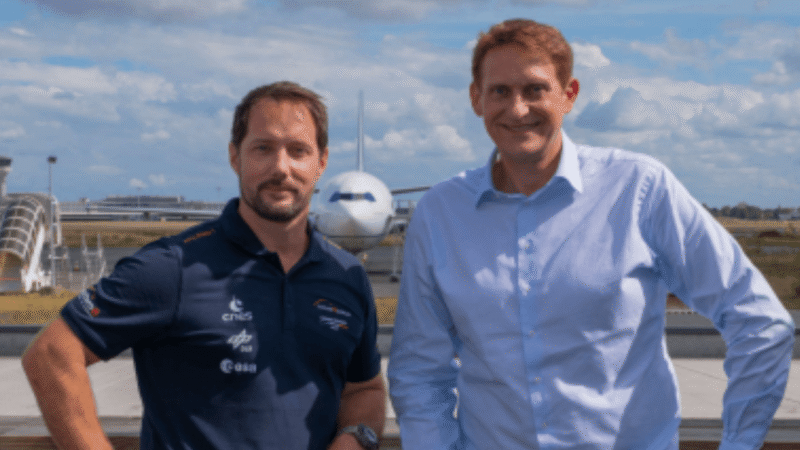
Nicolas Gaume, co founder and CEO of Space Cargo Unlimited, said Europe already has strong scientific and engineering capabilities, but needs the right infrastructure to convert research into products. He said the investment in Novespace strengthens the path from early microgravity research to future commercial manufacturing in orbit.
Thomas Pesquet, CEO of Novespace, welcomed Space Cargo as a shareholder and highlighted the potential to reach new markets and customers.
As part of the transaction, Gaume will join the Novespace Board. The move is expected to deepen cooperation between the two organisations as they work toward a more integrated commercial microgravity offering, linking parabolic flight, orbital manufacturing and future return to Earth capabilities.