

As artificial intelligence moves from labs into fields, factories, and food production lines, one obstacle continues to slow adoption: data. High quality, well annotated visual data is expensive, time consuming to collect, and often impossible to capture at scale in real world conditions. German startup simmetry.ai believes simulation can solve that problem, and has secured €330,000 in funding to accelerate its approach.
The investment comes from NBank, the investment and development bank of the German state of Lower Saxony, through its High Tech Incubator accelerator programme. The funding will support product development as simmetry.ai builds a scalable platform for synthetic data generation across agriculture, food production, and industrial environments.
From AI research to commercial application
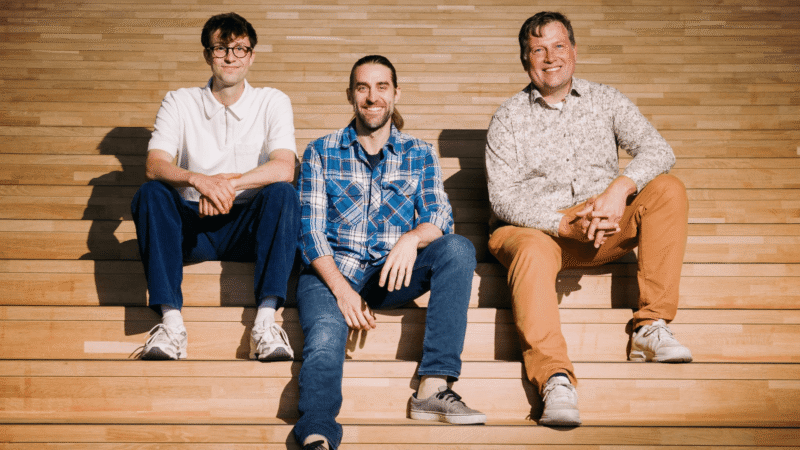
Founded in 2024, simmetry.ai is a spin off from the German Research Centre for Artificial Intelligence. The founding team combines academic research and engineering expertise, with Kai von Szadkowski as CEO, Anton Elmiger as CTO, and Professor Dr Stefan Stiene contributing deep research experience in computer vision and simulation technologies.
The company was created to translate years of academic work into a commercial platform that addresses a practical and growing challenge in AI development: the lack of diverse, high quality training data for computer vision systems.
Building photorealistic synthetic worlds
At the core of simmetry.ai is a simulation platform capable of generating photorealistic, fully annotated synthetic data across multiple sensor modalities. Instead of relying solely on real world image collection, developers can create controlled virtual environments that reflect the complexity and variability of real operating conditions.
The platform supports a wide range of computer vision tasks, including semantic segmentation, object detection, three dimensional pose estimation, and regression. These capabilities are designed for engineers building systems where visual perception is critical, such as robotics, autonomous machinery, industrial inspection, and smart monitoring systems.
By generating images under different lighting conditions, weather scenarios, object configurations, and edge cases, simmetry.ai aims to help AI models generalise better when deployed in real environments.
Focusing on data constrained industries
According to the company, data preparation remains one of the most resource intensive stages of AI development. In sectors like agriculture and food production, collecting and annotating real images can be particularly challenging due to seasonal changes, environmental variability, and operational constraints.
simmetry.ai’s technology is already being applied to use cases such as precision weed control, visual quality inspection in food production, and AI driven monitoring in industrial facilities. In these contexts, synthetic data can supplement real datasets and expose models to rare or difficult to capture scenarios.
Anton Elmiger explained that agriculture was chosen as an initial focus because of its technical difficulty and potential impact. Reliable crop monitoring and management systems depend on robust computer vision models, yet the availability of diverse training data often limits performance in real world conditions.
Reducing time, cost, and complexity
With the new funding, simmetry.ai plans to further develop its platform into a scalable solution that allows AI developers to generate tailored training datasets for specific applications. The goal is to significantly reduce the time and cost required to build and deploy reliable computer vision models in environments where data is scarce or expensive to obtain.
Rather than replacing real world data entirely, the company positions synthetic data as a powerful complement. By combining simulated and real images, developers can improve model robustness, reduce bias, and accelerate experimentation without waiting for costly data collection cycles.
As AI adoption continues to expand beyond controlled digital settings, simmetry.ai is betting that simulation driven data generation will become essential infrastructure for the next generation of computer vision systems.