


London-based Mozart AI is positioning itself at the centre of a fast-evolving creative economy after closing a $6 million oversubscribed seed funding round to accelerate the development of its AI-native music production platform. The round was led by Balderton Capital and drew participation from Mercuri, EWOR, Kevin Hartz, Charles Ferguson, and Emery Wells, alongside existing investors and a group of strategic angel backers from the music, AI, and creator technology ecosystems.
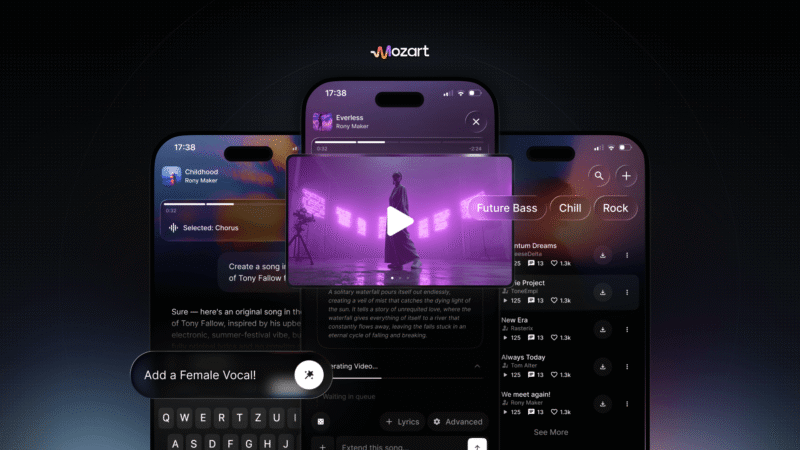
The new investment follows a pre-seed round raised earlier this year and brings Mozart AI’s total funding to more than $7 million. Alongside the financing, the company has also launched its mobile application, expanding access to its platform beyond desktop users and signalling a push toward broader adoption among creators.
Rethinking the digital audio workstation
Mozart AI is building what it describes as an AI-native digital audio workstation designed to blend traditional music production workflows with AI-assisted and prompt-driven creation. Rather than replacing existing creative processes, the platform aims to reduce technical friction and enable faster iteration, allowing users to engage at different levels of complexity depending on their experience and goals.
The software supports both ground-up composition and agent-based music creation. Users can start from a blank canvas or work with AI-generated ideas that evolve through collaboration between human input and automated tools. This flexibility is designed to appeal to a wide spectrum of creators, from casual hobbyists to professional producers working under tight deadlines.
AI tools for faster, flexible creation
At the core of Mozart AI’s platform is a suite of production tools that automate and accelerate many of the most time-consuming aspects of music making. These include stem generation, MIDI progressions, drum patterns, synth and effect creation, and sound remixing. The platform also automates tasks such as quantisation and time stretching, helping users move from idea to finished track more quickly.
Beyond audio production, Mozart AI enables creators to generate accompanying music videos and share finished content directly to social media platforms. By integrating creation, production, and distribution workflows into a single environment, the company aims to reduce reliance on fragmented toolchains that often slow down the creative process.
Ownership and commercial rights at the centre
A key element of Mozart AI’s positioning is its focus on creator ownership. Throughout the creative process, users retain full control over their work and ownership of their copyrights, using AI as a supportive tool rather than a replacement for artistic decision-making.
The platform is built on commercially cleared third-party generative models. According to the company, these model providers are trained on licensed material, allowing music created on Mozart AI to be used for commercial purposes without ambiguity around rights. This focus on legal clarity is intended to make the platform viable not only for experimentation, but also for professional and monetised use cases.
Strong early traction from creators
Since launching its beta version in September, Mozart AI reports rapid early adoption. More than 100,000 users registered within the first two months, and over one million songs have already been created on the platform. The company sees this early traction as validation of demand for tools that lower barriers to music production while preserving creative control.
Sundar Arvind, CEO and co-founder of Mozart AI, said the company is focused on enabling a new era of collaborative music creation. He noted that the goal is to help every artist turn an idea, whether a melody or a riff, into a release-ready song and professional music video in minutes, without requiring deep technical knowledge or juggling multiple tools.
Scaling toward a full public launch
With the new funding, Mozart AI plans to grow its team, further develop its core technology, and prepare for a full public release of the platform. As AI continues to reshape creative industries, the company is betting that creators will increasingly seek tools that combine speed, flexibility, and ownership, positioning Mozart AI as a next-generation workspace for music creation.