



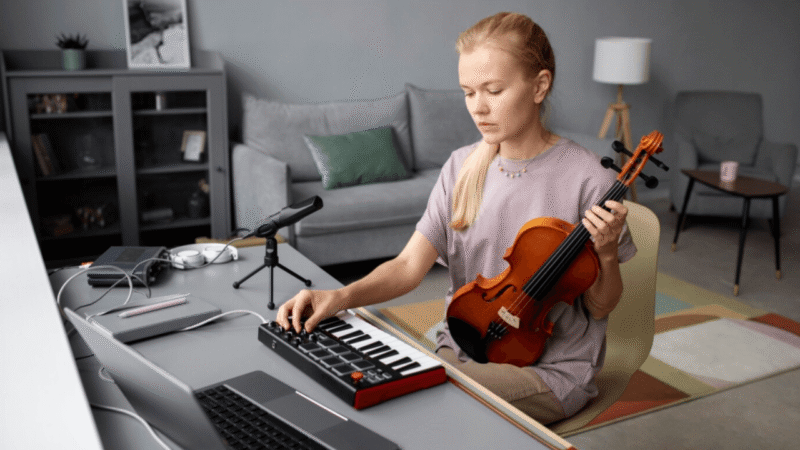
Music education has barely changed in decades. Weekly lessons, inconsistent practice at home, and progress judged largely on instinct remain the norm. Yet children today grow up in a world shaped by feedback loops, games, and data. London-based MuseCool believes the gap between how music is taught and how children learn has become too large to ignore, and that artificial intelligence can finally modernise one of education’s most tradition-bound disciplines.
From Conservatory Training to Startup Vision
Founded in 2017, MuseCool is a music education company offering personalised lessons both in person and online. It connects students of all ages with professional, conservatory-trained tutors across instruments including piano, guitar, violin, and drums. Alongside lessons, the company supports exam preparation, performances, and workshops, positioning itself as a modern private music school focused on flexibility, quality, and accessibility.
At the centre of MuseCool’s vision is CEO and founder Petru Cotarcea, whose personal journey shaped the company’s mission. Growing up in Romania, Cotarcea had access to low-cost music education, a legacy of the country’s communist past. That access changed his life, allowing him to train seriously as a musician and later earn a scholarship to Chetham’s School of Music in Manchester, followed by studies at the Royal Academy of Music.
By his late teens, Cotarcea was already performing professionally, including in the West End production of Sweeney Todd. Those experiences gave him early exposure to elite music education, but also a growing awareness of how dependent success was on access and consistency rather than raw talent alone.
A Failed Venture and a Clearer Direction
Before founding MuseCool, Cotarcea tried his hand at entrepreneurship in a very different field. At 19, he invested his savings in a peppermint farm in Romania, planning to build an essential oil business alongside his studies. The crop turned out to be unusable under EU regulations, forcing him to destroy the entire harvest.
The failure was formative. It convinced him to build something in a field he deeply understood: music education. Today, MuseCool operates one of the largest private music schools in London and has expanded to New York, serving primarily children aged five to fourteen.
The Core Problem: Practice Without Feedback
According to Cotarcea, the biggest weakness in music education is not teaching quality, but practice. Children often fail to practise consistently, and teachers have little visibility into what happens between lessons. Without improvement, motivation drops and parents eventually stop paying.
Music teaching remains highly traditional, with methods passed down through generations. While that lineage carries value, it has limited the adoption of modern tools. Unlike maths or language learning, music education has had almost no data to show what actually works at scale.
Why Audio Intelligence Is So Hard
MuseCool’s solution lies in applying AI to audio, one of the most complex forms of data. Unlike text, music is continuous, layered, and full of imperfections. Humans instantly recognise timing or pitch issues, but machines struggle to interpret flawed performances.
MuseCool’s system listens to entire lessons, analysing what was taught and how it was played. From that data, it automatically generates personalised practice exercises and insights for both teachers and parents.
Turning Practice into a Game
The company’s flagship product, The Muse, is an AI-powered practice assistant that transforms lesson content into short, game-like practice sessions at home. Instead of repetitive drills, children receive guided exercises aligned directly with their last lesson. Parents get simple progress updates, while tutors gain continuity between sessions.
Early testing revealed that beginner lessons often involve more conversation than playing. By capturing lesson-level data at scale, MuseCool believes it can reshape not just practice habits, but music education research itself.
Scaling a Data-Driven Music School
Looking ahead, MuseCool plans to expand beyond its own schools. The company is building a global platform where tutors can use the technology for free while parents subscribe. Over time, performance data could power a smarter marketplace, matching students and teachers based on real outcomes rather than profiles alone.
With a public launch planned for March and an international rollout to follow, MuseCool is betting that data, AI, and gamification can finally bring music education into the digital age without losing its human core.