


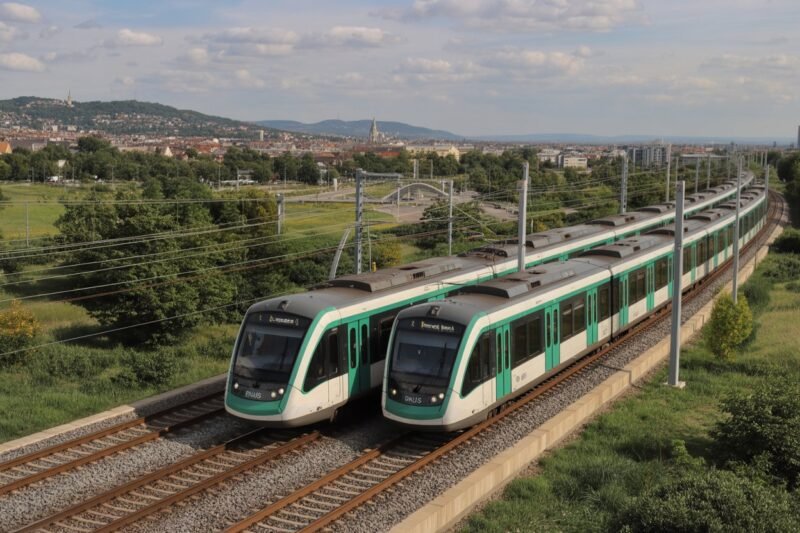
With a conditional tender, the Hungarian national railway company MÁV Passenger has stepped up its long-term plan to renew Budapest’s capital public transport system by purchasing 54 new electric multiple unit trains (E.M.U.s) to replace an aging fleet and enhance the quality and performance of public transport in the capital region. This is the most significant rolling stock investment that has been made in recent years and essentially integrates Hungary’s comprehensive rail modernization plan.
Tender scope and project value
The new framework agreement carries a price tag of around 326.5 billion HUF (around 983 million USD). The chosen manufacturer will be expected to complete the entire order of 54 units within a period of 96 months from the signing of the contract. These trains will be able to work on several suburban HÉV lines that serve Budapest and its outer districts, including lines H6, H7, H8 and H9.
The new electric multiple unit trains will be 110 meters long and will operate on a 1.5 kV DC electrification system. Equipped with low-floor access, the trains will provide boarding access for passengers with limited mobility, stroller users and the elderly – in this way, they will solve historical problems of older rolling stocks. The demands mirror the trend of inclusive transit solutions that comply with current European accessibility and sustainability norms.
Funding secured for initial fleet purchase
While the tender is for 54 trains in total, MÁV Passenger has stated that there will be a staged procurement dependent on the availability of finances. The operator has agreed to put at least 18 H5-line electric multiple unit trains in operation. The initial vehicles will be paid for by the leftover funds from the European Union, with some contributions from the Hungarian government.
The 18-train obligation comes with a stringent limit: the trains should be delivered and ready for use by December 31, 2029, so as to allow the EU funds to be utilized fully within the valid period. The date has implications for both MÁV Passenger and possible suppliers in that they need to be on time for the production and the integration schedule.
Urgent need for fleet modernization
The Budapest HÉV suburban rail system is at the center of the transportation network in the region and brings in tens of thousands of passengers on a daily basis who travel from the capital to the neighboring communities. It is, however, the case that many of these trains have been around for more than 50 years and as a result, the reliability has declined, maintenance has increased and the trains have limited conformance with modern efficiency and safety standards.
By the HÉV line upgrade, the district will be able to enjoy services with newly bought EMUs offering cheap operational and energy costs while emission and noise pollution will be cut. The new trains are supposed to contribute to fare punctuality and frequency, thus creating a public transport modal shift from cars to commuting by rail.
Supplier requirements and additional services
In addition to the production and handing over of the vehicles, the tender contains clauses on the provision of extensive operational and technical support. The winning proposal should include not only driver and maintenance crew training but also a driving simulator for the HÉV network. These features are expected to facilitate a smooth transition to the fleet and to current rail operation technologies.
Past efforts and future outlook
The present tender is the successor of a similar proposal in 2020 that intended to buy 120-meter long EMUs. Due to lack of funding, the 2021 decision to cancel that proposal was made. In contrast to the last proposal, the present plan is supported by secure EU and local funds, thus the chances of the acquisition going ahead are higher.
The HÉV renovation is at the core of Budapest’s public transport upgrading plan. Apart from that, the HÉV modernization project will bring huge progress in the areas of suburban mobility, environmental sustainability and the passenger experience of the residents of and commuters to the whole region, provided that we can expect to see these new rolling stocks before the end of the decade.
Once done, the new EMUs will make the HÉV a more competitive, reliable, and high-performing rail network, thus long-term urban development and regional connectivity will be supported.