



Quantum computers promise to solve complex scientific and industrial problems that conventional computing systems may struggle to handle. Yet turning this potential into commercially useful technology remains difficult because quantum processors are highly sensitive to environmental disturbances, which can introduce errors during calculations. German deeptech startup Quint Computing is working to address this challenge at the hardware level. The company has raised €9.1 million in initial funding, alongside a €2.2 million European grant, to advance its superconducting quantum processor technology and bring practical quantum computing closer to industrial adoption.
Vsquared Leads €9.1 Million Funding Round
Founded in October 2025, Quint Computing has secured €9.1 million in an initial funding round led by Vsquared. Other participating investors include Quantonation, Nucleus Capital, Faber, Vanagon Ventures and ZOHO.VC. The round also attracted support from industry experts, including Professor Mikko Möttönen, founder of quantum computing companies IQM and QMill.
In addition to private investment, the company has received a €2.2 million Pathfinder grant from the European Innovation Council. The combined financial support will help accelerate research, engineering and development of its quantum processor architecture.
A New Approach to Quantum Processor Design
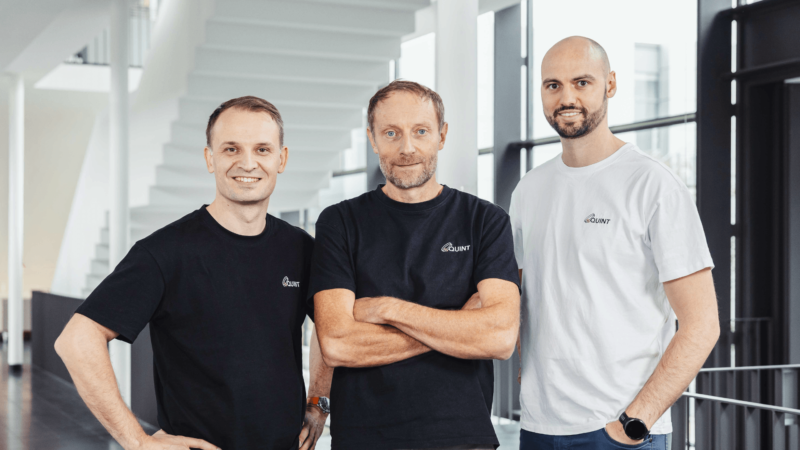
Quint Computing was founded by quantum physicists Professor Michael Hartmann and Professor Christopher Eichler, alongside economist Dr Jona Stinner. The company emerged from research conducted at Friedrich Alexander University Erlangen Nürnberg and is part of the Munich Quantum Valley ecosystem.
Its technology centres on superconducting quantum chips, which use superconducting electrical circuits to create and manipulate quantum bits, commonly known as qubits.
Unlike conventional computer bits, which represent information as either zero or one, qubits can use quantum states to process information in fundamentally different ways. This makes quantum computers potentially valuable for solving certain highly complex problems in science, chemistry, materials research and optimisation.
However, maintaining the stability of these quantum states is a major engineering challenge.
Tackling Quantum Computing’s Error Problem
Quantum processors are extremely sensitive to disturbances, including environmental noise and imperfections in their components. These disturbances can introduce errors that affect the accuracy of calculations.
Traditional quantum error correction methods generally rely on additional physical qubits and complex processing techniques to identify and correct errors. Although essential for building reliable quantum computers, these methods can significantly increase hardware requirements and system complexity.
Quint aims to reduce this burden through its patented processor architecture, which is designed to prevent a substantial proportion of errors directly at the hardware level.
According to the company, its approach could reduce system complexity, hardware requirements and energy consumption by a factor of 100 once fully implemented, while maintaining high computational speed.
The objective is to develop quantum processors that require fewer resources to deliver reliable computing performance, potentially making large scale systems more practical and affordable.
Industrial Applications and Commercialisation
The company’s technology could eventually support applications across several industries, including pharmaceuticals, chemicals, logistics and manufacturing.
In pharmaceutical research, quantum computing could help investigate complex molecular interactions. In chemicals and materials science, it could support the study of molecular structures and properties. Logistics and manufacturing businesses could also benefit from advanced computational approaches to complex optimisation challenges.
However, these applications will depend on further technical development and demonstrations of reliable performance.
Professor Christopher Eichler, co founder and CEO of Quint Computing, said the company has developed a roadmap to accelerate commercially viable quantum technology. He highlighted the potential of its processor architecture to reduce complexity while maintaining high clock speeds.
Expanding Research and Engineering Capabilities
The new funding will support the expansion of Quint’s research and engineering team, further development of its quantum processor technology and preparation for initial industrial deployment projects.
The company plans to recruit specialists in quantum chip design, fabrication, error correction and applications.
With backing from specialist quantum investors, industry experts and European innovation funding, Quint Computing aims to turn its research based architecture into scalable technology. Its longer term ambition is to help make quantum computing more accessible for industrial applications by addressing hardware reliability and complexity at their source.