



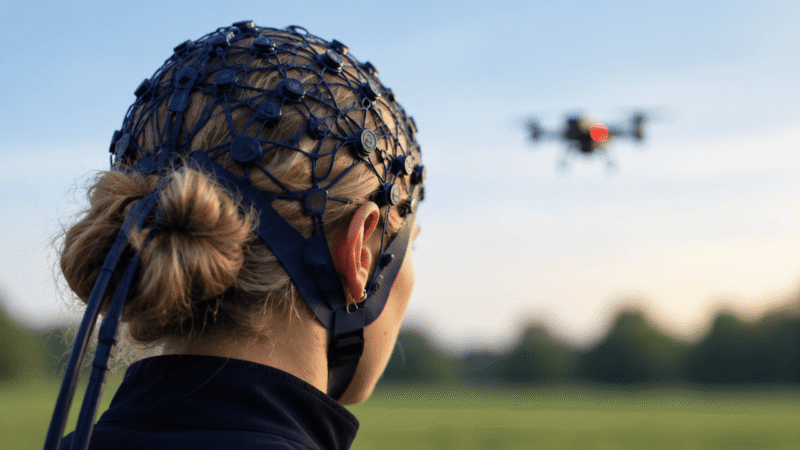
What began with a Norwegian teenager building robotic arms to draw pictures has evolved into an ambitious attempt to connect human intention directly with machines. Cerebionics, founded by Agnessa Pedersen, is developing a non invasive brain computer interface designed to translate brain activity into commands for drones, unmanned vehicles and other digital systems, while testing the technology in demanding real world environments.
From Robotics to BCI
Pedersen’s interest in brain computer interfaces grew from an earlier fascination with robotics and human machine interaction. While studying engineering with a focus on cybernetics and robotics, she became interested in finding ways for people to control machines without relying entirely on physical movements.
Cerebionics emerged from that idea. Instead of using implanted electrodes, the company is developing a wearable system based on electroencephalography, or EEG, which measures electrical activity from the brain through sensors placed on the scalp.
The objective is not to reproduce every movement a person makes. Instead, Cerebionics focuses on recognising higher level intentions and translating them into commands that a connected machine can understand.
A Highway Between Brain and Machine
Cerebionics describes its technology as a connection between the brain and an end system. The platform is designed to be modular, meaning it could potentially work with different machines and software environments.
Potential applications include drones, unmanned ground vehicles, command and control systems, industrial equipment and consumer technologies.
The company is working on a growing library of commands that can represent actions such as changing direction, confirming an instruction, switching systems or executing a command.
Because EEG is non invasive and comparatively established, the challenge is less about creating an entirely new sensing technology and more about interpreting noisy brain signals accurately.
Software Is the Hard Part
One of the central challenges for non invasive BCI is signal quality. EEG signals are weaker and less precise than signals captured directly from implanted electrodes because the skull affects what reaches the sensors.
Cerebionics therefore places significant emphasis on its software and decoding technology. Its models are designed to distinguish deliberate commands from the background activity constantly produced by the brain.
Calibration remains an important part of the current system because an individual’s brain activity can vary between sessions. The company’s longer term objective is to develop models that can generalise across users and reduce the amount of training required.
Beyond the Neuralink Model
Cerebionics is taking a different approach from companies developing implanted brain interfaces. Its non invasive system does not aim to decode extremely detailed motor movements, such as individual finger actions.
Instead, the company is targeting higher level commands where identifying intent can be sufficient. That could make the technology relevant in situations where operators already use several interfaces, including physical controls, voice commands or eye tracking.
The company sees BCI as another control channel rather than necessarily a replacement for existing interfaces.
Testing in Ukraine
A major part of Cerebionics’ development has involved working with users in Ukraine, including members of the country’s military. The company has used these engagements to understand how the technology performs outside controlled laboratory conditions.
The Ukrainian environment presents challenges that are difficult to replicate in a conventional testing facility. Operators can face changing conditions, communications disruptions and demanding workloads.
Cerebionics has explored scenarios involving drone operators and other military applications, while keeping many operational details confidential.
For the startup, direct interaction with users has also helped identify practical requirements around usability, reliability and speed.
Building for Wider Adoption
Cerebionics believes hardware has reached a stage where usable brain signals can be captured, but making the technology scalable remains primarily a software challenge.
For widespread adoption, the system would need to become faster to calibrate, easier to operate and affordable enough to compete with conventional controllers. The company is also considering future versions integrated into products such as smart glasses or goggles rather than requiring a separate wearable.
Beyond Defence
Although defence represents an important testing environment, Cerebionics sees applications across healthcare, industrial operations, robotics, gaming and consumer technology.
The company’s longer term ambition is to create a flexible interface capable of connecting human intention with many different machines. If its software can become sufficiently reliable and transferable between users, the technology could move from experimental BCI demonstrations toward practical human machine interaction.
For Cerebionics, the central proposition is straightforward: the brain could become another way to control technology, providing an additional communication channel between people and the increasingly autonomous machines around them.