

German robotics innovator Sereact has secured $110 million in a Series B funding round, marking a major leap forward in its ambition to redefine how robots operate across industries. The Stuttgart-based company is focusing on developing a universal AI model that can power a wide range of robotic systems, enabling them to perform complex real-world tasks with precision and adaptability.
Strong Investor Confidence
The funding round was led by Headline, a venture capital firm with roots in San Francisco and Berlin. Additional backing came from Bullhound Capital, Felix Capital, and Daphni. Existing investors including Air Street Capital, Creandum, and Point Nine also participated, reflecting continued confidence in the company’s vision and progress.
This latest round follows Sereact’s €25 million Series A funding secured in early 2025, bringing its total funding to more than $140 million. The scale of investment highlights growing interest in AI-driven robotics as industries increasingly seek automation solutions that go beyond rigid, pre-programmed systems.
Building a General-Purpose Robotics Intelligence
Founded in 2021, Sereact has developed AI software that enables robots to understand and interact with their surroundings in a flexible and intelligent manner. Unlike traditional robotics systems that are designed for specific repetitive tasks, Sereact’s technology equips machines with general-purpose visual and manipulation capabilities.
This means robots powered by Sereact can analyse their environment, make decisions, and execute tasks that require adaptability. From warehouse operations to manufacturing processes, the company’s systems are designed to handle a wide variety of physical activities with minimal human intervention.
Its technology is already being used by major companies such as BMW, Daimler Truck, Bol, and Active Ants, demonstrating its applicability across sectors.
Launch of Cortex 2
A significant portion of the new funding will be directed toward advancing Sereact’s latest AI model, Cortex 2, which is being launched alongside the announcement. Cortex 2 represents a major evolution in robotic intelligence by training machines on a wide range of physical behaviours.
Instead of following a fixed set of instructions, robots using Cortex 2 evaluate different possible actions and select the one most likely to succeed. This approach enables them to handle tasks that require precision and adaptability, such as assembly processes under tension, kitting, and placement tasks where even millimetre-level accuracy is critical.
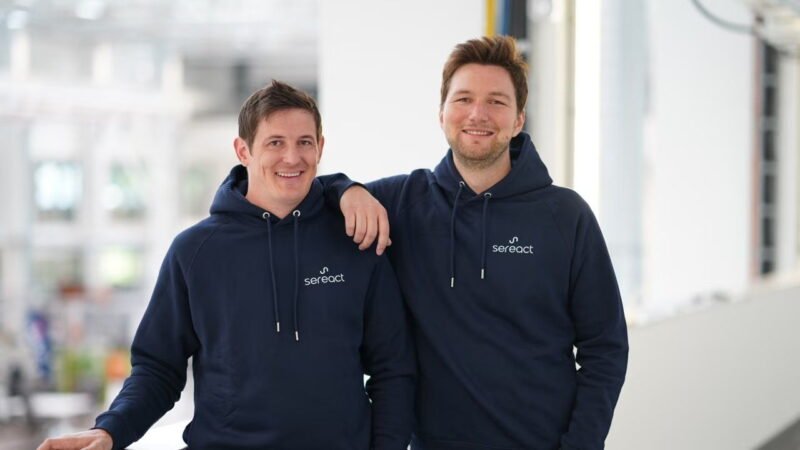
Co-founder and CEO Ralf Guide emphasised that the company’s focus is not on building robots themselves, but on creating the intelligence that powers them. The goal is to deliver a single AI model that can operate across different robotic hardware setups, whether single-arm systems, dual-arm configurations, humanoid robots, or fixed installations.
Expansion into the United States
In addition to product development, Sereact plans to use the funding to expand its presence in the United States. The company is opening a new office in Boston, which will serve as a hub for engineering, commercial operations, and business development.
This expansion reflects the growing demand for advanced robotics solutions in the US market, particularly in industries such as logistics, manufacturing, and e-commerce. By establishing a local presence, Sereact aims to strengthen relationships with existing customers while attracting new clients.
A Data-Driven Advantage
One of Sereact’s key strengths lies in its real-world deployment strategy. As its systems are used in live environments, they continuously generate data that feeds back into the AI models. This creates a powerful feedback loop, enabling the technology to improve over time based on real-world experiences rather than relying solely on simulated training data.
With fresh capital, a new generation of AI models, and an expanding global footprint, Sereact is positioning itself at the forefront of the next wave of robotics innovation. Its vision of a universal robotic intelligence could play a pivotal role in transforming how machines interact with the physical world across industries.
Sereact Secures $110M to Give Every Robot a Smarter, More Adaptive Brain