



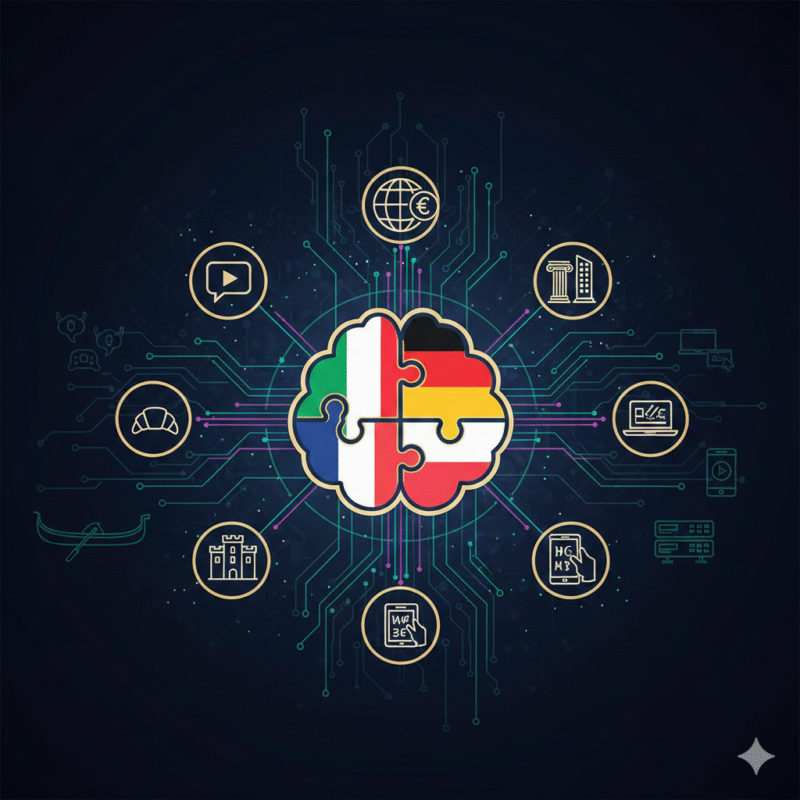
As global competition intensifies, European Union markets have become a critical destination for companies looking to scale their digital and SaaS products. With 24 official languages, finely tuned cultural expectations and some of the world’s most complex regulations, the EU is a region where localization can make or break market success. Businesses that treat localization as a strategic pillar rather than an afterthought often outperform competitors who rely solely on direct translation.
Industry analysts say the stakes are rising. European consumers increasingly expect digital products to reflect not only their language, but the cultural, legal and behavioral norms of their region. Companies entering Europe today must adapt with more precision than ever before.
Understanding Europe’s Cultural Patchwork
The European Union is frequently described as a single market, yet consumer behavior remains deeply regional. A product message that resonates in the Netherlands may require rethinking for Italy, not because of language alone, but because each nation interprets tone, visuals and value propositions differently.
In Germany, users often expect more direct explanations, with transparent pricing and detailed technical information. French consumers tend to value brand storytelling and emotional nuance. Southern European countries such as Spain and Portugal respond well to more conversational language, while Nordic audiences generally prefer concise, minimalist communication.
These cultural factors directly shape user trust. As Maria Lehtinen, a Helsinki-based UX consultant, explains, “People instinctively feel when a product wasn’t written for them. If the language is right but the tone is wrong, they won’t convert. Localization is not decoration, it’s how you earn credibility.”
Regional Precision in Translation
While machine translation has improved, EU-focused companies still rely heavily on native translators who understand regional variation. French in Paris differs subtly from French in Brussels, and German in Austria uses different everyday expressions than German in Germany.
SaaS products that depend on precise terminology such as fintech platforms, workflow tools or compliance software cannot afford linguistic ambiguity. A Belgian customer, for instance, will immediately notice if phrasing sounds “too French,” and may interpret it as foreign or careless.
Formatting details also matter. Date and time conventions, decimal separators, address structures and even button labels vary across Europe. For consumers, these details influence whether the product feels tailored or imported.
Legal Compliance as Part of Localization
Localizing for the EU means adapting not only language but also compliance materials. The General Data Protection Regulation (GDPR) requires clear privacy notices and consent mechanisms in the user’s native language, written in accessible, legally compliant terms. Some countries have additional requirements: Italy’s data-protection authority emphasizes explicit consent, while Germany has stricter expectations for data transparency and auditability.
In SaaS localization, legal clarity is often as important as UX clarity. Companies that enter Europe without region-specific onboarding flows or privacy explanations often experience early churn not due to product flaws, but due to mistrust and legal misunderstanding.
Localizing User Experience, Not Just Words
For digital products, localization extends into UX design. While American interfaces often rely on bold colors, upsell prompts and promotional banners, Northern European audiences typically prefer a calmer, unobtrusive layout. Meanwhile, mobile-first markets like Spain or Poland respond differently to navigational hierarchy than desktop-dominant markets such as Germany.
Payment localization is another key factor in SaaS adoption. In Germany and Austria, invoice-based payments and bank transfers remain popular, while France and Finland lean heavily toward credit and debit cards. In the Netherlands, iDEAL dominates digital transactions. A product that offers only global payment methods risks losing conversions before onboarding even begins.
According to Tomasz Kowalczyk, a Warsaw-based product strategist, “Companies underestimate how much UX choices communicate trust. If your onboarding screen looks unfamiliar or your payment system doesn’t include local options, the user immediately senses friction.”
Case Studies: Localization Done Right
Several tech companies have demonstrated how strategic localization boosts European traction. Slack’s early European growth, for example, accelerated after the platform adapted its interface, support documentation and marketing messages to reflect local work cultures including more formal tone in German and subtle shifts in humor for French audiences.
Meanwhile, Spotify’s expansion across Europe succeeded partly because the company invested heavily in localized playlists, partnerships and regional content strategies long before competitors realized the impact of cultural nuance.
These examples highlight a consistent pattern: localized products do not merely speak a different language, they behave as part of the culture.
Building Scalable Localization Infrastructure
As companies expand across multiple EU markets, manual translation processes become unsustainable. Modern localization teams rely on translation management systems, dedicated style guides, terminology databases and continuous integration workflows. For SaaS platforms with frequent releases, consistency becomes critical. A phrase used in onboarding must match the phrasing in email notifications, tooltips and support articles.
A strong localization workflow is cross-functional. Product teams, UX designers, legal advisors, marketers and native linguists all interact to ensure accuracy. When this collaboration begins early during development rather than after launch the process is significantly smoother.
Long-Term Strategy: Localization as a Competitive Advantage
Across the EU, trust is one of the strongest predictors of user adoption. Products that demonstrate cultural fluency from language to imagery to behavioral cues gain faster acceptance and stronger retention. For many companies, localization has evolved from a cost center into a market differentiator.
European consumers rarely reward shortcuts. The brands that succeed treat localization as an ongoing investment, revisiting their cultural assumptions and updating content as markets evolve. For SaaS companies in particular, localization is a long-term growth strategy. When done well, it leads to higher conversion rates, increased customer loyalty and a brand presence that feels genuinely integrated into Europe’s cultural fabric.