
Hospitality Tech has emerged as the most critical defence mechanism for the modern hotel industry as it faces the dual threats of rising operational costs and environmental regulation. For generations, the global hospitality sector operated on a foundation of massive resource leakage where nearly one quarter of all purchased food ended up in the bin and energy was burned in empty rooms without a second thought. This period of industrial negligence is being dismantled by a new vanguard of algorithmic architects and hardware innovators. By replacing human guesswork with high-precision sensors and predictive models, industry leaders are proving that sustainability is the most direct path to massive profitability. This deep dive explores the technical infrastructure and the philosophical shifts that are turning the hotel from a wasteful building into a high-performance digital asset.
The Economic Reality of the Hidden Resource Leak
The primary motivation for the aggressive integration of Hospitality Tech is the sheer scale of the financial drain currently affecting the market. Authentic data suggests that the global hospitality sector loses over $100 billion annually to food waste alone. This leakage is particularly dangerous because it is often invisible to traditional management systems that rely on monthly spreadsheets rather than real-time visibility. When food waste accounts for nearly eight per cent of global greenhouse gas emissions, the pressure for change moves from a moral choice to a regulatory mandate.
Energy consumption presents a parallel crisis for the sector. Utilities frequently rank as the second-highest operating expense for any hotel, after labour costs, with heating and cooling systems consuming up to 60% of the total energy budget. In a legacy building, these systems operate on rigid, dumb schedules that ignore the presence of a guest or the opening of a balcony door. This atmospheric heating of empty space is essentially burning cash in plain sight. Hospitality Tech provides the digital brain needed to synchronise a physical building with its occupants’ actual needs. By shifting to a responsive model that reacts in milliseconds rather than hours, hotel groups are achieving energy savings of 45% in some cases.
Mastering the Kitchen with Computer Vision Intelligence
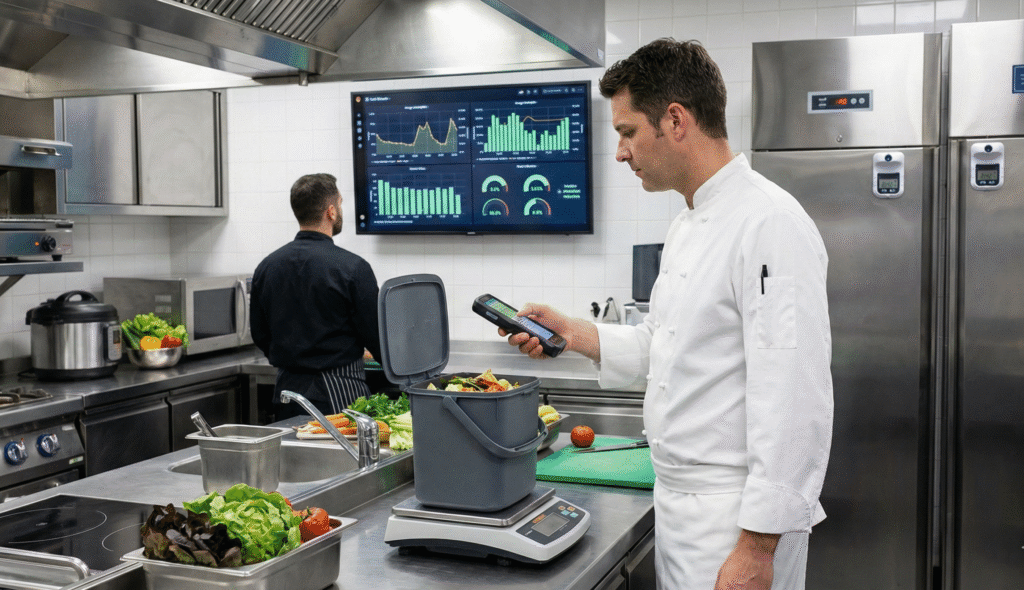
Implementing waste reduction in high-volume kitchens requires a sophisticated orchestration of artificial intelligence and high-speed camera hardware. The goal is to terminate the era of retrospective reporting and replace it with immediate data intervention.
The most powerful tool in this environment is the computer vision monitor, which identifies ingredients as they are discarded. Systems provided by pioneers like Winnow use an AI engine trained on millions of food images to recognise precisely what is hitting the bin. When a staff member throws away a tray of prepared food, the system calculates the weight, financial cost, and carbon footprint in real time. This information is displayed on a screen for the culinary team, creating a psychological feedback loop that discourages overproduction.
Another technical breakthrough comes from Positive Carbon, which utilises LIDAR and optical sensors to provide granular visibility without requiring any manual input from the chefs. This allows the team to focus on culinary excellence while the software builds a map of where the kitchen is failing. This data is then used to optimise procurement cycles and menu design, which often reduces total food costs by up to 8% within the first year. This level of technical precision is just as transformative as the shifts we discussed in the CitizenM digital experience case study, where every guest interaction is optimised for maximum efficiency.
Engineering the Autonomous Building Environment
The Internet of Things has provided the foundation for a total overhaul of building management. The modern hotel room is no longer an isolated box but instead a connected node in a city-wide network of intelligence. Smart thermostats and presence sensors act as the first line of defence against energy waste. Platforms like Tado allow the property to enter deep sleep mode the moment a guest check-out event is registered in the Property Management System.
The AI does more than just turn the lights off. It monitors external factors such as solar gain and weather forecasts to determine the most energy-efficient way to keep the room ready for the next arrival. This prevents the wasteful practice of running the air conditioner at full power for 10 hours while a guest is attending a conference. Furthermore, the software identifies thermal leaks or mechanical inefficiencies in the HVAC system before they lead to a complete failure. This predictive logic is essential for maintaining high-quality guest experience while slashing carbon emissions.
Water Recycling and the Circular Hotel
Beyond energy and food, the next frontier for Hospitality Tech is water conservation. Traditional hotels consume an average of 300 litres of water per guest night, which is unsustainable in a world facing water scarcity. Emerging technologies like orbital shower systems and greywater recycling units are changing this metric. These systems capture water from showers and sinks, then filter and sterilise it for reuse in toilet flushing or irrigation.
By integrating these circular systems, hotels can reduce their fresh water intake by up to 50%. This technology is often supported by the financial instruments we analysed in our manual on Green TravelTech Adoption Incentives, which allow property owners to offset the upfront capital expenditure of installation. The result is a building that has a fraction of its competitors’ environmental footprint while delivering a superior experience.
The Financial Performance of Environmental Integrity
Investors are increasingly using Hospitality Tech as a metric for a business’s long-term health. A hotel that cannot prove its sustainability credentials is now viewed as a high-risk asset. This shift is driving a massive wave of capital into green tech startups across Europe and the UK. Transparency has become a dominant marketing force as travellers use digital platforms to find accommodations with verified green badges. These labels are no longer based on vague promises but on the complex data harvested by the systems we have discussed.
This transition toward data-driven integrity is creating a new hierarchy in the travel market where the winners are the brands that can prove their impact with specific figures. This trend is particularly evident in the growing community of remote workers and high-performance nomads who prioritise environmental stewardship alongside connectivity. By adopting these intelligent systems, hotels are not merely saving money but are also securing their status in a market that rewards high trust and high performance. This operational efficiency is also a key driver for those looking to scale micro hotels, where margins are tight and every kilowatt counts. The convergence of hardware and software is proving that the most sustainable way to run a business is also the most profitable.
Conclusion
Hospitality Tech has redefined the hotel from a collection of brick-and-mortar assets into a high-performance digital ecosystem. By understanding the how and why behind these shifts from AI kitchen monitors to intelligent building environments, founders and investors can see the immense potential for growth and planetary health. The work of innovative firms is proving that the transition to a cleaner industry is both a moral imperative and a massive economic opportunity. As energy markets remain volatile and regulations tighten, the ability to measure and eradicate waste will be the most essential skill for any hotel leader. The future of travel is intelligent, and it is being built right now through the power of Hospitality Tech.