
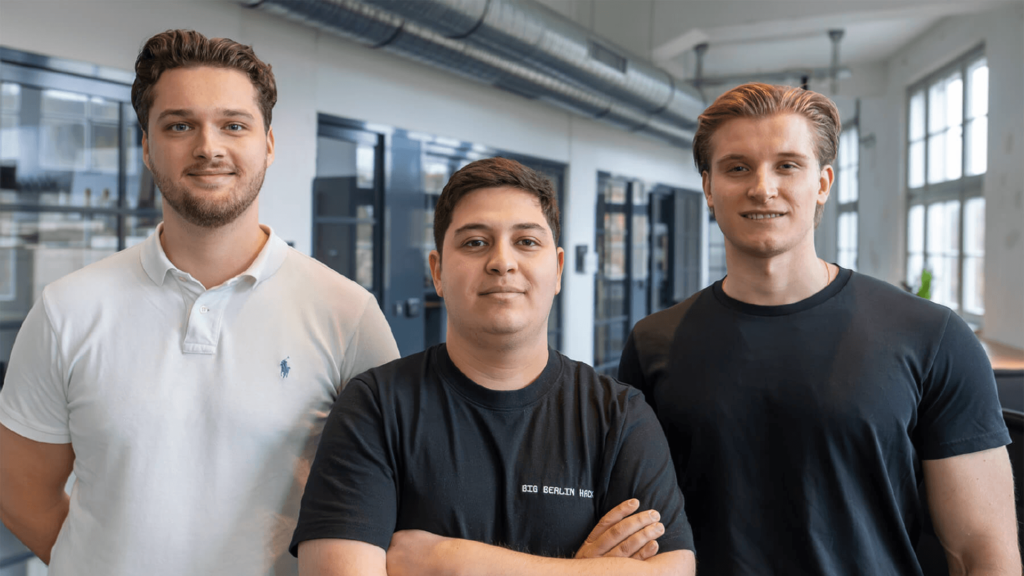
Berlin-based industrial AI startup Zentio has raised €1.4 million in pre-seed funding a first but substantial step in its journey to radically transform the way manufacturing decisions are made. The initial round was primarily funded by High-Tech Gründerfonds (HTGF), which is one of the most active early-stage investors in Germany, and the first round also received support from SIVentures. Besides capital, both investors are going to provide Zentio with operational and strategic help as it starts to scale its technology and team.
Zentio, founded in 2025, is addressing the problem that is deeply rooted in and cost a lot of the industrial operations sector, i.e., the problem of a complete understanding and optimization of the thousands of interdependent decisions that arise in the factory on a daily basis. Manufacturers are constantly required to change shift schedules, machine settings, production sequences, and capacity planning. Although each change has a far-reaching impact on various factors – from utilization rates and inventory levels to cash flow and on-time delivery performance – manufacturers have no way of fully comprehending these effects.
The Complexity Gap in Today’s Factories
During the last several decades, manufacturers have heavily depended on a patchwork of ERP systems, spreadsheets, and human expertise as the means to coordinate operations. However, these tools are essentially incapable of performing the simulation or evaluation of the full ripple effects of decisions across the value chain in real-time as they are only digitising existing processes.
Consequently, many firms engage in the following activities:
- They produce more than they can sell or hold excessive inventory.
- They are burdened with bottlenecks and idle time.
- They fail to deliver on time.
- They are not able to forecast capacity needs accurately.
- They invest working capital in safety stock.
- They suffer from chronic productivity losses.
The increasing complexity of worldwide supply chains coupled with labor shortages, unstable demand, and increasing machine connectivity has resulted in further expanding what Zentio defines as the “complexity gap,” i.e., the difference between the decisions factories must make and the decisions they can realistically analyze using existing systems.
Zentio’s AI-Native Approach
Zentio endeavors to fill this void by means of AI-native, real-time production planning that is quite different from traditional planning software in essence. The platform uses AI agents to ingest and organize operational, production, and machine-level data continuously learning from factory behavior. Accordingly, the company calls it a “self-learning flywheel effect” when every shift, breakdown, and scheduling decision leads to an increasingly accurate model of the production environment.
Co-founder and CCO Immo Polewka provides insight into the working of the platform:
“Our aim is to improve the quality of decision-making in European manufacturing to a level that is currently unimaginable. Integrating operational data with mathematical optimization and agentic automation, firms become capable of not only strategic planning ahead but also handling disruptions effortlessly by way of instant reaction of their plan,” he explained.
Zentio technologies enable factories, with such a firm underpinning, to:
Foresee capacity requirements weeks before
Analyze the impact of changes in shifts or machines immediately
Be able to tackle breaking down or shortage scenarios instantly by executing the most optimised alternatives
Lower the rate of waiting time and raise the production flow
At the same time, they can manage multiple factors like labor, materials, energy, and machinery availability at the same time.
Such an approach of the company is in line with a big trend in European manufacturing, which is the use of AI-driven decision systems leading to the factory’s evolution from mere automation to autonomous optimization.
Building Europe’s Next Industrial Software Layer
Zentio has a network of pilot customers and strategic partners across Europe whom they are currently working with to help them refine their system at the shopfloor level. A large part of their immediate roadmap is dedicated to upgrading their mathematical engines, optimization layers, and machine learning pipelines.
Co-founder and CTO Christophe Kafrouni elaborates on the short-term priorities:
“The upcoming months’ main emphasis for us is to further develop the core mathematical frameworks and ML pipelines working towards a complete integration with UX and agents. We are therefore recruiting more ambitious engineers who share our vision of creating the first generation of AI-native production planning and want to work with us,” he said.
Fuel for Long-Term Impact
After securing the additional funding, Zentio is primed to expand its engineering capabilities and deepen the relations with its current partners. HTGF’s investment is a signal that Germany is still keen to support industrial-tech startups that can help Europe stay competitive, especially at a moment when reshoring, energy volatility, and supply-chain resilience have become the top concerns of boardroom agendas.
Zentio is determined in its endeavor to construct a production-planning intelligence layer that would be not only capable of making factories highly automated but more importantly, genuinely smarter, more adaptive, and more in tune with the strategic nature of real-world manufacturing complexity.