
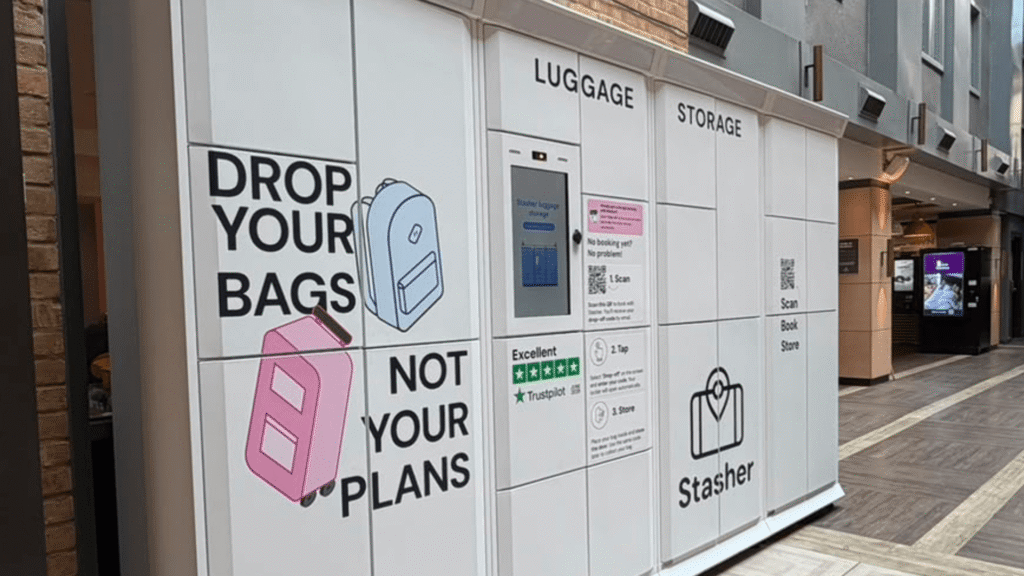
For travellers, the hours between checking out of a hotel and catching a flight or train can turn luggage into an unexpected logistical problem. London founded travel tech company Stasher is building a network designed to solve that problem, combining local luggage storage locations with an expanding fleet of smart lockers. The company has secured £3 million in new funding to accelerate its international expansion and develop the next phase of its storage infrastructure.
New funding round
The latest financing combines approximately £2 million in growth funding from Gilion with a £1 million strategic investment from smart locker provider Hive Box.
Founded in London in 2015 by Jacob Wedderburn Day and Anthony Collias, Stasher started with a marketplace model connecting travellers who need temporary luggage storage with hotels and local businesses that have secure space available.
The company has since developed the model into a global network covering more than 10,000 storage locations across more than 1,200 cities. Stasher says its platform gives travellers a way to find and book luggage storage close to transport hubs, accommodation and attractions.
Moving into smart lockers
The new funding comes as Stasher expands beyond partner businesses and introduces dedicated smart lockers.
Through its partnership with Hive Box, Stasher will initially receive 100 smart lockers for deployment across the UK and Europe by the middle of 2027. Hive Box will provide the physical lockers, IoT infrastructure and remote management technology, while Stasher will integrate the system with its existing booking platform.
The move gives travellers another option for storing luggage, particularly in locations where a staffed business may not be available or where demand continues beyond conventional opening hours.
Stasher says the lockers will complement its existing network rather than replace partner locations.
Using travel data to choose locations
A key part of the company’s expansion strategy will be deciding where new lockers should be installed.
Stasher has accumulated more than a decade of booking and search information, giving it insight into where travellers are actively looking for luggage storage. The company plans to use this data to identify locations where demand is strong, existing storage partners are approaching capacity or customers require access outside staffed operating hours.
This approach could allow the company to deploy lockers based on demonstrated travel demand rather than relying solely on conventional retail or transport infrastructure.
Building around the travel journey
Stasher’s marketplace connects travellers with hotels, shops and other local businesses that can securely hold luggage. The company says its service is particularly useful around major travel destinations, transport connections and accommodation areas.
The expansion into lockers gives Stasher an opportunity to extend the network into additional high footfall locations. Planned deployment areas include transport hubs, visitor attractions and major leisure destinations across the UK and Europe.
The strategy also gives Stasher greater control over the customer experience, from discovering a storage location to booking and accessing a locker.
Scaling a decade old platform
CEO and co founder Jacob Wedderburn Day said the new funding provides the company with additional resources to accelerate its next stage of growth after a decade of building its global network.
Stasher’s development reflects a wider shift in travel infrastructure, where digital booking platforms are increasingly connecting travellers with physical services at the point of need.
The company began as a relatively simple solution for people looking for somewhere to leave their bags, but its expanding network now combines marketplace supply with technology enabled storage infrastructure.
Expanding across Europe
The initial 100 lockers planned through the Hive Box partnership will form the foundation of Stasher’s smart locker network. The company intends to use the results and demand data from these deployments to determine where additional units should be placed.
With fresh growth financing and a strategic technology partnership, Stasher is aiming to build a hybrid luggage storage network that combines thousands of local businesses with automated lockers.
The longer term ambition is to make luggage storage easier to find and access throughout the travel journey, whether a traveller needs a staffed location in a city centre or a smart locker near a busy transport or tourist destination.