
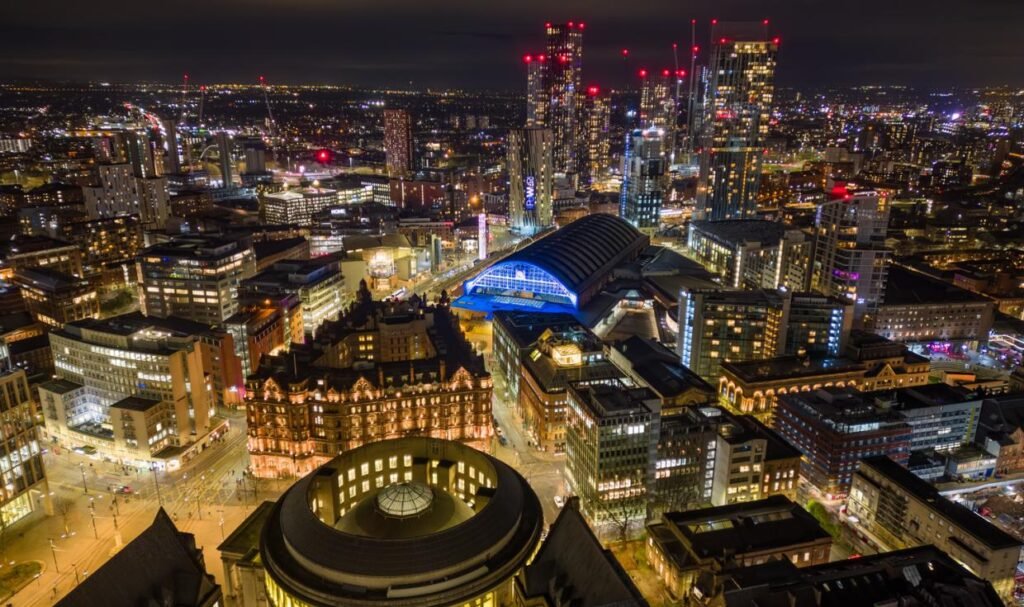
Manchester’s emergence as one of the most fascinating tech hubs in the UK has taken time but at 2025, it is quite evident that the city is having its moment.
According to a report by Capital Enterprise, an innovation specialist, Manchester was named the most popular UK city outside London to start a tech business. The founders pointed to its unique combination of world-class research, public-private collaboration and purpose-built innovation spaces as the main reasons why they chose the city. To understand what is causing this trend, we met with Katie Gallagher, Managing Director of Manchester Digital and Joshua Whiteley, Commercial Director at innovation-focused property developer Bruntwood SciTech.
For Ms. Gallagher, the success of the city is the result of a long period of time. “It’s certainly having a moment,” she states. “However, it is this perfect storm of things that have been going on for quite some time.”
Manchester’s power is in its variety. Instead of being recognized for only one niche, the city has developed multiple thriving tech specialisms. The history of the city in textiles has been transformed into a robust fashion-oriented ecommerce sector. The BBC’s move to Salford in 2011 has accelerated the growth of the creative and digital sectors, while the opening of GCHQ branch in Manchester in 2019 has led to the formation of a fast-growing cyber security cluster. At present, fintech, AI, and healthtech are also growing fast, propelled by university research and a steady stream of ambitious founders.
“It doesn’t really have one specialism — it has lots,” Gallagher points out. “That cross-cutting strength is exactly what makes it thrive.”
One of the biggest factors behind Manchester’s allure is its talent pipeline. The city has one of the largest student populations in the UK, and the universities produce graduates who are highly skilled in science, engineering, and digital technologies. What is more, many of them decide to stay.
“The range of academic research conducted here turns Manchester into a very attractive place for spinouts,” remarks Whiteley. “This is done by big players coming to the city and startups staying. It’s a self-generating process that in turn, attracts massive inward investment. The talent cycle keeps going and eventually reinforces itself.”
This circle is already bringing results. The region attracted big global companies like Accenture and Disney that established their operations here due to skilled workforce availability. Consequently, their being here provides graduates with the assurance that they need not leave Manchester if they want to have serious career development. As Gallagher says: “Five years back, it was difficult to find senior tech roles like CTOs. Now, that’s absolutely not the case.”
However, talent by itself is not sufficient. The creation of physical spaces specifically meant for innovation has contributed significantly as well — and this is the area where Bruntwood SciTech comes. The company, through its close relationships with universities, the NHS, and local government, builds campuses designed for fast-moving science and tech firms.
Bruntwood SciTech does not only provide standard office spaces, but it also builds environments that can nurture local companies from their inception stages to eventual enterprise scale. According to Whiteley, “We have been strategic and patient throughout. These partnerships give us the freedom and ability to lay the foundation for entire ecosystems.”
“Sister”, a £1.7bn innovation district on the previous Manchester university campus, is its most daring venture. When it is fully ready, the 4m sq ft site will concentrate on such areas as biotech and materials science, thereby, deepening the city’s deep-tech credentials.
Besides the money and the infrastructure, both Gallagher and Whiteley, point to something that is less tangible but equally important – Manchester’s culture.
“It really seems that people are genuinely interested in your success here,” Gallagher remarks. “It is very well connected, collaborative and supportive.”
Whiteley concurs and also adds that the standard of living is a major factor. “Besides being an hour away from three national parks, you are in a city that is pro-business, forward-looking, and very welcoming.”
For founders who are trying to decide where to locate their next company, Manchester is no longer just a viable alternative to London. In fact, it is rapidly turning into a first choice of its own.