
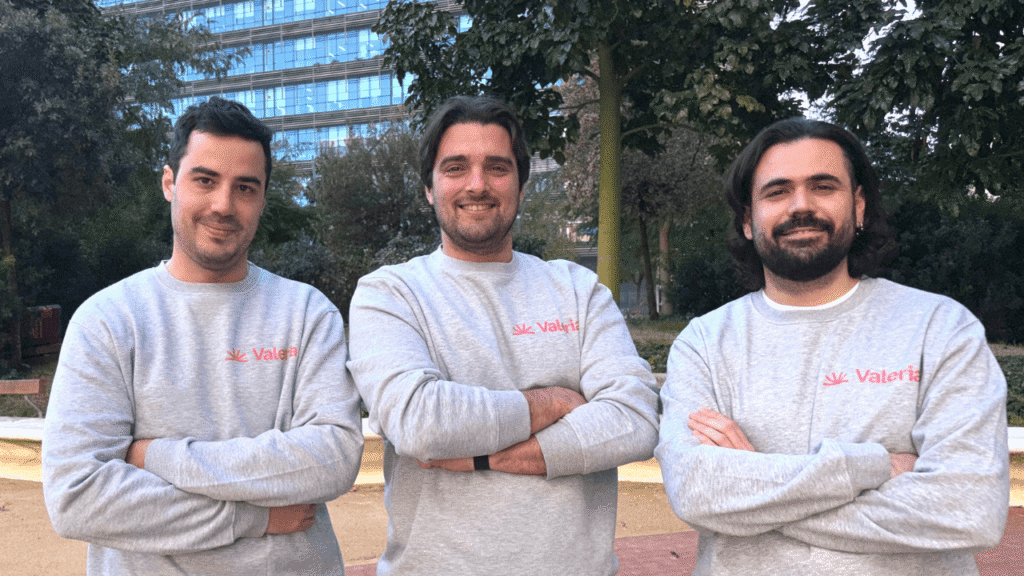
Payroll may be one of the most overlooked bottlenecks in modern operations, yet for industries built on shift work and rapid staff turnover, it can determine whether a business runs smoothly or falls into constant chaos. Barcelona based startup Valeria is setting out to fix that problem. The company has raised $2 million in a funding round led by Venture Friends, with participation from Fortino Capital and 10k Ventures, to build payroll infrastructure designed for frontline workforces.
Founded by Pau Laporte, Carlos Saiz, and Sergio Morales Bonet, Valeria is developing an AI native payroll and workforce operations platform tailored for sectors such as hospitality, retail, logistics, and services, where frequent onboarding, variable schedules, and strict compliance requirements are the norm rather than the exception.
Lessons from the frontline
The idea for Valeria emerged directly from the founders’ operational experience. Before starting the company, CEO Pau Laporte spent nearly a decade working in operations heavy businesses including restaurants, delivery platforms, and marketplace driven companies.
Early in his career, Laporte managed restaurant teams with extremely high turnover and complex payroll needs involving tips, bonuses, and fluctuating hours. Payroll processing was slow, dependent on accountants working limited hours, and disconnected from real operational demand. As teams grew into the hundreds and later thousands of workers, the issues multiplied, leading to errors, compliance risks, and recurring fines.
Later roles at companies such as Uber, Getir, and Glovo exposed the same structural weaknesses at much larger scale. According to Laporte, payroll systems were never built for dynamic workforces and struggled to integrate with operational tools or respond quickly to real time staffing needs.
Why payroll infrastructure is failing
Europe’s labour market is increasingly defined by flexible contracts, frequent job changes, and workforce mobility. However, most payroll tools are still built for static monthly cycles and permanent employees. This disconnect leaves labour intensive companies relying on manual processes, spreadsheets, and external accountants to manage payroll complexity.
Valeria was built to address that gap. While accounting is often handled internally, payroll is almost universally outsourced, even by large enterprises. That made payroll the ideal entry point for rebuilding workforce infrastructure from scratch using AI.
Payroll designed for operational reality
Valeria centralises payroll calculations, contract management, and compliance into a single platform that integrates directly with workforce and operational systems. The result is reduced manual work, fewer errors, and faster response times for frontline businesses.
Since launching in January 2025, Valeria has onboarded more than 100 customers and built a team of 18 employees, primarily engineers and operators with experience in global technology companies. The platform now resolves 94 percent of client queries automatically, including employee and contract related requests.
According to Venture Friends investor Lily Joo, Valeria is addressing one of the most complex and underserved problems in HR software by focusing on operational payroll complexity rather than generic workflows.
The challenge of government integration
One of the biggest obstacles Valeria faces is integrating with public sector systems. Labour and social security institutions often lack modern APIs, making data exchange slow and technically challenging. According to Laporte, this is where AI becomes critical, enabling automation that would have been impossible just a few years ago.
Many customers also lack strong internal tech infrastructure. Traditional payroll tools require heavy implementation and training. Valeria’s AI native design makes onboarding simpler and daily usage more intuitive, lowering the barrier for non technical teams.
Building cross border payroll infrastructure
Valeria is building its payroll engine with international expansion at its core. AI is used to automate onboarding and payroll execution, including registering employees with social security systems in seconds through familiar channels such as WhatsApp.
By standardising payroll data internally, Valeria aims to support multi country operations more efficiently than legacy providers, which are often limited to single markets.
With the new funding, Valeria plans to grow its team, deepen automation across the platform, and expand into additional European markets where high turnover industries face similar payroll challenges. The company’s goal is simple but ambitious: payroll that just works, no matter how complex the workforce.