
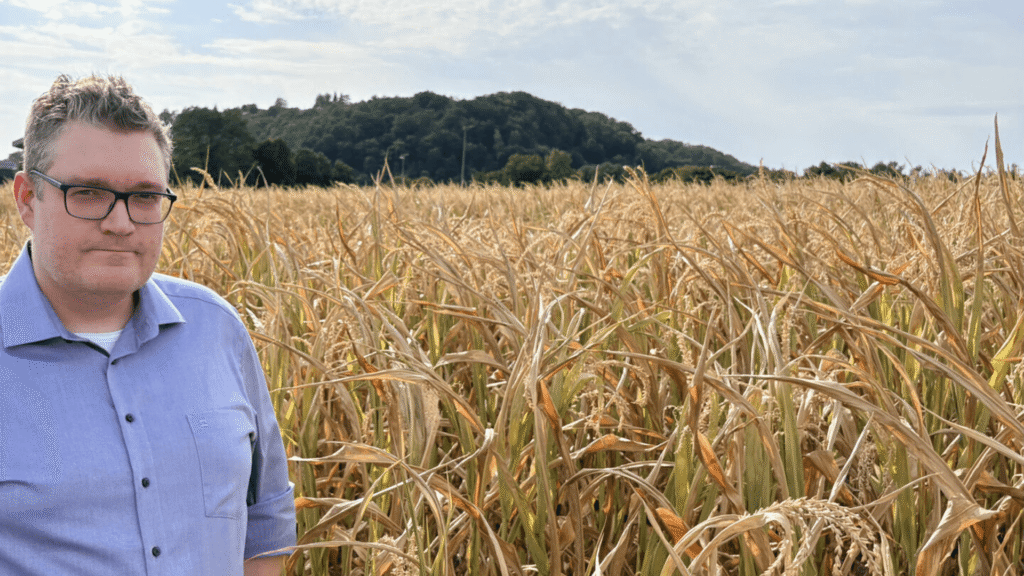
As climate conditions become increasingly difficult to predict, German agritech company Computomics is giving plant breeders a way to look further ahead. The Tübingen based company has raised €6.3 million in Series B funding to expand the commercial deployment of its climate smart breeding technology, which uses machine learning and genomic analysis to help identify crop varieties capable of performing under changing environmental conditions.
New Capital for Commercial Expansion
The Series B round was led by Convent Capital Agri Food Fund, which contributed €5 million. Existing investors High Tech Gründerfonds, MBG Baden Württemberg and Amathaon Capital also participated, alongside Computomics founders and scientific advisers.
The financing additionally benefits from support from the European Union through the InvestEU Fund.
Computomics plans to use the new capital to expand its technology across a larger number of commercial breeding programmes and strengthen its position in the rapidly developing climate smart agriculture market.
Bringing Data Into Plant Breeding
Founded in 2012, Computomics has developed technology designed to help breeders make more informed decisions earlier in the crop development process.
Traditional plant breeding can take years, with researchers often relying on field trials to determine how different varieties perform. Climate variability makes this process increasingly complicated because conditions can change substantially between the time a variety is selected and when it reaches farmers.
Computomics combines genomic information with environmental data such as temperature, rainfall and soil conditions. It also incorporates measurements collected from field trials.
Machine learning models then analyse these datasets to predict how particular plant genotypes could perform in specific environments. This allows breeders to assess potential candidates before investing significant time and resources into lengthy testing programmes.
Predicting Climate Resilience
At the centre of Computomics’ commercial offering is ×SeedScore, a platform designed to apply predictive analysis across large scale breeding programmes.
The technology can help breeders identify varieties that are more likely to perform in hotter and drier environments. It can also help determine which varieties remain stable across different locations and environmental conditions.
Another application is identifying where particular varieties may be best suited for cultivation.
This approach could become increasingly important as breeders attempt to develop crops capable of coping with climate pressures while maintaining productivity and quality.
From Field Crops to Vegetables
Computomics works with commercial breeders across a broad range of agricultural categories, including field crops, forage crops, vegetables and specialty crops.
Its wider technology portfolio includes CropCompass and BreedScope, which support climate smart breeding, as well as Pantograph, a platform focused on omics data analysis and trait discovery.
The company also develops MORPHEUS and MEGAN7 for microbiome analysis, giving Computomics capabilities extending beyond conventional genomic breeding workflows.
Reducing the Climate Guesswork
For breeders, one of the biggest challenges is the long gap between selecting a variety and seeing how it ultimately performs in real agricultural conditions.
Sebastian J. Schultheiss, co founder and CEO of Computomics, said breeders have always wanted to create climate resilient crops but historically lacked the ability to identify resilience before lengthy field testing revealed it.
Computomics is attempting to close that gap by combining biological data with environmental intelligence.
Scaling Climate Smart Agriculture
The latest funding comes as European agriculture faces growing pressure from changing temperatures, rainfall patterns and increasingly variable growing conditions.
For Computomics, the goal is not simply to analyse more agricultural data but to turn that information into practical decisions for breeders.
With €6.3 million in fresh capital, the company is now set to bring its predictive breeding platform into more commercial programmes, helping agriculture move from reacting to climate change toward designing crops for the conditions that are expected to come next.