
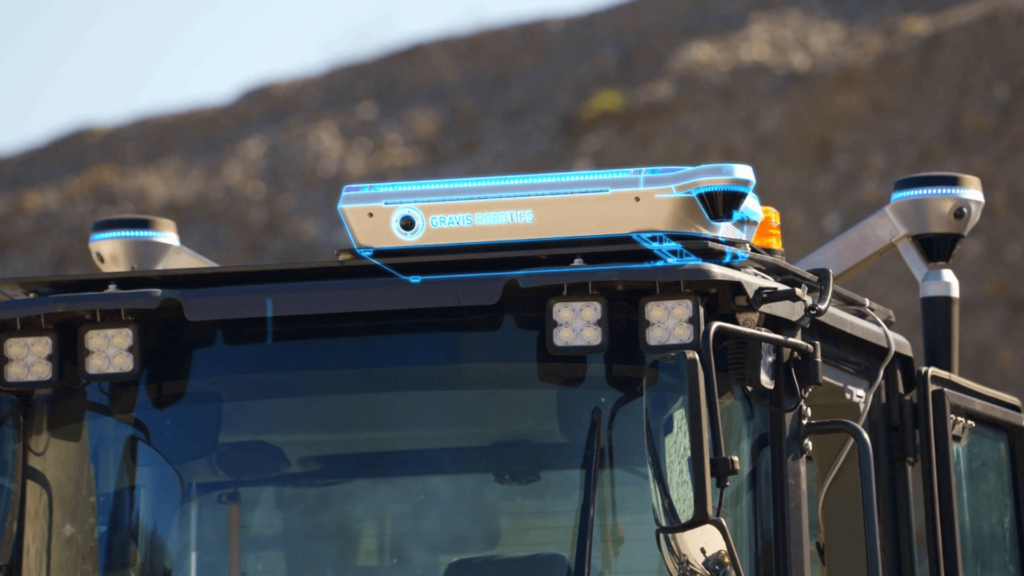
A new chapter in construction robotics is taking shape as Swiss startup Gravis Robotics secures a landmark $200 million investment from SoftBank, giving the company significant firepower to turn heavy construction equipment into autonomous machines. The deal marks a major vote of confidence in the idea that construction sites could increasingly rely on intelligent machinery capable of understanding and responding to complex physical environments without a human operator inside the cab.
A Record Series A
Gravis Robotics, a spinout of ETH Zurich, announced that SoftBank is the sole investor in its latest Series A round. The company describes the $200 million financing as the largest Series A investment in construction robotics to date.
The investment follows a $23 million funding round secured by Gravis in November last year. The substantially larger financing gives the company the resources to move from technology development and early deployment towards global commercial expansion.
The company plans to use the capital to scale its autonomous heavy machinery technology internationally, targeting construction and other industries that depend heavily on large earthmoving equipment.
Turning Existing Machines Autonomous
Gravis Robotics is developing software that can transform conventional excavators and other heavy construction machines into autonomous systems. Rather than requiring companies to replace their existing equipment with purpose built robotic machines, the technology is designed to add autonomous capabilities to machinery already used on job sites.
The approach could have significant implications for an industry where excavators and other heavy equipment perform demanding tasks in environments that can change constantly.
Autonomous machines need to understand more than simple commands. They must account for changing soil conditions, underground forces, terrain and the physical behaviour of the equipment itself. Gravis says its technology is designed around this challenge.
Giving AI Physical Intuition
Dominic Jud, CTO and co founder of Gravis Robotics, said skilled construction operators rely on subtle physical signals while working, including engine strain, machine vibration and hydraulic resistance.
Gravis aims to replicate this type of physical awareness through AI by combining machine telemetry with information about the environment and the forces acting on the equipment.
According to Jud, the company has not attempted to simplify construction environments for its software. Instead, its technology is designed to interpret physical conditions at extremely high speeds and respond accordingly.
This capability is particularly important for autonomous construction because job sites are rarely predictable. Soil mechanics can vary over short distances, while excavation work can involve constantly changing loads, surfaces and underground conditions.
SoftBank Doubles Down on Robotics
The investment also reflects SoftBank founder Masayoshi Son’s growing interest in robotics as a major technology opportunity.
SoftBank has invested heavily across technology and artificial intelligence, with its portfolio including companies such as OpenAI and Alibaba. Robotics has increasingly emerged as another strategic area for the Japanese investment group as advances in AI make machines capable of operating in more complex environments.
Gravis fits into that broader thesis by combining AI with physical machinery rather than limiting intelligent systems to digital environments.
Scaling Beyond Switzerland
With the new capital, Gravis Robotics is preparing to expand its technology globally. Its immediate focus is autonomous heavy machinery, but the underlying technology could potentially support a broader transformation of industries dependent on large machines and specialised operators.
Construction faces persistent challenges around labour availability, productivity and the difficulty of operating heavy machinery safely in demanding environments. Autonomous equipment could help address some of these pressures while allowing machines to perform repetitive or hazardous tasks with greater consistency.
The $200 million investment gives Gravis the financial backing to accelerate that transition and establish its autonomous construction technology on a much larger international scale.